
It’s a unit of radioactivity concentration in air—becquerels per cubic metre. In homeowner terms, it’s the standard Canadian unit your test report uses to compare your home to the guideline.


A Canadian Homeowner’s Decision Framework That Turns a Number Into Clear Next Steps
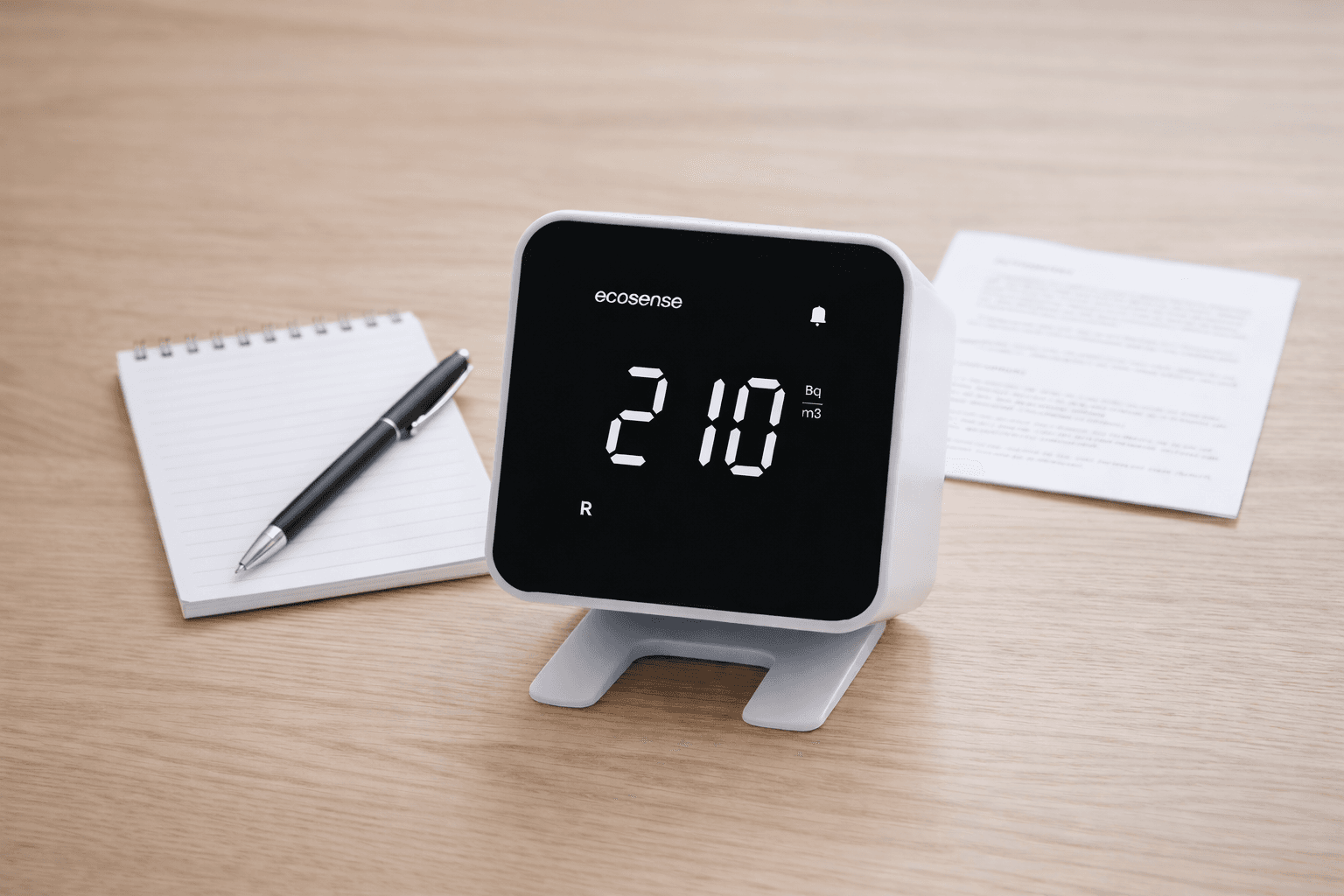
Sleek radon monitor’s Bq/m³ readout turns low, borderline, and high numbers into urgent home decisions. (Credit: Homeowner.ca)
Radon results are weirdly stressful for such a simple output: you get one number, usually in Bq/m³, and it’s not obvious whether you should relax, re-test, or start calling contractors. The problem is that radon isn’t like a leaky faucet you can see—it’s closer to a pressure and airflow issue your house “runs” every day, especially in winter.
What makes this harder is that radon behaves like a moving target. Levels can shift by hour, by season, and by how you use your home. A basement that’s “just storage” today can become a home office next month, and suddenly your real exposure changes even if the geology under your house didn’t.
Health risk is the reason this topic matters. In Canada, radon exposure is linked to lung cancer outcomes in a way many homeowners don’t realize, and the stakes are especially important for never-smokers, as described in Health Canada’s radon action guidance for municipalities for community-level public health planning.
This guide is designed to do one thing well: give you a clear interpretation framework for low, borderline, and high readings, plus step-by-step next actions that match Canadian standards and real homeowner constraints (time, budget, disruption, and uncertainty).
Canada’s key reference point is straightforward: under Health Canada’s national radon guideline, the indoor air reference level for dwellings is 200 Bq/m³, and corrective action is recommended when the average annual concentration in a normal occupancy area exceeds that level.
A few implications most homeowners miss:
The cleanest way to interpret a radon number is to treat it like a long-term exposure budget: the goal is not to “win” by landing at 199 Bq/m³, but to make reasonable choices that push exposure down over the years you’ll actually live in the space.
If there’s one place homeowners accidentally go wrong, it’s making a big decision from a weak test. A radon result is only as useful as the method behind it.
A proper report should include the elements described in Health Canada’s guide to radon measurements in residential dwellings, including test start/end dates, the room and level tested, device details, and the long-term average used to compare against the guideline.
Use this quick validity checklist.
Many placement mistakes come from good intentions: homeowners want the device “out of the way,” so it ends up in a closet, bathroom, near a window, or beside a sump pit. Practical placement guidance aimed at real homes is summarized in BC Financial Services Authority radon precautions information for home and real-estate contexts.
Here’s a placement do/don’t table you can actually follow.
Short-term tests and consumer monitors are useful for awareness, but they’re not the best tool for “does my home exceed the guideline?” decisions. The caution against relying on a few days of results is reinforced in HealthLinkBC’s radon information for homes and other dwellings, which emphasizes that radon fluctuates and that longer measurements give more reliable exposure estimates.
A single bad week (or a single good week) can trick you into the wrong conclusion. Treat short-term results like a weather forecast: informative, not definitive.
Homeowners don’t just need thresholds—they need categories that map to actions. A practical Canadian framing is offered by Evict Radon’s homeowner interpretation bands, which group long-term results into low, intermediate, and high ranges that align cleanly with Canadian decision-making.
Those bands also line up with global context. Internationally, the World Health Organization discusses a lower reference level where feasible and an upper limit for national reference levels in the radon handbook chapter available via NCBI Bookshelf as part of broader indoor air guidance.
And if your device reports in pCi/L, U.S.-market labelling and action language often tie back to the U.S. EPA framing described in the United States Environmental Protection Agency’s explanation of pCi/L and working levels for radon measurement units.
Here’s a homeowner-first framework that stays compatible with Canadian standards.
If your basement is a true living level (office, bedroom, TV room), interpret “borderline” more seriously than if the basement is unfinished storage you rarely use.
A low long-term reading is good news. Your goal isn’t to chase perfection—it’s to stay confident your home remains low over time.
Use this action plan.
Practical examples where a re-test is smart even after a low result:
A low result is best treated like a strong credit score: it’s reassuring, but it stays reassuring because you check in after big life changes.
Borderline results are where homeowners most often freeze: “It’s under 200, so I’m fine… right?” The more useful interpretation is: you’re under the guideline, but you’re close enough that your next decisions should be deliberate.
Health Canada provides timing expectations for remediation once you’re above the guideline, and also acknowledges the logic of considering action as you approach it in its guide to radon measurements for public buildings and similar facilities as an operational standard that is widely referenced in Canadian practice.
Here’s a homeowner workflow that keeps you moving.
Interim steps that can be reasonable while you plan:
Borderline radon isn’t “nothing to do.” It’s “time to choose.” Your best move is the one that fits your household’s exposure (where you live in the home) and your tolerance for residual risk.
Once a long-term average is at or above 200 Bq/m³, the game changes from “interpretation” to “execution.”
Start by choosing qualified help. Health Canada explicitly points homeowners toward certified providers in its radon reduction actions guidance, which highlights using professionals certified through the Canadian National Radon Proficiency Program (C-NRPP) for mitigation decisions and system quality.
Then understand what “normal” mitigation looks like so you can spot good work. The most common and effective method in Canadian homes is described in Health Canada’s guidance on reducing radon levels in your home, which outlines sub-slab depressurization (active soil depressurization) and the typical performance expectations homeowners can realistically plan around.
A high-reading action plan that works in the real world:
Use these questions to keep contractor conversations practical.
Don’t stop at installation. A mitigation system is only “done” once you’ve confirmed results with a follow-up measurement that reflects real exposure.
Most homeowners want a menu: “Can I just seal the cracks?” “Can I just run an HRV harder?” The honest answer is that different tools do different jobs.
Health Canada’s mitigation methods and their limitations are laid out in the Radon Reduction Guide for Canadians, including why sealing alone is typically not considered a complete solution and why ventilation approaches are usually best when only modest reductions are needed.
Here’s a comparison table that matches typical homeowner scenarios.
Think of sealing like weatherstripping for a drafty door: helpful, but it doesn’t replace a proper heating system when it’s -25°C.
Even with a “good” test, homeowners are often surprised when a monitor swings wildly. That’s normal—and it’s exactly why long-term averages are the decision tool.
Health Canada describes the drivers of variation (weather, pressure, soil conditions, construction type, and occupant behaviour) in its radon overview resource for homes as part of explaining why exposure estimates require longer measurement periods.
Common Canadian examples that move the number:
Monitors are best used for pattern recognition (“winter is higher than summer”) rather than judgement on one alarming day.
Canada is full of renovation and retrofit projects that make homes tighter and more efficient—and that’s great. But tighter homes can also trap more indoor pollutants if ventilation doesn’t keep up.
Health Canada specifically addresses this interaction in its guidance on radon and energy retrofits, including findings that some studies observed average radon increases after efficiency work and the practical recommendation to integrate radon testing into retrofit planning.
A smart retrofit checklist:
“Energy efficient” and “healthy indoor air” are compatible goals, but you often need one extra step: measure radon after you change how the house breathes.
Radon is not evenly distributed across the country, and newer data suggests the “how common is this?” answer depends heavily on where you live and what kind of building you’re in.
Recent findings are summarized in the 2024 Cross-Canada Survey of Radon Exposure, which reports a meaningful share of Canadian residential buildings at or above 200 Bq/m³ and a large additional share in the 100–199 Bq/m³ band.
Earlier national measurement work remains useful for broad patterns, including provincial and regional variation documented in Health Canada’s Cross-Canada Survey of Radon Concentrations in Homes final report as a baseline reference used across Canadian public health and housing discussions.
And for a mapping-style view of how prevalence varies by region, Statistics Canada provides an accessible overview in its radon mapping and housing exposure resource that helps homeowners understand why “my neighbour is fine” doesn’t automatically translate to “my home is fine.”
A practical way to use this information:
If you only test one level, test the lowest lived-in level—because that’s where radon usually enters and where long-term exposure can be highest.
Most homeowners want the simplest correct option. For most households, that’s a long-term test kit.
Public-facing Canadian guidance emphasizes the accuracy and accessibility of long-term testing in Health Canada’s Take Action on Radon initiative, including the idea that a multi-month test is the most reliable way to understand whether your home is in a high range.
If you’re deciding between DIY and hiring help, the “what does it cost?” question matters too. Health Canada’s practical notes on test kit availability and typical price ranges appear in its provincial and territorial radon action guide as part of making testing a realistic homeowner behaviour.
Use this comparison to pick the right tool for your situation.
In real-estate situations, people are tempted to use the fastest test available. If you can’t do a long-term test, treat the result as provisional and plan a proper follow-up once you move in.
Radon risk is cumulative. The reason a “borderline” reading can still matter is that exposure is a long game: years in a basement office or bedroom add up.
The Canadian Cancer Society explains the Canadian guideline, the reality that there is no completely safe level of exposure, and the practical advice to test and reduce high levels in its radon risk and prevention guidance for households looking to reduce cancer risk.
A balanced way to hold this:
The most “protective” radon plan is usually not dramatic—it’s simply: test properly, mitigate when you need to, and re-test after major changes.
It’s a unit of radioactivity concentration in air—becquerels per cubic metre. In homeowner terms, it’s the standard Canadian unit your test report uses to compare your home to the guideline.
Yes. Day-to-day variability is common. Use monitor readings for trends and curiosity, but base major decisions on a valid long-term result.
It’s under the guideline, but it isn’t a guarantee of zero risk. Treat it as a borderline planning signal—especially if the tested level is a major living area.
You can often stop testing for the moment, but re-testing is smart after major renovations, energy retrofits, ventilation changes, or if you start using the basement as a living space.
Not necessarily. Radon often runs higher in the heating season when the house is more closed up. A long-term test that spans winter conditions is more decision-relevant.
Test in the lowest level where someone spends meaningful time. If the basement is unfinished and rarely used, but might become living space later, plan to test again when that changes.
Test where you spend long hours, but prioritize the lowest occupied level. Bedrooms and home offices are often good candidates if they’re on that lowest lived-in level.
Sealing can help, but it’s usually a supporting measure rather than a complete fix—especially for high readings.
Sub-slab depressurization (active soil depressurization) is widely used because it’s reliable and typically achieves large reductions when designed and installed correctly.
In many homes it’s closer to a “major service call” than a renovation: some drilling and piping, a fan installation, and setup. The key disruption is planning fan placement, vent routing, and aesthetics.
You don’t need to panic overnight, but you should plan mitigation. If you’re far above the guideline, treat it as higher urgency and move faster.
You re-test, ideally with a long-term measurement that reflects real living conditions. Don’t rely only on an immediate post-install “good day.”
They can. Making a home tighter can reduce air exchange, which may raise indoor radon if ventilation isn’t adjusted accordingly—so re-test after major efficiency upgrades.
Treat that as a strong trigger to test (or re-test) because you’re increasing time spent in the lowest level and often changing ventilation and air-tightness.
Some regions have higher prevalence, but radon can occur anywhere. House-specific factors matter a lot, so regional risk should push you to test sooner—not give you permission to skip.
Many homeowner kits are relatively affordable in Canada. The exact range depends on the kit and lab processing, but it’s commonly positioned as a low-cost home health test compared to most home repairs.
Look for relevant certification (commonly referenced through C-NRPP in Canadian guidance), clear explanation of method and system design, a verification plan, and straightforward answers about maintenance and re-testing.