
Because installation is not proof of performance. Follow-up testing confirms the system is actually reducing radon levels in your home under real living conditions.


A Canadian Homeowner’s Playbook For Verifying Performance, Reading Results, And Staying Confident Over Time
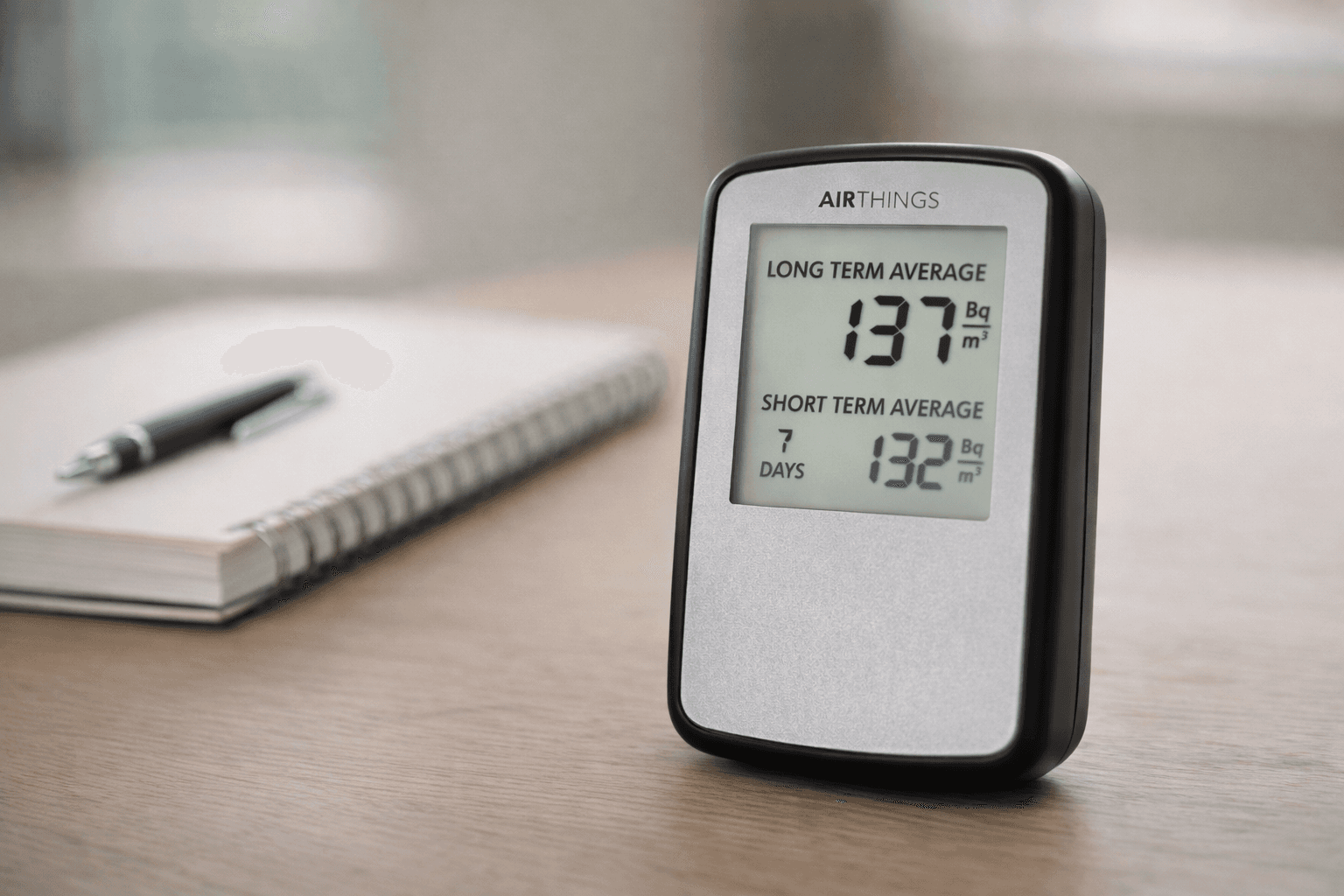
Digital radon monitor’s steady numbers confirm mitigation performance long after the fan starts running. (Credit: Homeowner.ca)
A radon mitigation system is supposed to reduce risk quietly in the background—yet the only way to know it’s doing that is to measure what happens after it’s turned on. In practice, post-mitigation testing is less about “getting a passing grade” and more about building confidence that the system is performing under real Canadian conditions, including winter stack effect and closed-house living.
In Canada, radon follow-up testing is anchored to a clear benchmark: Health Canada’s guide for radon measurements in residential dwellings sets a national guideline of 200 Bq/m³ for homes and also emphasizes reducing levels as low as reasonably achievable, which changes how you think about “success” when results are close to the line.
This guide walks you through a practical, homeowner-friendly workflow that mirrors how professionals verify performance: first confirm the system is operating, then confirm your annual-average exposure is actually lower. You’ll also learn how to place tests properly, how to interpret results without overreacting to fluctuations, and what to check if a result comes back higher than expected.
If you’ve just had mitigation installed, you’re in the ideal window to do this right. Good follow-up testing isn’t complicated—but it is precise. A small placement mistake or the wrong testing window can turn a “clear answer” into a confusing data point.
Most homeowner frustration with radon follow-up testing comes from expecting one test to answer every question. The more reliable approach is a simple two-test strategy: an initial commissioning check to confirm the system is operating, followed by a longer heating-season confirmation that reflects annual-average exposure. Guidance in Health Canada’s Radon Reduction Guide for Canadians lays out this logic by describing a short-term follow-up after activation and a longer follow-up test in the next fall/winter heating season, ideally in the original test location, with independence in mind for the longer confirmation.
Here’s the workflow in a way you can actually plan around.
Think of the first test as “commissioning” and the second as “certification.” The second one is what you’ll lean on for decisions, resale conversations, and long-term peace of mind.
A quick planning tip: if your mitigation was installed in spring or summer, don’t assume a great short-term result means you’re done. It may mean the system is working—but the confirmation test in heating season is what tells you how the home behaves when radon is typically more likely to build up.
The initial post-mitigation test should answer one question: did the mitigation system actually change the radon level in the way it was supposed to? This is not the test you use to decide “problem solved forever.” It’s the test you use to confirm the system is operating correctly and producing a meaningful reduction.
A practical standard for this first check is described in the Canadian National Radon Proficiency Program’s steps to reduce radon guidance, which recommends a short-term post-mitigation test of at least 48 hours after the fan has been running for at least 24 hours and notes that professionals may use tools like continuous monitors or listed short-term devices for this verification.
Use this as your homeowner checklist:
Label a sticky note and put it on your electrical panel or near the manometer: “Radon fan stays ON.” It sounds basic, but accidental shutoffs are one of the easiest ways to create confusing results.
It can tell you:
It cannot tell you:
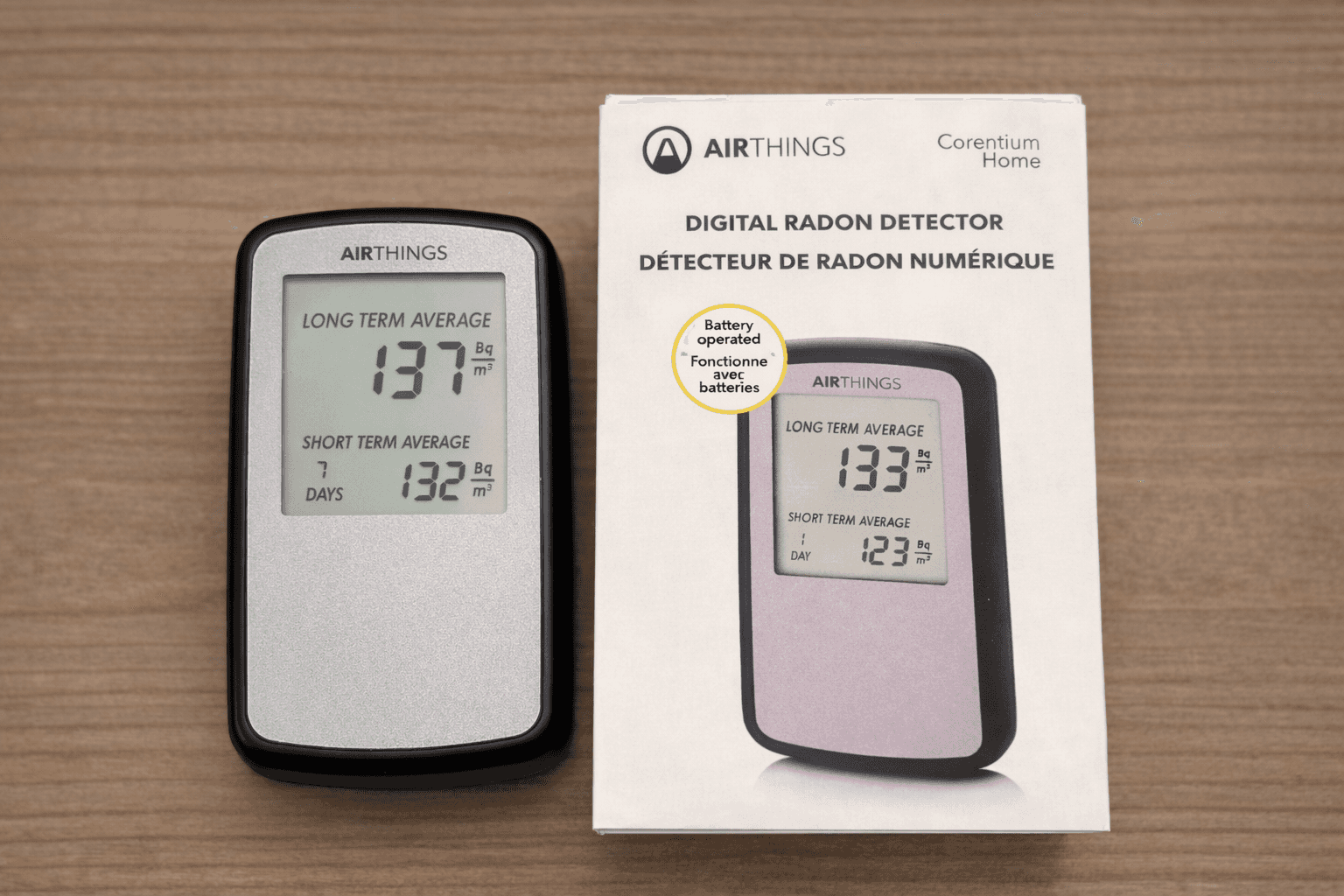
If you use a consumer monitor that shows hourly or daily numbers, don’t “chase the spikes.” Use the device the way it’s designed and treat the result as a trend indicator—then commit to a long-term confirmation test.
If you do only one follow-up test, make it this one. The long-term post-mitigation test is where you confirm that your mitigation system didn’t just “improve a weekend”—it improved the home’s typical radon level over time.
The timing and duration matter. Health Canada’s guide for radon measurements in residential dwellings explains that tests intended to represent annual average exposure should last at least 91 days (with 3–12 months recommended) and that at least 91 days should occur during the heating season (typically October to April), when indoor radon levels are often higher.
If your home is only occupied part-time (snowbird schedules, seasonal living), try to run the long-term test during the months the home is actually lived in—because that’s what “exposure” means in practice.
Even after mitigation, radon levels can vary dramatically by floor and by room use. For a confirmation test, the default rule is simple: test on the lowest lived-in level in a normal occupancy area, and—when possible—use the same location as the original measurement so you can compare before/after properly.
Post-mitigation results can look better or worse depending on where a device sits. That’s why placement is not a minor detail—it’s measurement integrity.
For homeowners who want a clear, practical set of placement rules, the BC Financial Services Authority’s radon precautions information summarizes Health Canada–aligned placement guidance in plain language, including testing on the lowest level occupied four or more hours per day and positioning long-term devices in an interior area at an appropriate height while avoiding bathrooms, closets, strong drafts, and typical entry hotspots like sumps and crawl spaces.
Use this quick filter:
After mitigation, it’s tempting to “test near the pipe” or “test where radon enters.” For exposure decisions, you want the opposite: a normal living area that represents what you actually breathe day to day.
Once you have the long-term result, you’re not just reading a number—you’re deciding what happens next. The best way to do that is with a simple decision table that avoids emotional overreaction to small differences near the guideline.
For context on timelines tied to radon ranges, Health Canada’s guide for radon measurements in public buildings lays out action urgency that tightens as levels rise (with faster action recommended at higher concentrations), which is a useful lens for homeowners interpreting post-mitigation results that remain elevated.
If your long-term result is close to 200 Bq/m³, your most productive next step is usually not panic—it’s precision: confirm placement, confirm continuous fan operation, and confirm you ran a true long-term heating-season test.
If your short-term commissioning test looked great but your long-term result is still high, don’t assume the long-term test is “wrong.” Seasonal conditions, occupancy patterns, and even small system issues can show up only over time. Treat the long-term result as the truth you investigate.
Avoid making decisions based on “live” readings that swing hour to hour. What matters for the guideline comparison is the long-term average.
If your post-mitigation confirmation test comes back higher than you expected, troubleshooting should start with the simplest, highest-probability issues—especially the ones that don’t require tools or technical work.
A practical homeowner troubleshooting baseline is described in Health Canada’s Radon Reduction Guide for Canadians, including guidance that mitigation fans should not be turned off, how a U-tube manometer can indicate whether the fan is working (equal levels can signal a problem), and maintenance considerations like fan lifespan and cold-climate condensation/icing risks for certain installations.
The most common “fix” is also the least glamorous: ensuring the fan stays on continuously. A single extended shutoff can distort results and confidence.
Canadian winters can expose installation details that never mattered in mild weather. If parts of the system sit in unconditioned spaces, cold surfaces can drive condensation that reduces performance or damages equipment. If your results are unexpectedly high after a cold snap or deep winter, treat that as a strong signal to ask for a system review—not as a reason to dismiss the measurement.
When you call for service, bring your notes: installation date, fan model (if you have it), commissioning test result, long-term result, device locations, and whether the fan was ever shut off. Good data shortens diagnosis time.
A mitigation system is not “install once, forget forever.” Fans age, seals degrade, and homes change—sometimes dramatically—through renovations and efficiency upgrades.
For a clear baseline, Health Canada’s guide for radon measurements in residential dwellings recommends follow-up testing in the next heating season after a mitigation system is installed, notes that homes with active soil depressurization systems should be retested at least every five years, and lists major renovations, ventilation/energy retrofits, and excavation or earthwork near the foundation as triggers to test again in the next heating season.
Put a recurring calendar reminder for early October: “Start radon long-term test.” If you miss it by a month, don’t abandon it—start anyway and run it longer.
Keep a simple “radon file” (paper or digital) with:
This turns radon from a one-time project into a manageable home maintenance line item.
Homeowners often ask: “If mitigation worked, what should my number look like?” The honest answer is that homes vary, but there are strong clues about what’s realistic and what’s a red flag.
One of the most reassuring signals comes from real-world performance evidence: Health Canada’s summary report on an active soil depressurization field study describes post-mitigation results being reduced and maintained well below the Canadian guideline when systems are properly designed and installed, which supports the idea that long-term stability is achievable.
At the same time, it helps to know what magnitude of reduction is common. Homeowner-facing education in Environmental Abatement Council of Canada’s radon overview discusses how mitigation is commonly used to confirm radon reduction effectiveness and reinforces that long-term measurements are the appropriate basis for decisions, which aligns with the practical reality that big improvements should show up most clearly in your long-term average.
“Below 200” is a guideline comparison, but “as low as reasonably achievable” is a risk-reduction mindset. If you’re close to the guideline and you have an easy path to improve performance, it can be worth exploring.
If you want your confirmation test to feel credible—especially if you might share it during a future sale—think about independence and clarity. A long-term follow-up test is strongest when it’s:
In practice, homeowners may use certified professionals, qualified labs, or independent service providers for measurement and verification. A simple way to understand what a third-party provider may offer is to review Radon Evolution’s services overview, which describes radon-related service categories that homeowners may encounter when looking for testing or mitigation support.
Even if you do the testing yourself, you can still follow a professional workflow: consistent placement, clear documentation, and long-term confirmation during the heating season.
Because installation is not proof of performance. Follow-up testing confirms the system is actually reducing radon levels in your home under real living conditions.
The short-term test is a commissioning check to confirm the system is operating and lowering radon now. The long-term test confirms your average exposure over time and is the result you should use for decisions.
A common professional approach is to wait at least 24 hours after continuous fan operation before starting the initial verification test, so the system has time to stabilize.
Think of it as “long enough to be a meaningful snapshot.” Many professional workflows use at least 48 hours for the initial check, then rely on a long-term test for the real confirmation.
It’s strongly preferred, because it makes the before/after comparison valid. If you move the test location, you may be measuring a different radon environment.
In the next fall/winter heating season after mitigation. That timing better represents conditions when radon levels are often higher in Canadian homes.
A long-term test should be at least 91 days, and longer (3–12 months) is often recommended when you want a strong estimate of the annual average.
During colder months, windows and doors are typically closed more, and stack effect can change pressure dynamics in ways that can increase indoor radon.
Place it in a normal occupancy area on the lowest lived-in level—somewhere you spend real time (like a bedroom, living room, or basement office), not in a bathroom, kitchen, or beside a sump.
Aim for the breathing zone—generally not on the floor and not at the ceiling—while keeping it away from drafts and heat sources.
From a guideline perspective, you’re in the “acceptable” range. From a risk-reduction perspective, you can still choose to improve further—especially if you’re close to 200.
It’s reasonable to consider it. Start by confirming that the test was placed correctly and ran long enough during heating season, then decide whether further improvement is practical.
Treat it as a signal to investigate: confirm the fan is always on, confirm the manometer indicates suction, verify placement, and request a system review or adjustment.
A digital monitor can be useful for trends and awareness, but long-term measurements are the right basis for decisions because radon fluctuates substantially.
Many homeowners prefer independence for the confirmation test, because it avoids the perception of “grading your own work.”
A practical baseline is every five years, plus additional tests after major renovations, ventilation changes, energy retrofits, or excavation/earthwork near the foundation.
Fan issues (including accidental shutoff or end-of-life failure), maintenance gaps, building changes that alter airflow, and cold-climate issues like condensation/icing in certain configurations.
Keep your pre-mitigation result and location, the commissioning check details, the long-term confirmation report, fan install date, and any service records—plus a simple retesting schedule.