

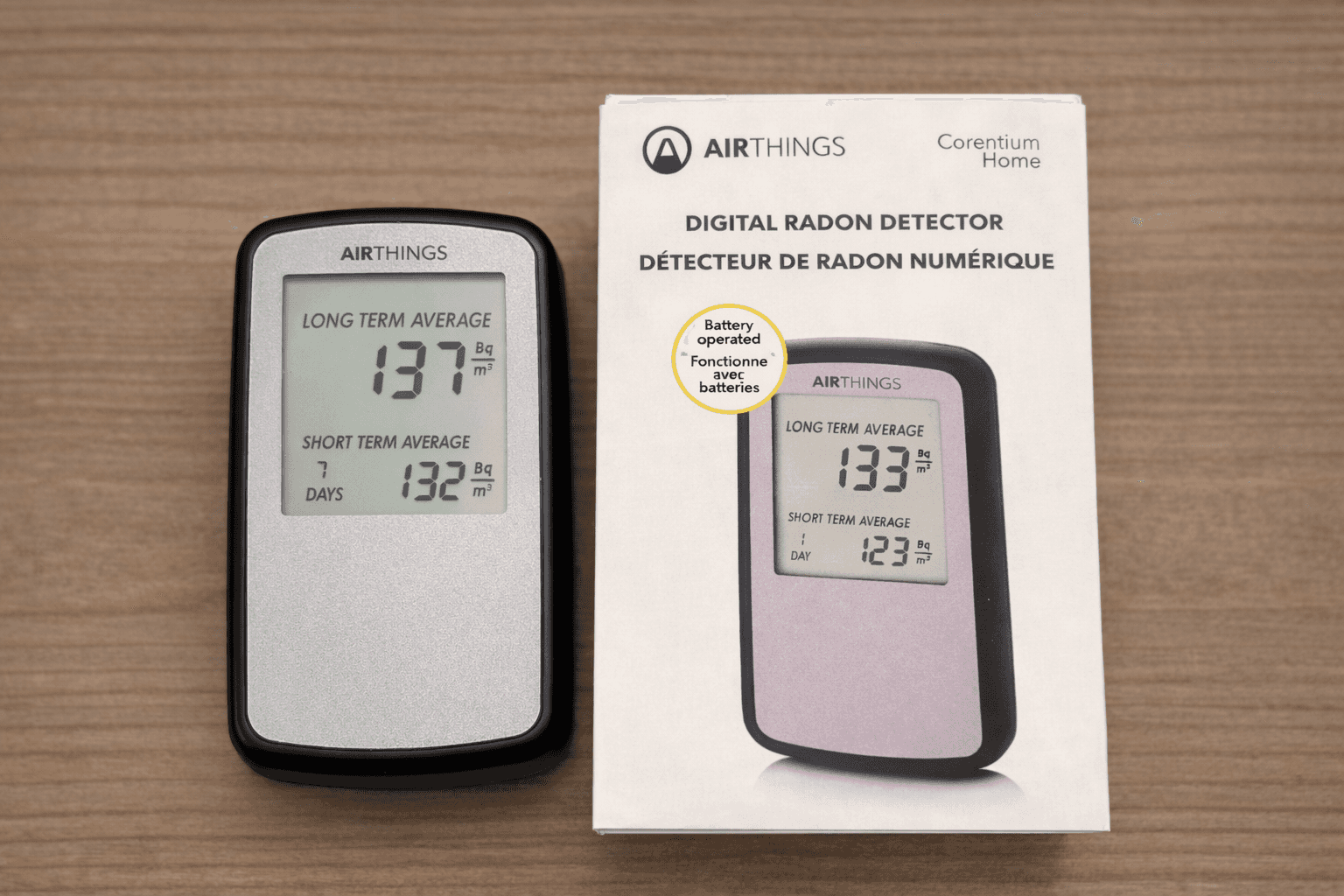
Start with the Canadian guideline of 200 Bq/m³ that Health Canada sets in the Government of Canada radon guideline and then focus on getting a long-term result you actually trust.


A Practical Canadian Framework For Cost, Confidence, And Decision-Grade Results
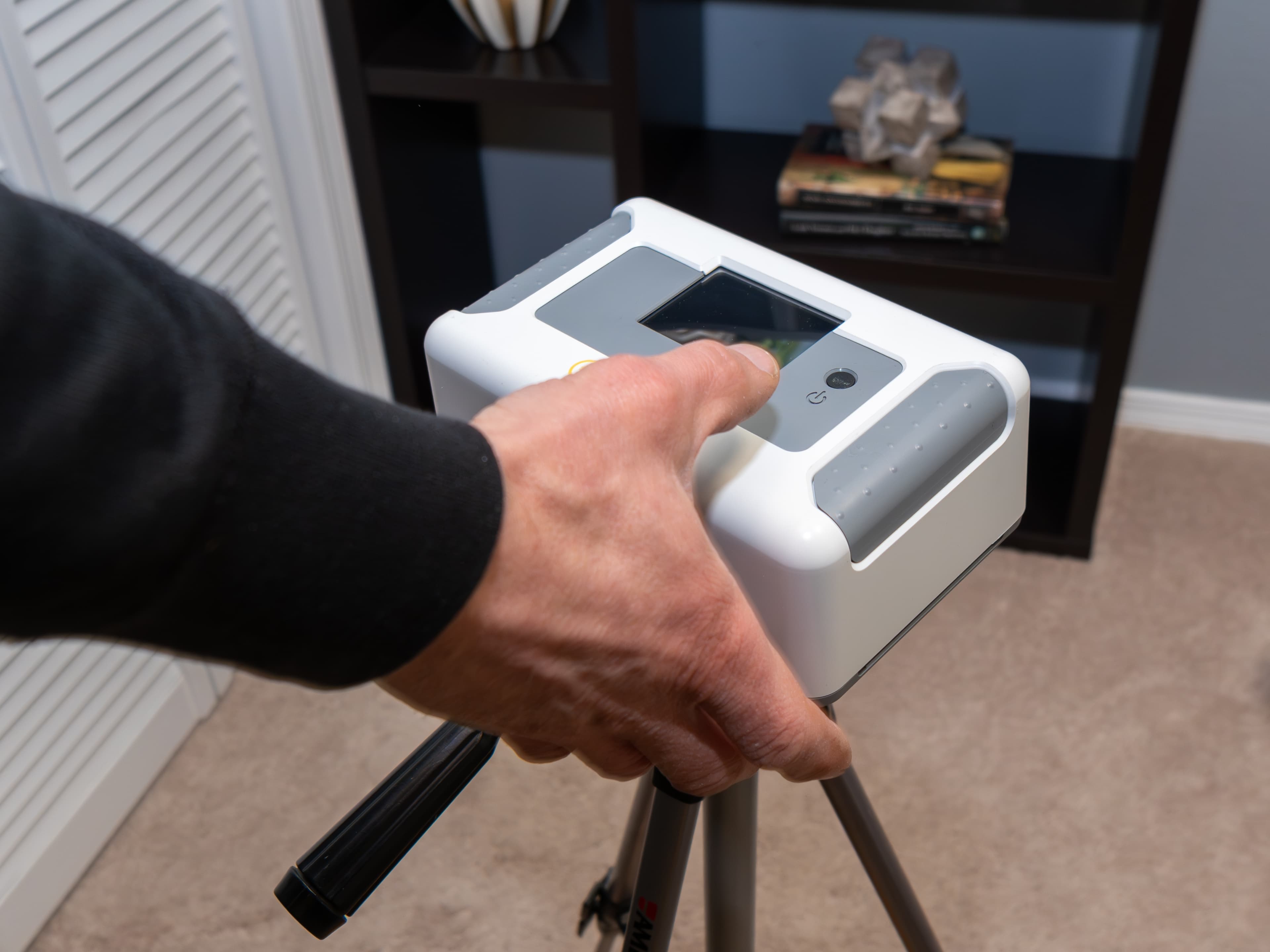
Portable radon detector goes down in the living space where winter placement and long-term accuracy matter. (Credit: Shutterstock.com)
Radon testing is one of those homeowner decisions that feels deceptively simple: buy a kit, put it somewhere, wait, and read a number. In practice, the “somewhere” and the “wait” are the whole game. A perfectly good detector placed in a bad location can give you a number that isn’t meaningfully tied to the air you actually breathe.
That’s why “DIY kit vs professional test” is less about who runs the test and more about how well the test is executed. The method (long-term vs short-term), the placement (lowest lived-in level, breathing height), and the discipline to leave the device alone for the full duration are what determine whether the result is decision-grade.
The other hidden truth is that you’re not just buying a device—you’re buying a measurement workflow. With DIY, you’re paying for lab analysis plus your own time and quality control. With a professional, you’re paying for standards, documentation, and reduced odds of needing to re-test due to preventable mistakes.
This guide breaks down what each option actually includes in Canada, what homeowners typically miss when budgeting, and exactly how to run a DIY long-term test in a way that lines up with federal guidance—so you can spend money once, get a useful result, and make confident next steps.
Canada’s headline number is straightforward: Health Canada sets the indoor radon guideline at 200 becquerels per cubic metre (200 Bq/m³) in its Government of Canada radon guideline which homeowners use as the main decision threshold.
That threshold matters because radon risk is not something you can reliably “guess” from house age, neighbourhood, or how drafty your basement feels. Health Canada emphasizes the seriousness of radon exposure through its public guidance on taking action on radon where the core message is that testing is the only way to know your home’s level.
Radon is also not evenly distributed across the country. Health Canada’s regional summaries in its provinces and territories action guides make the practical point: national averages hide big local spikes, so the only safe assumption is that your specific home needs its own measurement.
If you’ve ever wondered why Canada picked 200 Bq/m³ (and not a different number), Health Canada lays out the logic behind guideline-setting and public-health thresholds in its justification and policy rationales which is useful context when you’re deciding how much certainty you want from your test method.
A radon number is only as useful as the method behind it. If you’re going to act on the result—or use it in a real estate conversation—your goal is a decision-grade long-term measurement, not a fast number.
The easiest way to compare DIY and professional testing is to stop thinking of them as two products and start treating them as two workflows that can produce very different quality outcomes.
Health Canada explicitly frames homeowner options as either buying a long-term kit or hiring a certified professional in the Radon Reduction Guide for Canadians and that framing is helpful because it keeps the focus on outcomes: “Do you want to manage the workflow yourself, or outsource it?”
Many professionals can give you a fast screening result, but “fast” and “decision-grade” are not the same thing. If your decision is long-term (health, resale, mitigation), you still want a long-term measurement strategy.
A long-term DIY kit is typically three things bundled together:
What varies—and what changes the real cost—is what’s included in the sticker price (return shipping, lab fees, and how the company handles reporting).
A practical buying rule comes from Take Action on Radon’s guidance: choose an approved long-term kit and confirm what’s included before you buy, as outlined on the Take Action on Radon testing guidance where they explicitly prompt homeowners to check whether return shipping and lab analysis are bundled.
If you’re comparing DIY kits to professional services, compare all-in cost per decision-grade result, not “price of the box.” A kit that forces a re-test is rarely the cheaper option.
DIY becomes expensive when it becomes repetitive. The biggest “hidden cost” is not postage—it’s losing three months because the device was placed incorrectly.
Health Canada’s clearest homeowner walkthrough is its step-by-step instructions for device choice, placement, duration, and next actions on the electronic monitor or long-term detector guidance which is the best reference point if you want your DIY process to match federal expectations.
Below is a practical version of that workflow, written for real Canadian homes (basements, closed windows, heating season habits) while staying aligned with the core rules.
Step 1: Pick the right test type for the decision.
If you’re trying to understand your home’s typical exposure, choose a long-term test window. Health Canada’s residential measurement guidance emphasizes that the most reliable estimate comes from 3–12 months and warns against shorter periods in the residential dwellings measurement guide because radon varies by season and day-to-day patterns.
Step 2: Choose the right level and the right room.
Place the detector on the lowest lived-in level (for many homes, that’s a finished basement; for others, it’s the main floor), and choose a room where someone spends meaningful time each day. Health Canada’s homeowner context for “where you actually live” is reinforced in its broader Healthy Home guide which is useful when you’re deciding between a storage basement and a family-room basement.
Step 3: Place it at breathing height, with normal airflow.
Aim for roughly 0.5–2 metres off the floor (think: a shelf or small table, not the ground and not the ceiling). Give it space around it—don’t wedge it behind objects.
Step 4: Avoid the common “bad zones.”
Skip kitchens, bathrooms, laundry rooms, closets, and areas near exterior walls, vents, windows, doors, and heat sources. Your goal is representative air, not an artificially high/low corner case.
Step 5: Record your start date, then don’t touch it.
Write down start and end dates immediately. If you move it, cover it, or “check” it constantly, you’re adding noise.
Step 6: End the test, then complete the lab process.
For passive kits, seal and ship it as instructed. For electronic monitors, record the appropriate long-term average your device reports and keep a screenshot or exported log.
Step 7: Interpret against the Canadian guideline and decide next actions.
Use the long-term result as your decision number. If you’re at or above the guideline, shift from “testing” to “planning” (timelines, mitigation quotes, and verification testing).
Long-term tests are commonly run during the heating season because windows are closed more often and indoor-outdoor pressure differences can increase radon entry, so a winter test often reflects a conservative exposure picture.
Your goal is not the lowest radon number—it’s the most representative number for where your household spends time.
Professional radon testing is more expensive because you’re not paying for a box—you’re paying for a controlled measurement process that reduces homeowner error and usually comes with clear reporting.
Health Canada’s technical guidance strongly points homeowners toward certified providers through the radon technical information resource where certification is treated as a quality and safety differentiator rather than a marketing badge.
A practical way to operationalize that is to use the Canadian National Radon Proficiency Program (C‑NRPP) registry; the Canadian National Radon Proficiency Program website explains its role and provides a way to find certified measurement and mitigation professionals across Canada.
You’ll see two broad professional models:
Flood Ready summarizes current consumer expectations by noting typical DIY and professional ranges on its radon mitigation solutions page which is helpful as a sanity check before you start collecting quotes.
If a professional quote is based on a short screening period, ask what their plan is for long-term confirmation if the result is near or above the guideline. You’re paying for a decision, not just a number.
A simple way to choose is to define what you’re trying to buy:
If you’re deciding how much urgency to assign, it helps to remember that radon risk varies widely and locally. Health Canada’s community-level summaries in its municipalities action guide support a practical conclusion: you can’t “average your way” to safety, because two houses in the same city can behave very differently.
Health Canada is unusually direct about real estate: it does not recommend conducting radon testing during a transaction, and instead suggests testing before listing or shortly after purchase as described in its radon and real estate guidance which can save you from trying to force a long-term decision into a short closing window.
If you’re under a firm closing date, a short professional screening may be better than nothing, but treat it as a risk signal—not the final word. Build in a plan (and possibly a financial holdback) for long-term confirmation.
Once you have a long-term number, your next move depends on which side of the guideline you’re on—and what changes are coming to the home (renos, basement finishing, mitigation work, major envelope upgrades).
If your result is at or above the guideline, Health Canada’s homeowner-facing page on reducing radon levels in your home sets expectations about mitigation effectiveness and reinforces that professional installation is a common pathway for meaningful reductions.
If your result is below the guideline, don’t treat it as “done forever.” Health Canada outlines situations that trigger re-testing—like renovations, changes to the lowest lived-in level, and post-mitigation verification—in the residential dwellings measurement guide which helps you build a long-term maintenance plan instead of a one-time project.
“Peace of mind” comes from a repeatable plan: baseline → act if needed → verify → re-test when the home changes.
DIY radon testing fails most often in predictable ways—and most of them aren’t about buying the “wrong” kit. They’re about placement, timing, and process.
Here are the mistakes that most commonly force homeowners into re-testing:
If you’re worried you’ll forget the rules, take one photo of the detector in place on day one and save it with your start date. That single habit prevents most “Where did I put it?” problems three months later.
If you’re responsible for a school, hospital, care facility, or detention setting, residential guidance isn’t the right document—Health Canada maintains separate measurement guidance in its public buildings radon measurement guide which follows different operational realities.
Start with the Canadian guideline of 200 Bq/m³ that Health Canada sets in the Government of Canada radon guideline and then focus on getting a long-term result you actually trust.
Because radon changes day to day and season to season, and Health Canada explains the reliability advantages of longer measurement windows in its residential radon measurement guide which is aimed at decision-grade results.
Use the lowest lived-in level in a room that’s actually occupied, and follow the placement logic described in Health Canada’s electronic monitor or long-term detector instructions so your number reflects real exposure.
Health Canada advises against trying to run a long-term test during the transaction window, and outlines better timing options in its radon in real estate guidance which also discusses approaches like testing pre-sale or shortly after purchase.
Look for certification expectations and quality signals in Health Canada’s radon technical information and then verify the provider through the C‑NRPP registry.
The Canadian National Radon Proficiency Program is the certification body that lists trained radon professionals and explains its standards on the C‑NRPP website which gives homeowners a practical way to find qualified help.
You’ll see a range across sellers and what they bundle, so it’s useful to compare “all-in” totals using itemized examples like the Mr Radon long-term kit listing rather than relying on the lowest sticker price.
Return shipping and logistics surprises are common, and some sellers explicitly separate that cost as shown on the AGAT Laboratories long-term kit page which is why “what’s included” matters as much as the base price.
Yes—Take Action on Radon emphasizes approved long-term kits and prompts you to confirm what the purchase includes on its radon testing guidance which is a strong practical checklist for first-time buyers.
Ranges vary by region and scope, so combining broad expectations like those on the Flood Ready cost overview with local quote examples is usually the fastest way to budget accurately.
Yes, and you can see how it’s priced as an add-on in guides like the HomeStars Barrie home inspection cost page which reflects how many buyers encounter it.
Scope and provider practices vary widely, and a wide band like the one shown in the HomeStars Calgary cost guide is often a signal to compare what the service actually includes.
Yes—some providers describe combined approaches, such as the offering described on the Inspect Canada indoor air quality page which can be useful if you want both speed and confirmation.
Shift from measurement to remediation planning, and use Health Canada’s homeowner guidance on reducing radon levels to set expectations for mitigation and follow-up verification.
Some inspection firms list screening formats directly, such as the 96-hour option described on the Parkland Home Inspections services page which is a helpful reference when comparing service models.