


As Natural Resources Canada notes in its heat pump facts resource, cold‑climate air‑source heat pumps can operate down to very low outdoor temperatures (around −30 °C), while backup heat is used on the very coldest days to maintain comfort.


A Homeowner’s Field Guide to Cold-Weather Performance That Still Feels “Normal”
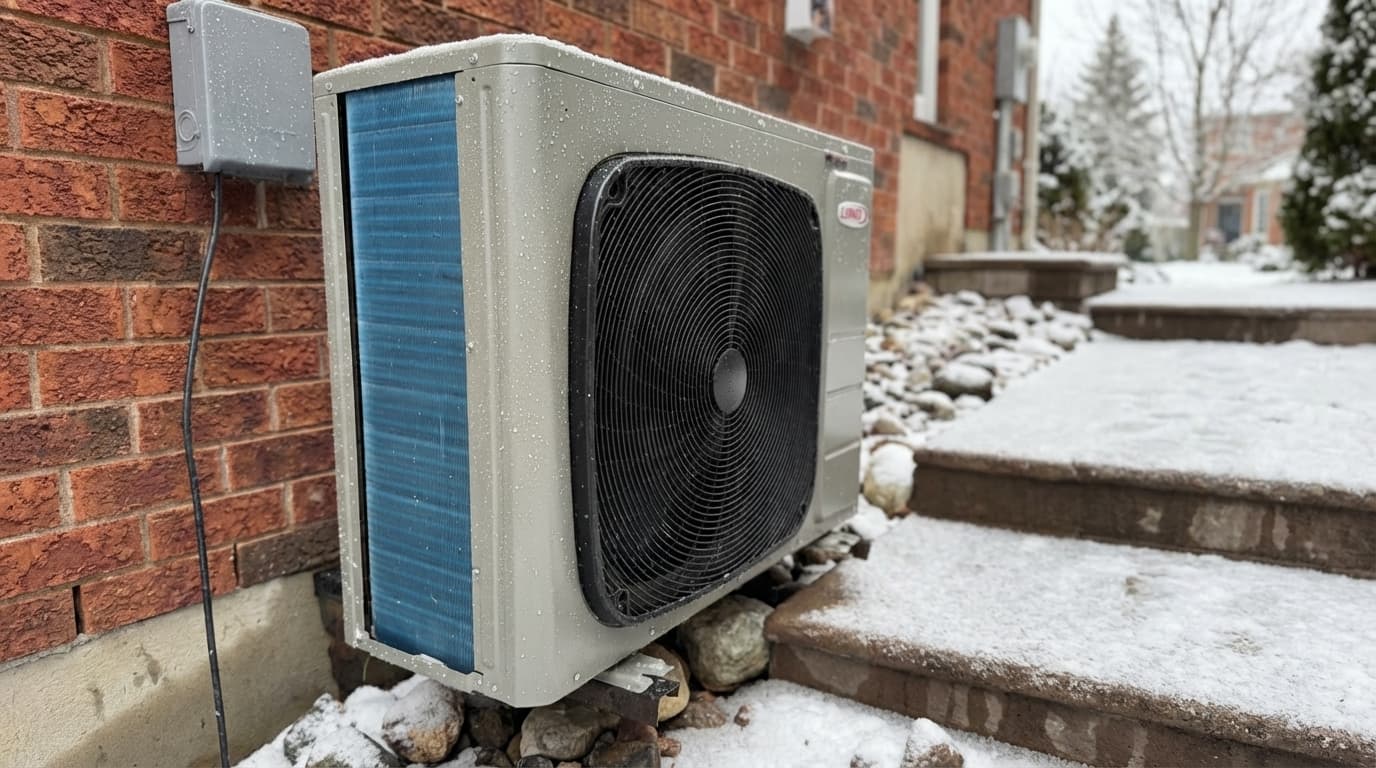
Outdoor heat pump rimed with ice keeps humming, where winter capacity and backup heat decisions begin. (Credit: Homeowner.ca)
Heat pumps absolutely can work in Canadian winters, but the “feel” of the heat is different than what many homeowners expect—especially if you’ve lived with a furnace that throws very hot air in short bursts. A heat pump tends to run longer, more gently, and more consistently. For many homes, that translates into fewer big temperature swings and fewer “cold-then-hot” cycles.
The catch is that winter performance isn’t a single number. It’s a system outcome that depends on three things working together: the house (air sealing and insulation), the heat pump (cold-climate capability and sizing), and the controls (thermostat strategy plus when and how backup heat engages). If any one of those is weak, comfort drops fast in a cold snap.
You’ll also notice behaviours that are completely normal in winter but look alarming if you’ve never owned a heat pump: frost on the outdoor unit, occasional steam-like plumes during defrost, longer run times, and supply air that feels “warm” rather than “hot.” None of those automatically mean something is wrong.
This guide walks through what to expect—comfort, capacity, noise, ice, and backup heat—in practical homeowner terms. The goal is not to turn you into a technician. It’s to help you recognize normal winter behaviour, set your system up for comfort, and know exactly when to use backup heat or call for service.
The most common winter surprise is this: the thermostat says your usual temperature, but the air coming from the vents (or a ductless head) doesn’t feel as hot as you’re used to. That’s often normal.
A heat pump is designed to move heat efficiently, which usually means delivering air that is warm but not scorching. To make up the difference, it tends to run longer and maintain a steadier indoor temperature. The result is often fewer spikes and dips—more “background warmth” than “heat events.”
Comfort also has a psychological component. If you’re used to the sensation of hot air on your skin, a heat pump can feel underpowered even when it’s doing its job. You’ll often feel more comfortable when:
For a reality check on what many Canadians consider “comfortable” temperatures, guidance from CAA‑Québec points to about 20–22 °C when people are home and roughly 18–19 °C at night or in unused rooms, while also noting that even small air leaks can make a home feel colder than the thermostat suggests.
If the thermostat reading seems “right” but you still feel chilled, try a quick comfort audit before blaming the heat pump: stand near exterior doors and windows, check for obvious drafts, and note whether one or two rooms are consistently worse than the rest. Localized discomfort usually points to airflow or envelope issues, not a whole-house capacity problem.
In winter, your heat pump is only as good as the home it’s trying to heat. If the building envelope leaks air or has under-insulated assemblies, the system has to replace heat that’s constantly escaping. That’s a comfort problem first, and an energy-bill problem second.
A good north-star statement comes from Natural Resources Canada’s “Keeping the Heat In” introduction where the emphasis is that a well-insulated and properly ventilated home is more comfortable, quieter, and has less dust and pollen—comfort outcomes that matter just as much as efficiency.
If you want one number that explains why “the house” matters so much, Natural Resources Canada’s guidance on insulating walls notes that exterior walls can account for about 20% of a house’s total heat loss, and that cracks and penetrations can create significant uncontrolled air leakage.
The practical implication is simple: the tighter and better insulated the home, the more “heat pump comfortable” it becomes. That’s especially true during long cold stretches, because you’re reducing the peak heat demand the system must meet.
To connect the dots between drafts and performance, Natural Resources Canada’s “Keeping the Heat In” section on how your house works emphasizes that controlling airflow is essential for comfort and that insulation performs properly only when air movement through it is controlled.
A homeowner-friendly way to think about this is: air sealing reduces the “wind chill” inside your home. Insulation reduces how quickly the home bleeds heat through surfaces. Heat pumps love both, because they can maintain comfort with less strain—and with less need for backup heat.
If you’re upgrading to (or relying on) a heat pump for winter, prioritize the “big leaks” you can feel (drafty doors, rim joists, attic bypasses, utility penetrations). That’s where comfort improvements show up fastest.
Heat pumps don’t “fail” in the cold the way some myths suggest. What actually happens is more predictable: as outdoor temperatures fall, a heat pump has less available heat to move, and it has to work harder to move it. That reduces both efficiency and effective heating capacity.
A useful metric here is COP (coefficient of performance). COP is simply “heat delivered divided by electricity used.” A COP of 2 means you’re getting about twice as much heat energy out as the electric energy you’re paying for. A COP near 1 means you’re closer to electric resistance heating performance.
Performance numbers from Natural Resources Canada’s heat pump publication illustrate the winter curve clearly: around 8 °C outdoors, air‑source heat pumps commonly show COP values in the neighbourhood of 2.0 to 5.4, while at −8 °C COPs commonly drop into roughly the 1.1 to 3.7 range. In real terms, that means the system is still usually efficient in winter, but it’s delivering less “easy heat” per unit of electricity as it gets colder.
It’s also normal for heat pumps to have a minimum operating temperature—a point where the unit either can’t run or can’t provide meaningful heat. Practical guidance from Hydro‑Québec explains that many air‑source models have a minimum operating temperature, often in a band roughly around −15 °C to −25 °C for newer models, below which an auxiliary system must provide the heat.
Cold-climate capability varies by model, and it matters. Provincial guidance from the Gouvernement du Québec is a helpful framing: “standard” air‑source heat pumps are often associated with heating use down to around −8 °C, while low‑temperature models can typically be used down to around −20 °C—and the expectation is that another heating system takes over in colder weather.
Here’s the homeowner takeaway: winter comfort is about matching your home’s heat demand to the heat pump’s output at the temperatures you actually experience. In many parts of Canada, a cold‑climate unit can cover most winter hours, but you still plan for backup because the coldest hours are when comfort problems show up.
If your home feels “fine most of the time” but struggles during a few cold snaps, that’s often a capacity-at-temperature issue (or an envelope/airflow issue) rather than a sign the heat pump “doesn’t work in Canada.”
A well-designed Canadian setup doesn’t pretend backup heat will never run. Instead, it treats backup as a normal part of resilient winter comfort—and uses it strategically.
One myth worth retiring is that heat pumps only work in mild climates. As Natural Resources Canada explains in its heat pump facts resource, cold‑climate air‑source heat pumps can operate in very low outdoor temperatures (down to about −30 °C), with backup heating available to keep homes warm cost‑effectively on the very coldest days.
In practical terms, that means your heat pump often does the “heavy lifting” for a large share of the season, while backup heat covers:
The expectation that a secondary system is part of the design is also reflected in Québec-specific guidance from Transition énergétique Québec, which frames low‑temperature heat pumps as winter-capable but still paired with another heating system to take over when it’s colder than the unit’s practical range.
Backup heat can take different forms (electric baseboards, electric resistance elements in a ducted air handler, a furnace in a dual-fuel setup, or another fixed heater). The right choice depends on your home, region, and utility rates. The point is not the backup type—it’s the handoff: the system should switch (or supplement) smoothly so you don’t get cold rooms during the coldest hours.
If you’re shopping or upgrading, ask one direct question: “At what outdoor temperature will this system meet my full heating load without backup, and what’s the control strategy when it can’t?” The answer should be specific, not vague.
If you want reassurance that “heat pump + backup heat” is not theoretical, Canadian test data is a strong reality check.
A field study described by Natural Resources Canada at the Canadian Centre for Housing Technology evaluated a mini‑split cold‑climate heat pump paired with backup heat, finding that the system maintained comfort at outdoor temperatures below −15 °C with a COP greater than 2 while still requiring some backup during the coldest periods; in the same study context, the test home’s design heating load was around 12.14 kW at −25 °C, and the analysis suggested the heat pump system would be around a COP of roughly 2.0 at −25 °C.
For homeowners, the most valuable lesson from this kind of data isn’t a single COP number—it’s the systems thinking:
That last point is especially important. Many comfort complaints trace back to how thermostats and staging are set up, not whether the heat pump is “good.” If the backup is set too low to engage, the house can drift below setpoint during extreme cold even if the equipment is functioning normally.
If you have multiple thermostats (heat pump plus baseboards, or heat pump plus a second system), write down each setpoint and what you expect to happen when it’s very cold. If you can’t explain the handoff, it’s worth an HVAC checkup—because winter will eventually “test” the system for you.
Heat pumps are efficient when they run steadily. Many winter comfort problems happen when thermostat habits fight that reality.
A simple operational baseline comes from Hydro‑Québec’s winter operating tips, which emphasizes keeping the heat pump on in winter and maintaining a constant temperature setting, noting that frequent temperature changes can make the unit work harder and can reduce efficiency and increase wear.
That doesn’t mean you can’t use setbacks at all—but it does mean you should be strategic. For typical scheduling guidance, Natural Resources Canada’s smart thermostat recommendations suggest setpoints around 20 °C when awake and at home and around 17 °C when sleeping or away, while pointing to a modest 2–3 °C reduction as a practical range for saving energy without sacrificing comfort.
And when you’re in a cold snap, small adjustments beat big swings. Advice in Hydro‑Québec’s heat pump tips collection stresses that turning the thermostat up only 1–2 °C and letting the unit run steadily is usually sufficient, because large jumps can use more energy without making the house warm up faster; in the same guidance set, the practical control idea is to let the heat pump be the main heat source and keep electric baseboards set a couple degrees lower so they act as backup rather than competing.
Here’s a homeowner-friendly “dial-in” process you can do without touching any wiring:
If you’re using a single thermostat that can stage auxiliary heat (common in ducted systems), avoid “emergency heat” modes unless you’ve been instructed to use them. Emergency heat can disable the heat pump and run on resistance heat only, which is usually the most expensive way to heat electrically.
A heat pump does make noise, but modern systems are often quieter than people fear—especially variable‑speed/inverter models that can ramp gently instead of slamming on and off.
For a practical range, a compilation from Quality Home Air Care describes many residential outdoor units landing roughly in the 40–70 dB range depending on size, load, and model category, which is why two neighbours can have very different experiences even with “similar” systems.
If you want to sanity-check what that means in everyday terms, another overview from Heat Pump Prices & Reviews breaks down typical loudness expectations and why higher-end models and better installations tend to be less intrusive.
Indoor sound is often lower than people expect, particularly with ductless heads. A technical explainer from alpha innotec’s knowledge centre describes how indoor sound levels can be very low for well-designed systems, especially at partial load.
Noise complaints are often less about the equipment and more about placement and vibration paths. Guidance from Better Homes BC recommends practical mitigation strategies like placing the outdoor unit away from windows and neighbouring buildings, mounting it on a solid base (often a concrete pad) with a vibration‑absorbing mat, and using barriers such as fences, decks, or landscaping to disrupt noise transmission.
Common winter sounds that are usually normal:
Sounds that are worth investigating:
If the outdoor unit noise bothers you, don’t start with “replace the heat pump.” Start with: placement relative to bedrooms, whether the unit is level, whether snow/ice is forcing it to work harder, and whether vibration is being transmitted into the structure.
If outdoor temperatures hover near or below freezing, moisture in the air can freeze onto the outdoor coil while the heat pump is running in heating mode. That’s normal physics, and it’s why heat pumps have defrost controls.
A cold‑weather maintenance explainer from Ready Refrigeration describes the typical pattern: frost forms on the outdoor coil, the heat pump periodically enters a defrost cycle to clear it, and the unit resumes heating—because ice restricts airflow and can reduce efficiency if it’s allowed to accumulate.
The trick is separating normal defrost from “something’s wrong.” Ontario-focused HVAC guidance from Shiptons Heating & Cooling notes that normal defrost intervals in freezing weather are often on the order of 30–90 minutes, and that a unit encased in ice or one that is defrosting extremely frequently (like every few minutes) can indicate a malfunction that needs professional service.
There are also simple homeowner maintenance actions that make a big difference, especially in snow-heavy regions. Practical winter advice from TakeCHARGE Newfoundland and Labrador recommends keeping the outdoor unit clear of snow after significant snowfalls (blocked airflow reduces efficiency and can damage equipment) and suggests removing ice by gently pouring warm water instead of using sharp tools or heavy objects.
Thick, persistent ice is not “just winter.” A Canadian heat‑pump specialist’s winter issue rundown from HeatPumps.ca highlights that light frost can be normal, but thick ice buildup or a unit freezing solid is often tied to blocked airflow, drainage issues, roof meltwater dripping onto the unit, or defrost problems—and that persistent heavy icing or strange noises are good reasons to book service.
Here’s a quick cheat sheet to help you decide what’s normal:
Never chip ice off the coil with a tool. If you can’t clear it safely with gentle warm water and improved airflow, stop and call for service—coil fins and refrigerant circuits are easy to damage and expensive to repair.
If you’re selecting a heat pump for Canadian winters, “high efficiency” needs context. Some ratings are mostly about cooling. Others matter directly for heating season performance.
Here are three terms worth understanding:
COP (Coefficient of Performance)
This is the most intuitive “instant efficiency” snapshot, and it changes with outdoor temperature. It’s why heat pumps are typically most efficient in mild weather and less efficient (but often still favourable) in deep cold.
SEER (Seasonal Energy Efficiency Ratio)
This is primarily a cooling-season efficiency metric. It matters for summer comfort and operating cost, but it doesn’t tell you whether a unit will carry your load at −20 °C.
HSPF (Heating Seasonal Performance Factor)
This is a seasonal heating metric that’s more relevant to winter capability. One reason it’s useful is that it gives you a consistent yardstick across models, even though real-world results still depend on sizing, house performance, and climate.
To put real Canadian-market numbers on the map, Natural Resources Canada’s heat pump publication reports heating seasonal performance factor values (Region V) roughly ranging from about 7.1 to 13.2 for air‑source heat pumps, and notes that newer cold‑climate units can pair very high SEER cooling ratings (up into the low‑40s) with HSPF values near 13—useful context when you’re comparing “high efficiency” claims.
Beyond ratings, many cold-climate programs rely on specification lists that screen for low-temperature performance. The voluntary standard from Northeast Energy Efficiency Partnerships’ cold-climate specification describes how qualifying air‑source heat pumps are identified for performance across a wide ambient range, and the update context from Northeast Energy Efficiency Partnerships’ announcement post is a useful indicator that “cold climate” is treated as a defined performance target rather than a vague marketing label.
When you’re talking to contractors or evaluating quotes, focus your questions on winter outcomes:
The best winter systems are not defined by a single piece of equipment. They’re defined by the way the house, the heat pump, and the controls are matched to the climate you actually live in.
As Natural Resources Canada notes in its heat pump facts resource, cold‑climate air‑source heat pumps can operate down to very low outdoor temperatures (around −30 °C), while backup heat is used on the very coldest days to maintain comfort.
Not necessarily. Many modern units still contribute meaningful heat below −20 °C, but output and efficiency drop, and some systems will rely more heavily on backup as temperatures approach the unit’s minimum operating range.
Heat pumps usually deliver air that’s warm rather than “hot,” then run longer to maintain a steady temperature. If you’re used to short bursts of very hot air, the sensation can feel different even when the thermostat is being met.
Expect backup heat during extreme cold, when the heat pump reaches its minimum operating temperature, or when the house load spikes (high wind, doors opening, recovering from a large setback). A properly configured system makes that transition automatically.
Yes—during defrost, the unit melts frost from the outdoor coil, and you may see a plume that looks like steam. It’s often just water vapour in cold air.
Guidance from Shiptons Heating & Cooling describes typical defrost intervals in freezing weather on the order of 30–90 minutes, while very frequent defrosting (every few minutes) or a unit encased in ice can signal a problem that needs service.
Advice from TakeCHARGE Newfoundland and Labrador focuses on keeping the outdoor unit clear of snow to protect airflow and suggests removing ice gently with warm water rather than using sharp tools that can damage the coil.
Usually no. In many setups, the heat pump should remain the primary heat source, with baseboards or another system supporting it as needed. Turning the heat pump off can push you into higher-cost heating for longer than necessary.
Guidance from Natural Resources Canada’s smart thermostat recommendations suggests around 20 °C when awake and at home and around 17 °C when sleeping or away, and points to modest setbacks (about 2–3 °C) as a good balance between savings and comfort.
Many are quieter than people expect, but sound depends on model and placement. Outdoor sound ratings commonly fall into a range that can be noticeable if the unit is near bedrooms or neighbouring windows, so siting and vibration control matter.
Cold-climate models are designed and tested to deliver useful heat at lower outdoor temperatures and often have better low-temperature capacity retention, which reduces how often backup heat is needed.
Call if the unit is freezing into a solid block of ice, defrosting constantly, making new grinding/banging noises, or failing to hold temperature despite reasonable thermostat settings and clear airflow.