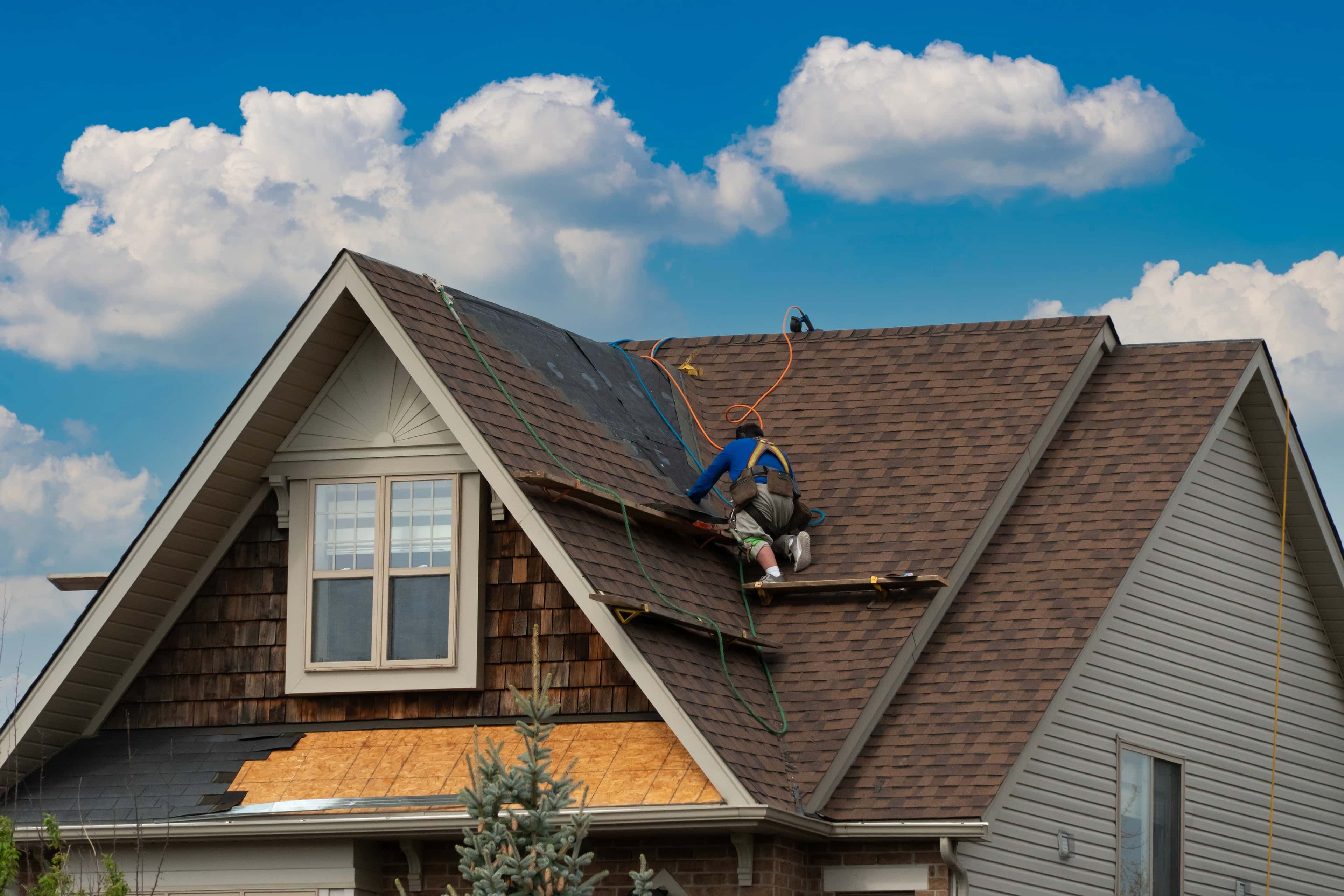


Most standard asphalt shingle replacements on a single-family home take 2 to 5 days, depending on roof size, complexity, and weather. Metal roofing or homes with structural repairs may take a week or longer.


What Drives the Price, What to Budget, and How to Compare Quotes With Confidence
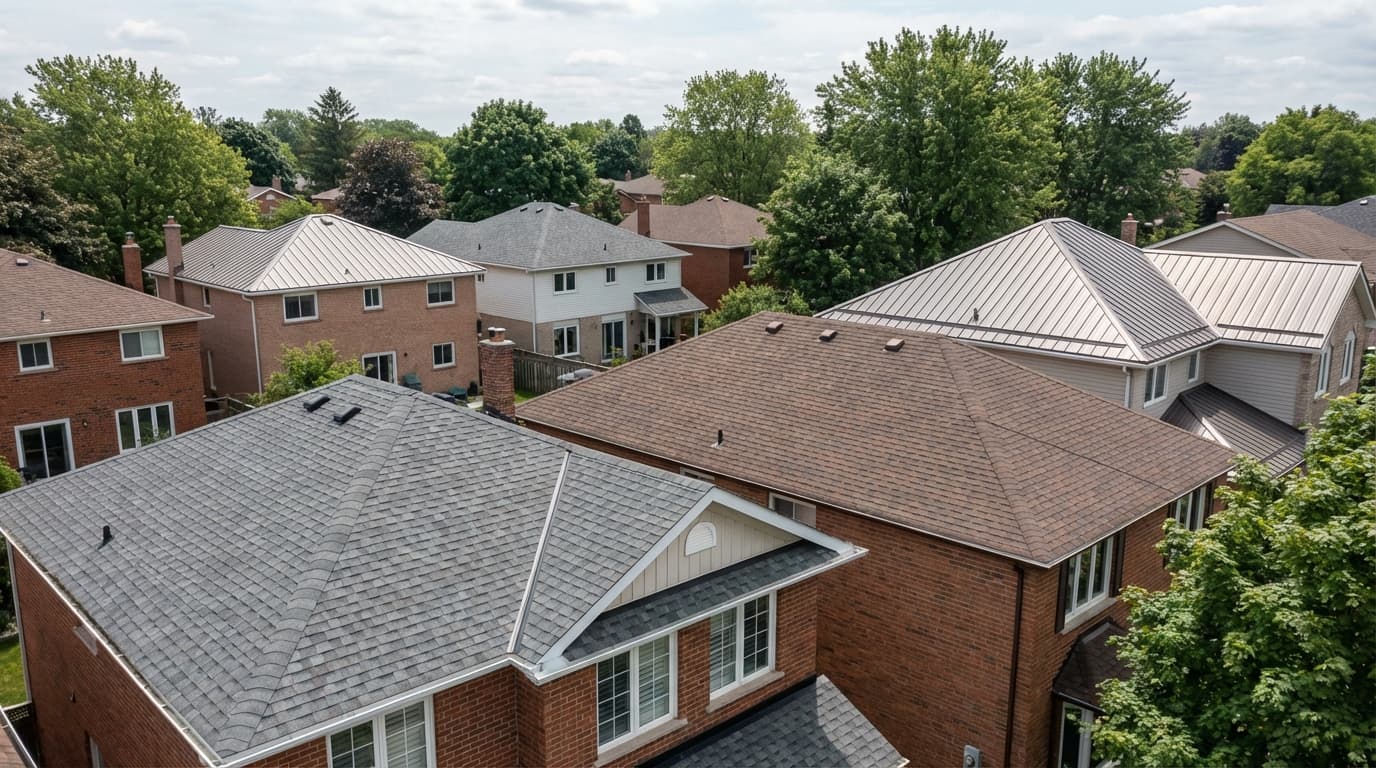
Mismatched shingles and metal panels across one block reveal how province and material choices reshape roof budgets. (Credit: Homeowner.ca)
Most homeowners start their roofing research with a single question: how much? It's a reasonable place to begin. But the number you find in a national cost guide and the number on your actual quote will rarely match — and the gap between them is where the real decisions live.
Roof replacement pricing in Canada is shaped by forces that vary sharply from province to province. A homeowner in Calgary is budgeting against hail-belt insurance dynamics and Alberta Building Code wind-uplift requirements. A homeowner in Halifax is contending with salt air corrosion and smaller, less competitive labour markets. Someone in Northern Ontario faces snow-load engineering costs that a homeowner in Windsor will never see on a quote. These aren't minor footnotes. They are the reason two identical-looking houses in different provinces can receive quotes that differ by thousands of dollars.
This guide breaks down roof replacement costs across every Canadian province and territory, explains how quotes are structured, compares the materials that matter most in Canadian climates, and gives you the tools to budget confidently — whether you're planning within the next six months or the next two years. Every range you'll see here reflects 2025–2026 data from Canadian sources, with assumptions stated clearly so you can judge how they apply to your home.
Canadian roofing companies typically quote on a cost-per-square-foot basis, though some use the industry term "square" — which equals 100 square feet of roof area. Understanding which unit your quote uses matters, because the difference between $5 per square foot and $500 per square is nothing. The difference between misreading $5/sq ft as $5/square is $45,000 on a 2,000-square-foot roof.
For standard asphalt shingles, most Canadian roofing guides report installed costs between $4 and $7 per square foot, which translates to roughly $400 to $700 per square. On a typical detached home with 1,500 to 2,500 square feet of roof area, that puts full replacement costs in the range of approximately $6,500 to $18,000 for asphalt shingles.
Metal roofing occupies a much wider band — roughly $7 to $30 per square foot installed — because "metal roof" can mean anything from basic steel panels to standing-seam copper systems. The quote you receive will depend heavily on the specific system, not just the material category.
A roof replacement quote is not a single price for a single thing. It is a bundle of labour, materials, removal, disposal, and contingency — and the way a contractor splits those components tells you more than the total at the bottom.
According to a 2026 Ontario roofing cost analysis, materials typically represent about 45% to 60% of an Ontario roofing budget, with labour accounting for the remaining 40% to 55%. Metal roofing skews higher on labour share because installation requires specialized skills and more time.
But many published cost tables exclude items that will appear on your actual quote. RenoAssistance's 2026 roof guide notes that demolition, crane rental, scaffolding, and parking or street-use permits are frequently excluded from advertised per-square-foot prices. Structural adjustments and unforeseen conditions — rotted decking, inadequate ventilation — add further.
Roof area is the starting variable, not the final one. Several factors push per-square-foot costs higher:
Published cost ranges assume a standard home and straightforward access. If your roof has multiple layers, steep pitch, or limited access, budget 15–25% above the midpoint of any range you see — including the ones in this guide.
The table below summarises the typical cost range for a standard asphalt shingle roof replacement on an average-sized detached home (roughly 1,500–2,500 sq ft of roof area) across Canadian provinces. These are planning ranges, not guarantees — your quote will depend on your specific roof. Note that applicable sales tax (GST, HST, or GST + PST) is not included in these ranges but can add 5% to 15% to the final invoice depending on your province.
A $15,000 roof replacement costs $15,750 after tax in Alberta (5% GST) but $17,250 in Nova Scotia (15% HST). When you're comparing quotes across provinces or budgeting from national averages, always add your applicable sales tax to get the real bottom line.
Ontario has some of the highest roofing labour and material costs in the country, driven by the GTA's construction demand and urban density. A 2026 Ontario cost overview estimates that full roof replacement ranges from $6,500 to $18,000, with installed costs typically running $3.50 to $9.00 per square foot depending on material, slope, and whether a full tear-off is required.
But Ontario is not one market. The Greater Toronto Area tends to have the highest costs because of concentrated labour demand. Ottawa can run higher due to ventilation and snow-load requirements. Southwestern Ontario is generally more price-competitive, and Northern Ontario often sees elevated costs from travel, logistics, and climate-driven engineering requirements.
For metal roofing in Ontario, expect per-square-foot costs starting around $7 and climbing past $15 for premium standing-seam systems. Larger or complex roofs can push total metal replacement costs well above $30,000.
BC's roofing costs are shaped by high living costs in the Lower Mainland, complex roof designs common in coastal communities, and a climate that demands moisture resistance above all else.
According to Green Building Canada's BC cost guide, asphalt shingles run $4 to $9 per square foot installed, with architectural shingles averaging around $6 per square foot. Metal roofing spans $8 to $30 per square foot, and cedar shingles — historically popular in BC because of locally sourced Western red cedar — range from $14 to $30 per square foot.
Vancouver and Victoria labour rates tend to run 15 to 20% above the rest of the province. However, the larger urban markets are also more competitive, so gathering multiple quotes can yield better pricing than in smaller interior communities where fewer contractors operate.
Cedar roofing has declined in popularity across BC as old-growth logging restrictions have reduced wood quality and driven material costs up. Cedar shingles still create a striking appearance, but the long-term maintenance costs and reduced lifespan of newer-growth wood should be factored into any cedar vs. metal comparison. Regardless of roofing material, BC's heavy rainfall makes eavestrough and gutter guard systems an important complement to any roof replacement project.
Alberta's roofing market is defined by two forces: hail and insurance. Calgary sits in Canada's most active hail corridor, and severe weather events regularly drive demand spikes that push pricing and wait times upward.
A 2025 Calgary roofing cost guide reports that average full replacement ranges from $8,000 to $26,000, with asphalt shingles at $4.25 to $6.75 per square foot and metal roofing at $9.00 to $14.00 per square foot. Labour costs alone run $2.75 to $5.00 per square foot, depending on material and pitch.
Impact-resistant shingles are gaining traction in Alberta — not just for durability, but because some insurers offer premium reductions for hail-rated products. Older homes in established Calgary neighbourhoods can cost 15% to 25% more due to hidden structural issues, unpermitted prior work, and tight access for equipment.
Alberta Building Code requirements for snow-load tolerance and wind-uplift resistance push material and engineering costs above what you'd see in milder provinces for the same house size and design.
Winnipeg and surrounding communities see pricing that reflects "Prairie" roofing economics: moderate labour costs relative to major urban centres, but climate demands that make proper installation non-negotiable.
A Winnipeg roofing cost guide reports that asphalt or fiberglass shingle replacement typically costs $6,000 to $10,000 for an average home, with metal roofing running $10,000 to $30,000 or more. Installation rates generally fall in the $3 to $5 per square foot range, and the average Winnipeg home has between 1,500 and 3,000 square feet of roof area.
Cold-climate installation details matter enormously here. Ice and water shield in valleys and along eaves, adequate attic ventilation, and proper sealing against spring meltwater infiltration are not optional upgrades — they are the difference between a roof that lasts and one that fails early. Cheap installs that skip these steps will cost more in the long run.
Saskatchewan pricing tracks closely with Manitoba, shaped by similar climate and comparable labour markets. For standard asphalt shingle roofs, homeowners in Saskatoon and Regina can expect costs in the $6,000 to $15,000 range, with per-square-foot pricing broadly consistent with the national $4 to $7 band. Smaller communities may see higher logistics costs, and fewer available contractors can reduce competitive pressure on pricing.
Quebec's roofing costs sit toward the higher end of national averages, driven by heavy snow loads, stringent building standards, and a labour market with its own regulatory framework.
A Quebec roofing cost guide reports asphalt shingle costs between $6 and $12 per square foot installed, with total prices for sloped-roof replacement commonly starting around $11 to $14.50 per square foot including installation. RenoAssistance estimates that a standard bungalow shingle replacement runs roughly $7,000 to $9,500, with larger or complex homes pushing well above that.
Montreal offers the most competitive market in the province, while Quebec City and smaller regional centres may carry higher pricing due to fewer contractors and seasonal demand compression. Quebec's construction labour regulations and the role of the Régie du bâtiment du Québec (RBQ) in contractor licensing mean that verifying credentials is both more structured and more important than in some other provinces.
Atlantic Canada's roofing costs are influenced by coastal weather exposure, smaller and less competitive labour markets, and the logistics of material delivery to more remote communities.
For standard asphalt shingle replacement, many bungalow and cottage-style homes in the Atlantic provinces fall in the $7,000 to $15,000 range depending on size and access. Coastal homes exposed to salt air and persistent high winds often require higher-performance materials — or more frequent replacement of standard ones — which shifts the lifecycle cost equation.
The smaller contractor pool in many Atlantic communities means fewer quotes to compare. It also means the quality gap between a good contractor and a poor one can be wider. Checking references and workers' compensation coverage is especially important where the market offers less natural quality filtering.
Roofing in the territories operates under a fundamentally different cost structure than southern Canada. Three factors drive prices well above national averages.
First, material logistics. There is no local asphalt shingle manufacturing in the territories — every bundle of shingles, sheet of plywood, and roll of underlayment must be shipped north. In many Nunavut and NWT communities, this means barging materials during a short summer shipping window (typically July through September), which compresses supply timelines and adds freight costs that can represent 30% or more of the material bill. Miss the barge season and you're waiting a full year or air-freighting at extreme cost.
Second, extreme climate engineering. Roofs in the territories must withstand some of the most demanding conditions on the continent: sustained cold well below -40°C, heavy snow loads, persistent wind, and extreme temperature differentials between heated interiors and frozen exteriors. This requires highly specialized vapour barriers to prevent interior moisture from condensing inside the roof assembly — a failure mode that can destroy a roof structure from the inside within a few years. Insulation and ventilation requirements are significantly more demanding than even Northern Ontario or the Prairies.
Third, labour supply. Qualified roofing crews are scarce in remote communities, and flying in southern contractors adds travel, accommodation, and per-diem costs to every project. The combination of limited competition and high mobilisation costs means homeowners have less negotiating leverage than in any southern market.
For homeowners in territorial communities, budgeting should start above the upper end of national ranges — often 40% to 60% higher for comparable materials and scope — and include significant contingency for logistics delays and weather-related work stoppages.
Choosing a roofing material is not just a cost decision. It is a climate decision, a maintenance decision, and — if you plan to stay in your home long enough — a cost-per-year-of-service decision.
Asphalt shingles dominate the Canadian market for good reason: they're affordable, widely available, and suitable for most residential roof designs. Three-tab shingles start around $4 per square foot installed, architectural shingles (the most common choice today) average about $5.50 to $7.25, and luxury designer shingles can reach $9 per square foot.
Lifespan ranges from 15 to 30 years depending on quality, installation, and climate exposure. RenoAssistance's 2026 guide notes that some newer shingle products are marketed with lifespans up to 50 years, though those claims are difficult to verify without decades of field performance data.
In hail-prone regions like Calgary, impact-resistant architectural shingles offer both performance and potential insurance savings. In high-moisture coastal areas like Vancouver or Halifax, algae-resistant formulations are worth the modest premium.
Metal roofing spans a wide cost range — $7 to $30 per square foot installed — because the category includes everything from basic steel panels to premium standing-seam copper. Steel sits at the lower end, aluminum in the middle, and copper and zinc at the top.
The durability argument is straightforward: metal roofs commonly last 40 to 70 years, compared to 15 to 30 for asphalt. They shed snow efficiently, resist wind uplift better than shingles, and reflect solar radiation — which can reduce cooling costs in summer. Metal roofing is non-porous, so moss, algae, and lichen don't establish the way they can on shingles, making it well-suited to BC's high-rainfall coastal zones.
The tradeoff is upfront cost. A metal roof on a 2,000-square-foot home might run $15,000 to $55,000 or more depending on system and complexity. But if you plan to stay in your home for 20+ years, the cost per year of service often favours metal over asphalt — even before accounting for lower maintenance and fewer repairs.
Cedar was once the natural choice in BC, where Western red cedar was locally sourced and competitively priced. Today, cedar shingles and shakes cost $14 to $30 per square foot installed, with a lifespan of 25 to 50 years — but only with regular treatment, inspection for mould and insect damage, and periodic replacement of individual shingles. Fire-code restrictions apply in wildfire-prone municipalities. The old-growth wood that made cedar roofing legendary is increasingly unavailable, and newer-growth cedar is less durable. For most homeowners outside heritage preservation, metal or premium asphalt now offers better long-term value.
Start with a rough estimate using this formula:
A homeowner in Ontario with a 2,000-square-foot roof choosing architectural asphalt shingles might calculate: 2,000 × $6.00 = $12,000, plus 15% contingency = $13,800 working budget. That won't match any specific quote, but it provides a sanity-check range when comparing bids.
The contingency is not padding — it is planning. Decking replacement alone can add $4 to $8 per square foot on top of shingle costs. A 10–20% buffer prevents the stress of discovering mid-project that your budget doesn't cover the actual scope.
Most Canadians finance major renovations through savings, home equity lines of credit (HELOCs), or personal loans. CMHC data confirms that HELOCs and other credit products are commonly used for renovations in the roof-replacement price range.
The Canada Greener Homes Grant closed to new document submissions on December 31, 2025, and the Canada Greener Homes Loan closed to applications on October 1, 2025. However, the Greener Homes Affordability Program — which covers the full cost of recommended retrofits for eligible low-to-median-income households — remains open in some provinces and territories. If your roof replacement includes insulation or ventilation upgrades, it's worth checking current eligibility through Natural Resources Canada.
Some provinces also operate their own renovation incentive programs. Ontario's Home Renovation Savings Program, for example, may apply to qualifying energy-efficiency upgrades performed alongside roofing work.
When you have two or three quotes side by side, compare them line by line. Here's what should be itemised:
Once you've decided a replacement is needed, follow this sequence to stay in control of the process from start to finish.
Step 1 — Document what you have. Before contacting anyone, photograph your current roof from multiple angles. Note the approximate age, any visible damage (curling shingles, missing flashing, sagging), and the number of existing layers. This baseline gives you leverage — you'll know when a contractor is over-scoping or under-scoping the job.
Step 2 — Estimate your roof area and set a budget range. Use the formula above to calculate a rough working budget. Add your province's sales tax and a 10–20% contingency. This is your walk-away number — the ceiling above which you need to reassess scope or financing.
Step 3 — Request three to five quotes. Contact contractors in January or February for work you need done by fall. Ask each for an itemised breakdown that matches the quote comparison table above. If a contractor won't provide line-by-line detail, that tells you something.
Step 4 — Verify credentials. For every contractor on your shortlist, confirm active workers' compensation coverage (WSIB, WCB, WorkSafeBC, or CNESST depending on your province), liability insurance, and business registration. Ask for their WCB clearance letter or certificate number — legitimate contractors provide this without hesitation.
Step 5 — Compare scopes, not just prices. Lay your quotes side by side. Check whether each includes tear-off, disposal, decking repair allowance, ice and water shield, ventilation, and both material and labour warranties. The cheapest quote is often the one missing the most line items.
Step 6 — Confirm the contract details. Before signing, verify that the written contract specifies materials (brand and product line, not just "asphalt shingles"), start and completion dates, total price with payment schedule, warranty terms, and a pre-agreed rate for decking repair if hidden damage is discovered.
Step 7 — Prepare for installation day. Clear the driveway and perimeter, move vehicles, protect landscaping near the house, and inform your neighbours. During installation, photograph the tear-off (exposed decking condition), any hidden damage discovered, and the materials on site before new shingles go on. These photos are your documentation if warranty questions arise later.
Canadian roofing season runs roughly from late April through October in most provinces, with the peak demand window falling between June and September. Fall — particularly September and early October — is widely considered the optimal window for installation in central and eastern Canada: temperatures are warm enough for proper shingle adhesion, humidity is lower, and contractor schedules are beginning to open up after summer's peak.
Winter roofing is possible but carries additional costs. Cold temperatures require special handling of shingles (which become brittle below about 5°C), safety measures for ice and snow on the work surface, and weather protection for exposed areas. Some contractors offer winter scheduling at standard rates to keep crews busy, while others charge a premium for the added complexity.
If you're 6 to 24 months from needing a roof, use that lead time strategically. Booking in late winter or early spring for a fall installation gives you the best combination of scheduling flexibility, competitive pricing, and optimal weather. Homeowners who wait until they see active leaking lose this leverage — emergency replacements during peak season command premium pricing. If you're dealing with an active leak right now, start with our guide to roof leak detection and emergency fixes before committing to a full replacement timeline.
Request quotes in January or February for work you need done by fall. Contractors have time to provide detailed scopes, and you have time to compare without the pressure of a leaking roof.
Every province has a workers' compensation board, and verifying that your contractor carries active coverage is the single most important credential check you can make. The name varies by province — WSIB in Ontario, WorkSafeBC in British Columbia, WCB in Alberta, Manitoba, and Saskatchewan, CNESST in Quebec — but the principle is the same: if a worker is injured on your property and the contractor doesn't have coverage, you may be liable.
Beyond workers' compensation, verify that the contractor carries liability insurance (separate from workers' comp, this covers damage to your property during the work) and holds manufacturer certifications from the shingle or panel brand they're installing. The Canadian Roofing Contractors Association (CRCA) publishes national best-practice standards and a Standard Form of Warranty that provides an additional quality benchmark.
Ask for a written workmanship warranty separate from the manufacturer's material warranty — material warranties cover defects, labour warranties cover installation quality, and you need both. Confirm business registration and ask for recent local references. For a deeper walkthrough, see our guide to choosing a reputable roofing company in Canada.
Ontario's consumer guidance on hiring contractors emphasizes the importance of written contracts that specify scope of work, materials, start and completion dates, total price and payment schedule, and warranty terms. These principles apply across Canada, even if specific provincial rules differ.
A roofing contract should also specify what happens if hidden conditions are discovered. The best contracts include a per-square-foot rate for decking replacement and a process for notifying you before any additional work begins. Vague clauses like "additional charges may apply for unforeseen conditions" are not substitutes for specific, pre-agreed rates. For a detailed breakdown of what to ask and what red flags to watch for, see our playbook for hiring a roofer in Canada.
A quote that is significantly lower than others for the same scope should raise questions, not excitement. Common shortcuts that produce low bids include skipping ice and water shield, using thinner underlayment, omitting ventilation upgrades, and quoting labour at rates that suggest unlicensed or uninsured crews.
Most standard asphalt shingle replacements on a single-family home take 2 to 5 days, depending on roof size, complexity, and weather. Metal roofing or homes with structural repairs may take a week or longer.
Some provinces allow one layer of re-roofing over existing shingles, which saves on tear-off and disposal costs. However, layering adds weight, can mask underlying damage, and typically shortens the new roof's lifespan. Most roofing professionals recommend a full tear-off for best results.
If you plan to stay in your home for 20 or more years, metal roofing often delivers better cost-per-year value than asphalt. Metal sheds snow efficiently, resists wind and hail better, and requires minimal maintenance. In hail-prone regions like Alberta, metal may also reduce insurance premiums.
If your roof is under 15 years old and the damage is localised (a few missing shingles, a single leak), repair may be sufficient. If it's over 20 years old, shows widespread granule loss, has multiple leaks, or is visibly sagging, replacement is usually the better investment. A professional roof inspection can help you make the call.
Metal roofing is the strongest performer in heavy-snow regions because it sheds snow efficiently and handles freeze-thaw cycling without the granule loss that degrades asphalt. If budget limits you to asphalt, choose architectural shingles rated for high wind and impact, and ensure your roof includes proper ice and water shield along eaves and valleys.
The federal Canada Greener Homes Grant and Loan programs are both closed to new applicants as of late 2025. However, the Greener Homes Affordability Program remains available for qualifying low-to-median-income homeowners in some provinces. Ontario's Home Renovation Savings Program may also apply to energy-efficiency upgrades. Always verify current program status before budgeting for incentives.
At least three. Comparing quotes side by side — line by line, not just bottom-line totals — helps you identify what each contractor includes and excludes. It also reveals whether a low bid is competitive or simply incomplete.
The most common surprises are decking replacement (which can only be fully assessed after tear-off), ventilation upgrades required by code, permit fees, and disposal charges. Ask every contractor how they handle unforeseen conditions and whether their quote includes a contingency allowance or a per-square-foot rate for decking repair.
Lighter-coloured roofing reflects more solar radiation, which can modestly reduce cooling costs in summer. In most Canadian climates, however, heating costs dominate the energy equation, and insulation quality matters far more than roof colour. Choose colour based on aesthetics and neighbourhood norms unless you're in an unusually hot microclimate.
A new roof removes a significant concern for buyers and home inspectors, which can make your home more competitive in the market. While the exact return varies by market and material, a home with a recently replaced roof avoids the negotiation discount that buyers typically apply when they know a roof replacement is imminent.