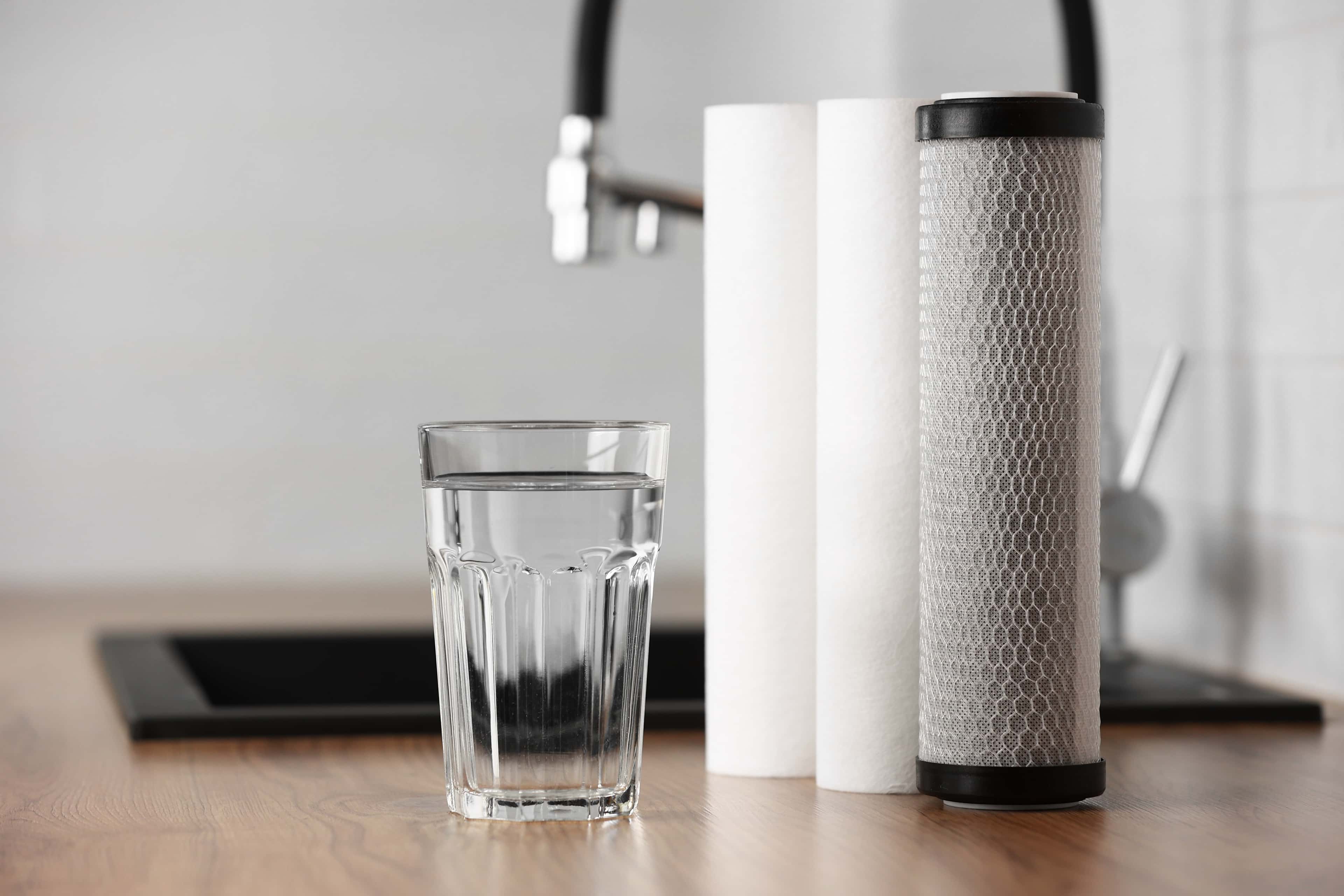


Reverse osmosis is a process that uses pressure to push water through a membrane that blocks many dissolved substances. The system creates two streams: treated water for drinking and a reject stream that carries away what the membrane leaves behind.


A Practical, Canada-Specific Guide to Picking an RO Setup That Matches Your Water, Your Home, and Your Tolerance for Maintenance
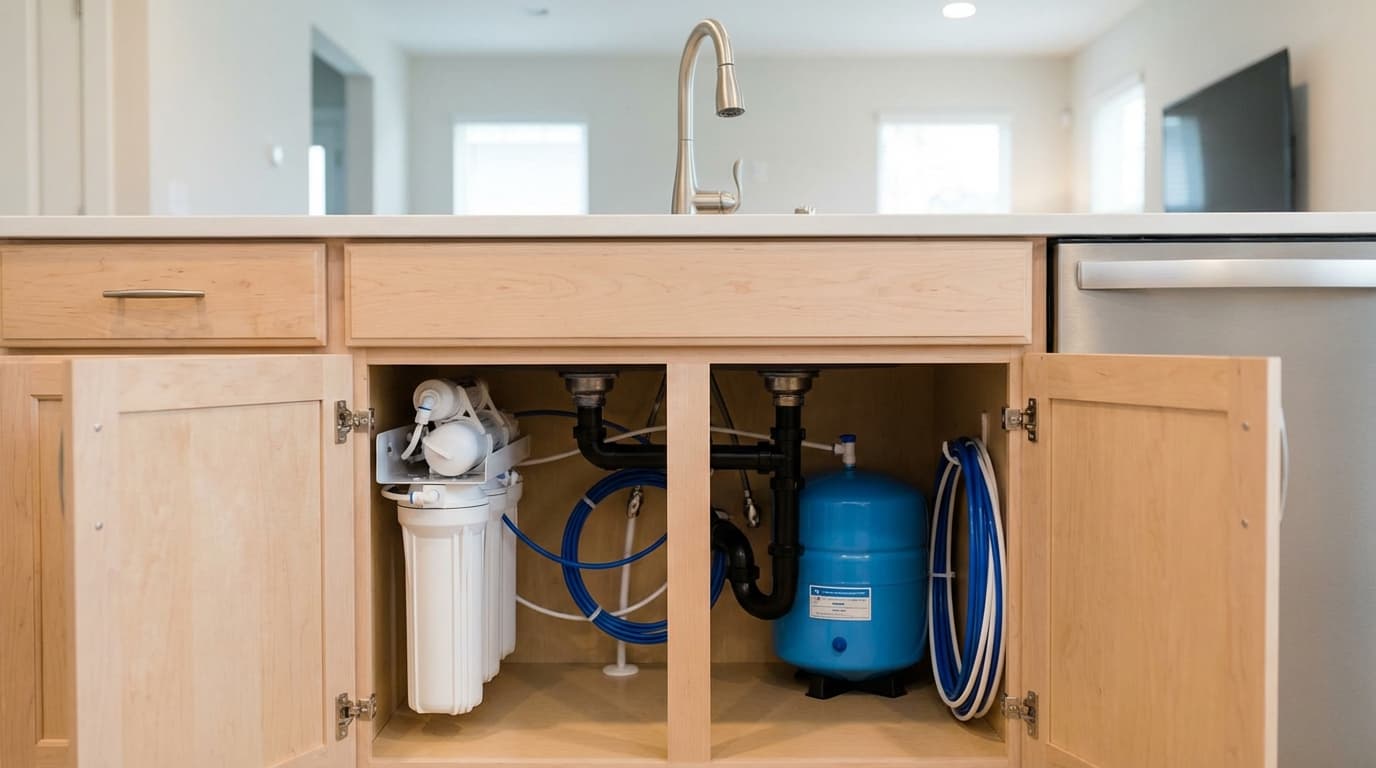
Under-sink reverse osmosis filters turn tap water into consistent purity where maintenance and costs hit home. (Credit: Homeowner.ca)
If you’re researching reverse osmosis water systems in Canada, you’re probably in one of three situations: your tap water tastes “off,” you’re dealing with a specific worry like lead in an older home, or you’re on a well and want more control over what you drink. RO shows up in every one of those conversations because it’s one of the few residential options that can meaningfully reduce dissolved contaminants—not just particles you can trap with a screen-like filter.
At the same time, RO is often marketed as a universal upgrade. That’s where homeowners get burned: buying a system that’s oversized, under-certified, or simply mismatched to the problem. A countertop RO setup won’t solve a whole-home issue, and a whole-home system can be overkill (and expensive) if your only concern is drinking water taste at the kitchen sink.
It also matters where you live and what water you start with. Many Canadians are on municipal water that’s treated and monitored, while others rely on private wells or seasonal properties where water quality can shift over time. Those starting points change what “good” looks like, and they change what you should pay for.
This guide is designed to do two things at once: explain RO in plain language, and give you a practical framework for comparing systems. You’ll learn what RO is great at, what it doesn’t do well, what “stages” actually mean, and how to choose a system that fits Canadian homes—without relying on hype.
Reverse osmosis is easiest to understand as a controlled split: some water becomes your drinking water, and some water carries away what the system rejects. In residential systems, pressure pushes water against a semi-permeable membrane; water molecules pass through more readily than many dissolved substances, and the concentrated remainder is directed away.
In practical homeowner terms, the key idea is that RO is built for dissolved contaminants, not just visible sediment. That’s why people notice a big difference when their water has a “mineral-y” taste, high TDS, or certain dissolved metals that basic filters aren’t designed to reduce. An RO system is also why you’ll see a dedicated drain connection: the system needs a path to flush the rejected concentrate.
A common misconception is that RO “stores” contaminants in the membrane the way a carbon filter holds onto taste and odour compounds. In reality, RO performance depends on a combination of membrane condition, water pressure, prefiltration, and the system’s ability to keep flushing the reject stream. That’s why the plumbing and the filter stages matter just as much as the membrane itself.
When you’re comparing products, it helps to anchor on how residential RO systems are described in NSF International’s guide to home reverse osmosis systems because it frames RO as a multi-component system (not just a membrane cartridge) and sets realistic expectations for what’s happening under your sink.
If your home has low water pressure or your under-sink space is tight, choose your RO format first (tank vs tankless, and system footprint) before you get lost in “stage counts” and marketing labels.
Most residential RO systems sold in Canada are multi-stage units for a reason: the membrane is the expensive, sensitive component, and the other stages exist largely to protect it and improve usability.
A common, practical sequence looks like this:
That last bullet (remineralization) is where many Canadian buyers get stuck, because it sounds like you’re “fixing” a health problem created by RO. In reality, for most people, it’s mainly a taste preference and a way to reduce the “flat” flavour some associate with low-mineral water.
A useful way to compare systems is to stop treating “more stages” as “better” and start asking more specific questions:
Stage count is only meaningful if you know what each stage does. Two systems can both be “five-stage” and still perform very differently depending on membrane quality, filter sizing, and certification.
RO is often described as a “broad” reducer of dissolved substances, but you’ll get the best outcome by being specific about the claim you’re buying. “Improves taste” is vague; “certified for TDS reduction” or “certified for lead reduction” is actionable.
Here’s the homeowner-friendly way to interpret RO performance:
This is where certification standards matter, because they describe what the system must demonstrate to make certain claims. A practical starting point is understanding what’s covered under NSF International’s explanation of NSF/ANSI 58 for reverse osmosis drinking water systems which outlines how RO drinking water systems are evaluated for safety and performance claims such as TDS reduction and contaminant reduction.
What this means for you at the store (or on an online listing) is simple: don’t “assume” RO equals “removes everything.” Treat certification and tested claims as the deciding factor, especially if you’re trying to solve a specific concern.
Your goal isn’t to buy the most aggressive system on paper. It’s to buy the system that is verified to solve your actual problem and that you will maintain on schedule.
If you live on municipal water, the first question isn’t “Which RO system is best?” It’s “What problem am I solving?” Many Canadians add RO because of taste, odour, and peace of mind—especially in condos and older neighbourhoods where plumbing history is uncertain.
The reality check is that, for households receiving municipally supplied water that meets Canadian drinking water guidance, additional treatment is often not necessary for health reasons. That framing is clear in Health Canada’s overview of drinking water treatment devices which emphasizes that treatment devices are typically chosen for specific needs (aesthetic preferences or targeted concerns) rather than as a default requirement for safety.
So when does RO make sense on city water?
When does RO tend to be overkill?
For municipal water, start by deciding whether you need better drinking water at one tap (point-of-use) or whether you truly have a whole-home issue. Most homeowners land on a point-of-use solution.
If you’ve ever noticed that your tap water smells like a swimming pool, you’re noticing disinfectant residual. In some communities, the residual is primarily free chlorine; in others, it may be chloramine (often monochloramine), which behaves differently in distribution systems and can be more stable over distance.
This matters because homeowners often interpret taste and odour as a sign of danger, when it’s frequently an aesthetic issue tied to disinfection practices. A helpful Canadian reference point is Health Canada’s “Water Talk: Chloramines in drinking water” which describes chloramines as a longer-lasting disinfectant residual and notes that taste and odour concerns are typically aesthetic rather than health-related at guideline levels.
From a buying perspective, chloramine vs chlorine usually affects your approach in two ways:
If your main issue is taste and odour, you may not need the most complex RO system available. You need a system that’s certified, correctly sized, and maintainable in your home.
Private wells and non-municipal sources are a different world. Water quality can vary by season, weather, nearby land use, and well condition. The homeowner mistake here is buying equipment first and testing second.
A more reliable approach is: test, identify the actual issues, then select treatment stages that work together. This is especially important when the “problem” isn’t just one thing. For example, you might have iron staining, sulphur odour, and hardness all at once—and RO is not designed to be the first line of defence for every one of those.
It’s also important to separate health concerns from aesthetic frustrations. For instance, the “rotten egg” smell associated with hydrogen sulphide is widely reported in well water, but the smell itself is often treated as an aesthetic problem. Guidance like Health Canada’s Q&A on drinking water treatment devices discusses how some odours are aesthetic and points to treatment approaches that may be more appropriate for iron, manganese, and hydrogen sulphide than relying on RO alone.
A practical well-water framework looks like this:
If you suspect microbial contamination in a well (or you’ve been advised of a boil-water notice), treat that as a health and safety issue first. Don’t treat RO as a substitute for addressing the source problem and following local public health guidance.
A lot of RO confusion comes from mixing up where you’re treating the water. Under-sink RO is typically point-of-use: it treats the water at a single dedicated faucet for drinking and cooking. Whole-home systems are point-of-entry: they treat all water coming into the home, including showers, laundry, and outside taps.
This distinction shows up in Canadian guidance around treatment approaches, including in Health Canada’s technical document on radiological parameters in drinking water where residential treatment devices are discussed in point-of-use and point-of-entry terms and framed around matching the device to the risk and exposure pathway.
For most homeowners, point-of-use RO is the sweet spot because:
Whole-home RO can make sense in narrower scenarios—usually when your incoming water is consistently problematic and you need broad reduction across the house. Even then, whole-home RO often implies extra design decisions (pretreatment, storage, drain handling, and ongoing service) that many homeowners underestimate.
If your “problem” is a single concern at the kitchen tap (taste, TDS, lead risk), a point-of-use RO system is usually the most practical and cost-contained solution.
RO systems are technical products sold in a marketing-heavy category. Certification is your shortcut for separating “looks good online” from “verified to perform.”
In Canada, you’ll see different certification marks and testing bodies on packaging and listings. What matters is that the device is certified to the right performance standard for the claim being made and that the certification body is credible and recognized in the Canadian context.
One of the most useful sources for Canadian buyers is the list of organizations associated with standards and certification in Health Canada’s technical document for the chloramines guideline which discusses recognized certification organizations and provides Canadian context for how treatment devices are evaluated and referenced.
Here’s the practical buying rule:
Health authorities can provide guidance on standards and safe selection, but they don’t “approve” brands. Treat certification as a pass/fail baseline, and then compare systems on fit, maintenance, and cost of ownership.
Lead concerns come up frequently in older Canadian housing stock, especially where service lines, solder, or internal plumbing materials are legacy-era. The key homeowner move is to stop thinking in categories (“RO vs filter”) and start thinking in claims (“certified for lead reduction at the tap”).
Different technologies can reduce lead, but the shopping decision should be anchored to the certification standard tied to lead reduction claims. A clear reference point is NSF International’s overview of NSF/ANSI Standard 53 drinking water filters which describes how drinking water filters can be evaluated for contaminant reduction claims and why “lead reduction” is something that should be verified rather than assumed.
A practical approach for homeowners is:
Don’t rely on “lead-free” marketing language alone. For health-related concerns, a verified certification claim is the safer decision-making anchor.
Most RO disappointment isn’t about water quality—it’s about friction. Filters are hard to access, replacements are confusing or expensive, or the setup doesn’t match how the household actually uses water.
Instead of chasing a “best RO system,” evaluate cost and effort across three buckets:
Upfront and installation fit
Ongoing maintenance reality
Water use and household behaviour
Here’s a high-level comparison to help you match the format to the home:
Before you buy, open the cabinet, measure the usable space, and identify where the drain connection will happen. The “best” system is the one that physically fits and can be serviced without hassle.
If you want a decision process you can repeat (and defend later), use this checklist:
Start with the why
Match the system type to the exposure
Use certification as your baseline
Plan maintenance like a homeowner, not like a brochure
Pressure-test your expectations
The most expensive RO system is the one you stop maintaining. Choose a configuration that makes upkeep straightforward and predictable.
Reverse osmosis is a process that uses pressure to push water through a membrane that blocks many dissolved substances. The system creates two streams: treated water for drinking and a reject stream that carries away what the membrane leaves behind.
RO is commonly used to reduce total dissolved solids (TDS) and can reduce many dissolved inorganic contaminants. The exact contaminants reduced depend on the system’s certification and performance claims, as well as proper maintenance.
It refers to a certification standard that applies to reverse osmosis drinking water treatment systems. In homeowner terms, it’s a way to verify that a system has been evaluated for safety and for specific performance claims rather than relying on marketing language.
NSF/ANSI 58 is associated with reverse osmosis drinking water systems, while NSF/ANSI 53 is associated with certain contaminant reduction claims for drinking water filters. If you’re buying for a specific concern (like lead), the standard tied to that claim matters.
For most Canadians, mineral removal is not considered a health issue because drinking water is typically a minor source of minerals compared with food. Some people prefer a remineralization stage for taste, but it’s usually not required for health.
Most people who eat a reasonably balanced diet do not need mineral supplements just because they use RO. If you have a medical condition or dietary restriction, it’s reasonable to confirm with your clinician, but supplements are not a default requirement.
Usually, no. Many households on municipal water add RO for taste, odour, or targeted concerns at a specific tap. If your water meets applicable guidelines, RO is often an optional upgrade rather than a safety necessity.
Often, yes—especially when the system includes carbon prefiltration and a carbon postfilter. The exact improvement depends on your starting water and the filter design, but taste and odour are common reasons people install point-of-use treatment.
Not reliably on its own. Sulphur odour is usually better addressed with targeted treatment at the point-of-entry, and then RO can be used as a final drinking-water step if needed. Treat the odour and staining problems upstream before relying on RO.
If your concern is drinking and cooking water, point-of-use RO is usually the most practical option. Whole-home systems are more complex and are generally reserved for situations where the incoming water problem affects the entire home and requires broad treatment.
Yes. Testing tells you what you’re actually dealing with and helps you avoid buying the wrong system. It also helps you decide whether you need pretreatment (sediment, iron, odour control) before RO.
Buying based on stage count or price without confirming the issue they’re solving and without prioritizing certification. The second biggest mistake is underestimating maintenance and choosing a system that’s hard to service.