Not always. If your daily driving is modest and the vehicle sits plugged in for long stretches, Level 1 may keep up. Level 2 becomes more valuable when you need consistent overnight recovery or faster turnaround.


A Canadian Homeowner’s Guide To Choosing The Right Setup For Your Home, Panel, And Parking Space
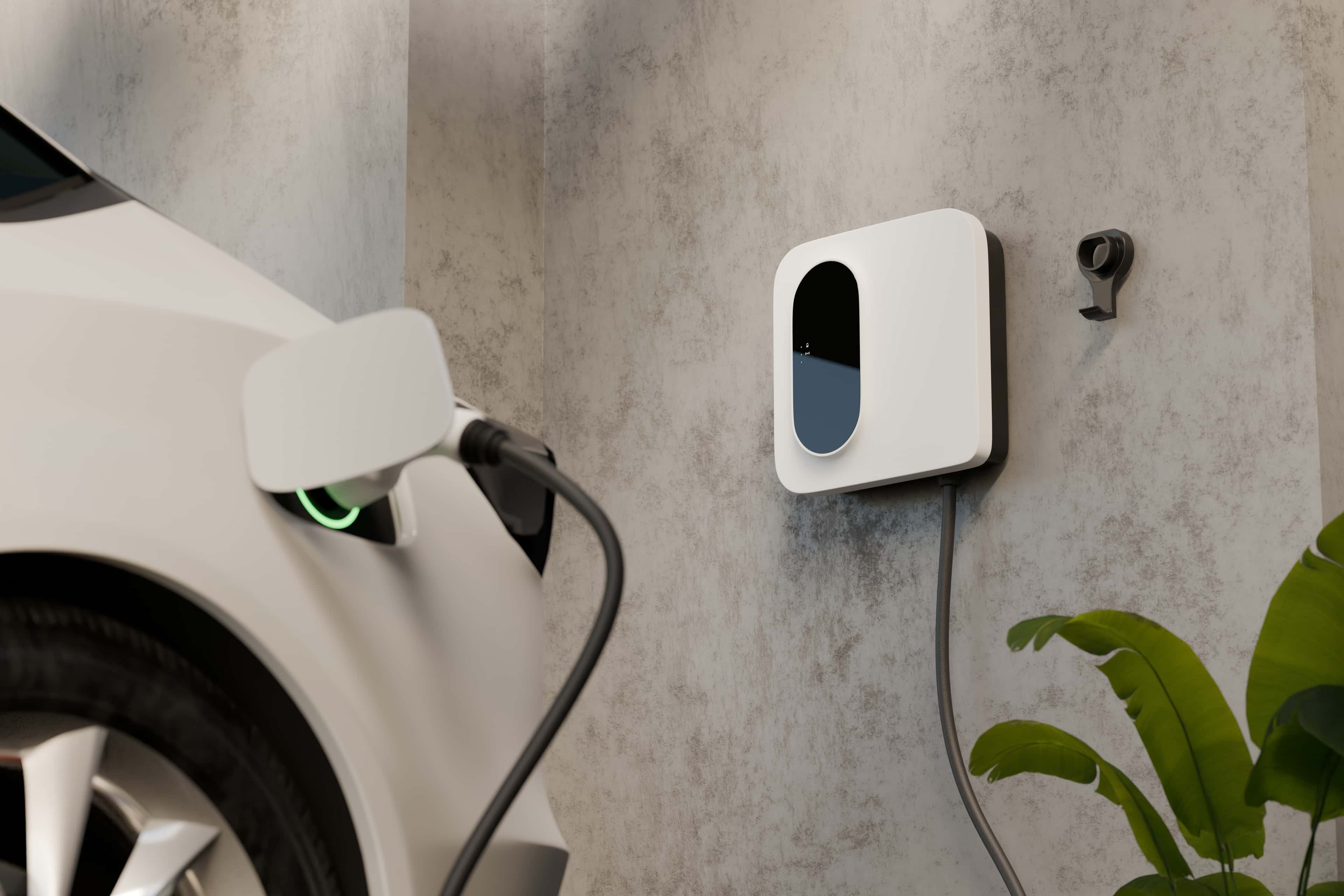
Modern wall-mounted EV charger turns panel capacity and permits into everyday, code-compliant charging at home. (Credit: Homeowner.ca)
Home EV charging is easy to picture but harder to scope. On the surface, it looks like a simple product purchase: pick a charger, mount it on the wall, plug in the car. In practice, it is a home-infrastructure decision. Your best option depends on how far you drive, how long the vehicle sits at home, where you park, how much spare electrical capacity your home has, and whether you are planning for one EV or two.
Because Natural Resources Canada reports that more than 80 per cent of EV owners charge at home, the home setup is usually the part that shapes day-to-day convenience most. When it is well matched to your life, charging fades into the background. When it is mismatched, everything starts to feel more complicated than it needs to be.
The confusing part is the language. Homeowners say “charger.” Electricians talk about EVSE, branch circuits, continuous load, permits, and load calculations. Product pages talk about amps, kW, connectors, outdoor ratings, and smart features. Those are not separate conversations. They are different ways of describing the same decision from the homeowner side, the electrical side, and the buying side.
This guide brings those pieces together in plain language. You will see what EVSE actually is, what changes when you move from Level 1 to Level 2, why panel capacity and continuous-load rules matter in Canadian homes, how to compare Level 2 options without getting lost in specs, and what the installation process usually looks like for detached homes and for condos or strata buildings. It is not a DIY wiring manual, and it does not replace a licensed electrician’s assessment. It is the planning framework that helps you ask better questions before you buy.
What most homeowners call the charger is, more precisely, electric vehicle supply equipment in Toronto’s Green Standard guidance: the cables, connectors, protective hardware, and controls that sit between your home’s branch circuit and the vehicle. That distinction matters because the wall unit is not doing all the work by itself. The vehicle also has an onboard charger that determines how much AC power it can actually accept.
For a homeowner, the most useful mental model is this: EVSE is the safe delivery system, and the car decides how much of that delivery it can use. If your EVSE can provide more power than the car can accept, the car becomes the limit. If the car can accept more than the EVSE can provide, the EVSE becomes the limit. That is why buying the biggest available home unit does not automatically make charging meaningfully better.
Amps and kilowatts are where many shoppers get stuck. Amps tell you about current. Voltage tells you the type of circuit. Kilowatts tell you the rate of energy transfer, which is the closest shorthand for “how fast this feels in real life.” A higher-amp Level 2 unit on a compatible 240-volt circuit can usually deliver more kW than a Level 1 cord on a 120-volt outlet. But the useful question is not “What is the biggest number?” It is “How much charging do I need to recover overnight?”
Bigger numbers do not automatically mean a better setup. The best home EV charging system is the one that matches your vehicle, commute, parking space, and available electrical capacity.
In day-to-day terms, Hydro Ottawa’s homeowner guidance puts Level 1 at roughly 8 kilometres of range per hour and basic Level 2 at about 30 to 40 kilometres per hour, which is why one feels like a slow refill and the other feels like true overnight recovery. The exact result depends on the vehicle, battery condition, temperature, and how much power the car can accept, but the homeowner takeaway is straightforward: Level 1 works in smaller daily increments, while Level 2 handles a much larger nightly reset.
That does not mean Level 1 is “bad.” It can be completely workable for plug-in hybrids, lower-kilometre drivers, households with long parking windows, or buyers who want to start with what they already have before committing to electrical work. If your vehicle is parked for 12 or more hours each night and you only need to recover a modest amount of driving, Level 1 may keep up just fine.
Level 2 becomes compelling when your routine leaves less margin. Full battery-electric vehicles, longer commutes, same-day turnaround, cold-weather range loss, and time-of-use pricing all push homeowners toward faster charging. Level 2 does not just refill faster; it also gives you flexibility. You can charge later at night, recover from a busy driving day, and still wake up ready for the next one.
A practical way to think about it is recovery, not peak speed. If your daily driving is easy to replace during the hours the car is parked, Level 1 can be enough. If you regularly need to recover a larger share of the battery overnight, or want the freedom to charge during lower-rate hours only, Level 2 is usually the better fit.
Work backwards from your daily routine. Estimate how many kilometres you typically need to recover overnight, then ask whether your parked hours at home make Level 1 realistic or make Level 2 the stress-free choice.
Home EV charging is not judged only by the EVSE you want to buy. It is judged by what the whole house can support. Because BC Hydro’s guidance on overloaded residential services explains that homes at 225 amps or less are limited to 80 per cent continuous load, a 200-amp service is not the same thing as 200 amps of always-available room for EV charging. Electricians look at the entire system: service size, main panel, existing large loads, distance to the parking area, and how likely several high-demand appliances are to run at the same time.
This is why EV chargers are commonly put on dedicated circuits. Charging can run for hours, so it is treated as a sustained demand rather than a brief appliance spike. The breaker, conductor size, receptacle or hardwired connection, and EVSE settings all need to line up. That is also why the amperage shown on a product page is only part of the story. What matters is whether your home can support that output safely and economically.
The good news is that “I want Level 2” does not automatically mean “I need a service upgrade.” Sometimes the answer is a lower-amp EVSE. Sometimes it is scheduling. Sometimes it is an approved load-management approach that reduces or pauses charging when the rest of the house is busy. Sometimes it is a future-ready circuit installed now with the EVSE set lower today. A service upgrade is one path, not the default path.
Do not read the number on your main breaker as spare EV charging capacity. Capacity is about the whole home’s sustained usage pattern, not a single label inside the panel.
As BC Hydro’s buyer guide notes, home EVSE comes in different connector types, cord lengths, mounting styles, amperage classes, and networked options, the right unit is usually the one that fits your site and your habits, not the one with the most aggressive marketing headline. A smart buying process starts with the parking space and the panel, then moves outward to features.
Start with installation style. Hardwired units are often the cleaner long-term choice for permanent installations, especially outdoors or at higher output. Plug-in units can be attractive when you want easier replacement or when a properly installed dedicated receptacle already makes sense. The important point is that plug-in does not mean informal. The circuit, receptacle, breaker, and EVSE rating still need to match.
Then look at usable power. A modest Level 2 unit that comfortably handles your overnight recovery can be a better purchase than a high-output model you cannot use at full speed. Also remember that the vehicle may cap the actual charging rate. Buying beyond the car’s acceptance limit may only matter if you expect to change vehicles later.
Weather and layout are next. Canadian homeowners should think hard about whether the EVSE will live in a garage, under a carport, or fully exposed on an outside wall. Cable management matters in winter. So does the operating temperature range, the stiffness of the cable in the cold, and whether the holster or connector dock keeps snow and grime out. A cord that is too short is annoying every single day, while a cord that is far too long can become messy and awkward.
Smart features are useful when they solve a real problem. Scheduling can help with time-of-use rates. Usage tracking helps if you need household cost visibility or reimbursement. App control can be worthwhile in shared-driveway or multi-driver households. Dual-connector or load-sharing features matter if a second EV is realistic in the next few years.
The best shortlist is usually short. Narrow it down to a few models that suit your electrical reality, climate exposure, connector needs, and control preferences. Then compare warranty terms, support, and installer familiarity rather than getting hypnotized by the highest amp rating.
Avoid uncertified marketplace imports, mismatched adapters, or “temporary” setups intended to bypass proper installation. Home EV charging should feel ordinary and repeatable, not improvised.
In Ontario, the Electrical Safety Authority says every home EV charger installation needs a permit before work begins and that homeowners must hire a Licensed Electrical Contractor, which is a useful example of how serious the administrative side of the project is. Across Canada, the exact authority and process vary, but the pattern is similar: capacity assessment, equipment selection, permit, installation, inspection, and final records.
The homeowner’s job starts before the first quote. Good information shortens the back-and-forth and helps electricians give more accurate advice. You do not need to diagnose your panel. You do need to document the site clearly and explain how you want to use the charger.
From there, the process usually follows a predictable flow:
Detached homes and condos diverge mainly because of who has to say yes.
If you live in a condo or strata building, resist the urge to buy the charger first and figure out approval later. In multi-unit buildings, the real project is often about permissions, electrical capacity, metering, and rules before it is about the EVSE itself.
Keep every document: quote, permit number, model details, inspection paperwork, and any certificate or acceptance record issued after completion. Those records matter for warranty support, future troubleshooting, insurance questions, and resale.
For condo and strata projects, BC Hydro’s multi-unit charging guide puts the sequence in a useful order: sort out cost-sharing and billing, confirm electrical capacity, then move into charger selection and permits, which is also a good reminder for homeowners in any housing type: solve the site and infrastructure questions first. The best path depends less on what the catalogue says and more on what your household is trying to accomplish.
The smartest homeowner move is usually not “buy the biggest.” It is “buy the setup that removes friction.” That might be a smaller Level 2 unit with strong scheduling. It might be a hardwired outdoor installation with a better cable and holster. It might be a two-car-capable system because you know your household is heading that way. Or it might be doing nothing for now because Level 1 already covers your real usage.
A good next step is to build a very short shortlist and request quotes that answer the same questions in the same order: capacity, install method, circuit size, permit process, inspection, and recommended EVSE features. That gives you comparable proposals instead of sales pitches that talk past each other.
If the first answer you get is “You need a service upgrade,” it is reasonable to ask whether a lower-amp EVSE, scheduling changes, or approved load-management options were considered first.
Not always. If your daily driving is modest and the vehicle sits plugged in for long stretches, Level 1 may keep up. Level 2 becomes more valuable when you need consistent overnight recovery or faster turnaround.
In everyday speech, yes. Technically, the wall unit is EVSE, while the vehicle contains the onboard charger that determines how much AC power it can accept.
Kilowatts are the better shorthand for real-world charging pace, but they are shaped by both voltage and current. For buying decisions, think about overnight recovery first and spec-sheet numbers second.
No. A higher-output unit is only better if your home can support it and your vehicle can use it. Many households are perfectly well served by a lower-output Level 2 setup.
No. Service size is only one piece of the calculation. Existing loads, panel configuration, and how the house is used all affect whether EV charging fits comfortably.
Often, yes. Some homes can add EV charging with a properly sized circuit, a reduced EVSE setting, or an approved load-management solution instead of a full service upgrade.
Hardwired is often the stronger long-term choice for permanent and outdoor installs, especially at higher outputs. Plug-in can be attractive when you value easier replacement and have the right dedicated receptacle installed properly.
Yes, if the EVSE is rated for the environment and installed appropriately. Pay close attention to outdoor suitability, cable handling in the cold, and whether the connector storage is practical in snow and ice.
Long enough to reach the charge port from your normal parking position without stretching across walkways or forcing awkward parking. Measure your space before you buy instead of trusting product photos.
They are worth it when they solve a real problem, such as scheduling around time-of-use rates, tracking electricity use, or managing access in a shared household. If you will never use those features, a simpler unit may be the better buy.
Yes, in some cases. You can manage two EVs with shared scheduling, a dual-port unit, or a load-sharing setup designed for that purpose. It is best to plan for this before the second EV arrives.
In many jurisdictions, yes. The exact process varies by province and municipality, but homeowners should expect formal electrical work, inspection requirements, and licensed-contractor involvement rather than an informal install.
Keep quotes, permit details, inspection records, model information, and any completion or acceptance documents. They are useful for warranty support, insurance questions, future upgrades, and resale.
Because the project involves shared infrastructure, shared decision-making, and often shared billing questions. In a detached home, the decision is mostly yours; in a multi-unit building, several stakeholders may need to agree before work starts.
Do not assume an adapter makes a setup safe or compliant. The receptacle type, circuit size, breaker, EVSE rating, and installation method all need to match properly.
Buy for realistic future flexibility, not theoretical maximums. It is smart to leave room for a future vehicle or a second EV, but only within the limits of your home’s actual electrical capacity.
It can. Charging equipment spends a lot of time waiting rather than actively charging, so standby efficiency, along with safety certification and practical reliability, is worth considering when comparing otherwise similar models.