What Condo Owners and Pre-Construction Buyers Need to Know About Closing-Day Valuations
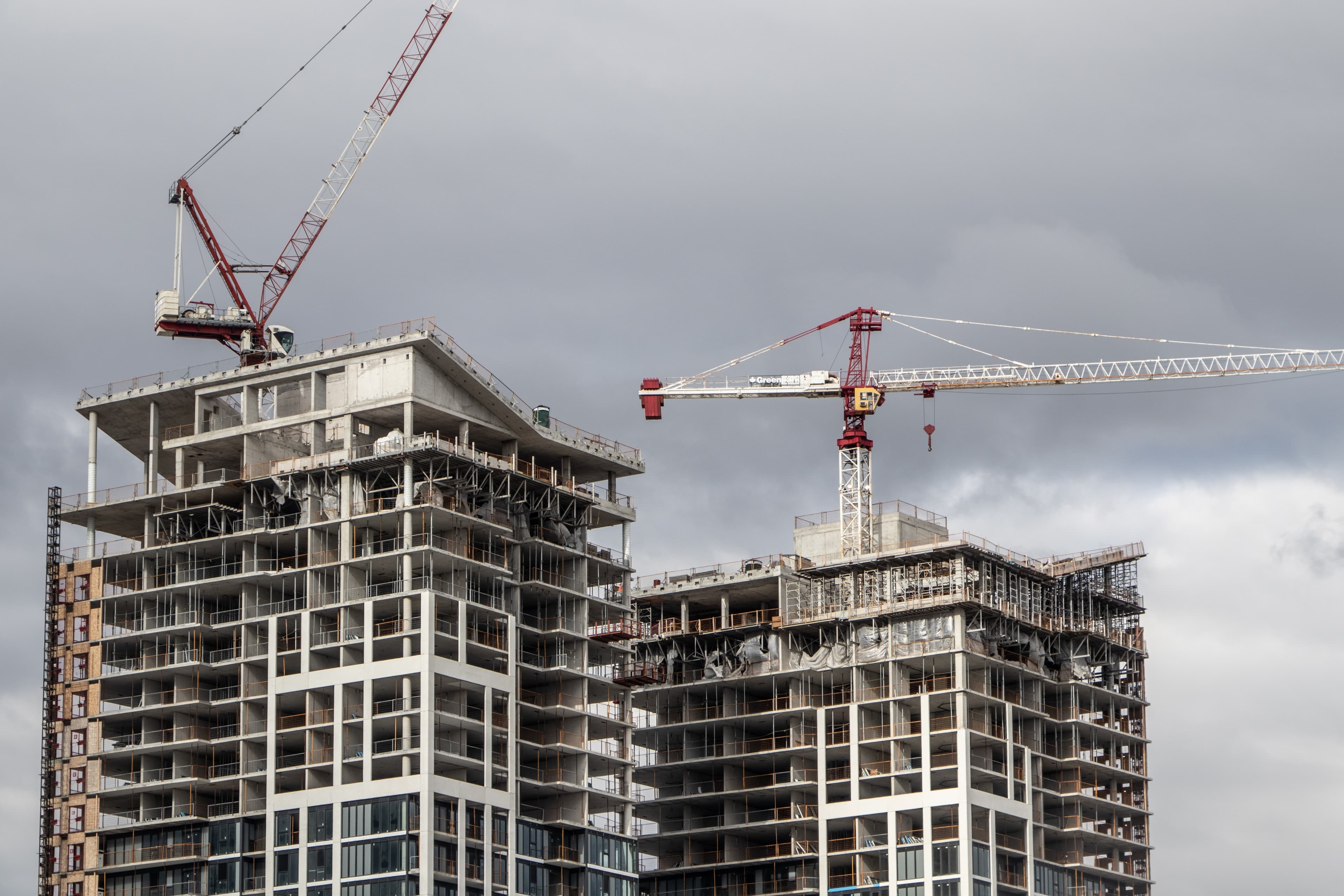
Modern condominium construction highlights urban development trends. The visible cranes and structures indicate progress in building high-rise residential spaces. (Credit: Shutterstock)
In a Reuters exclusive dated March 9, 2026, meeting minutes showed Canada’s banking regulator—the Office of the Superintendent of Financial Institutions (OSFI)—warned major banks in October 2025 that “blanket” condo appraisals could put lenders offside federal loan-to-value rules when pre-construction buyers actually close. That matters now because condo prices have been sliding, and the gap between a contract signed years ago and today’s market value is where financing can suddenly break down.
This isn’t just a technical banking-policy story. For buyers nearing a pre-construction closing, an appraisal that comes in low can translate into a straightforward—but stressful—problem: the lender may not be able to advance as much money as you expected, even if you were “approved” earlier. For existing condo owners, the same downshift in valuations can quietly reduce equity and change how much you can borrow against your home, particularly through a home equity line of credit (HELOC) or refinancing.
What follows is a plain-language explainer of (1) what “blanket appraisals” are in the pre-construction context, (2) how the federal 80% loan-to-value (LTV) constraint becomes binding when prices fall, and (3) the practical implications for condo owners—without making predictions about where prices go next or telling you what you “should” do.
A “blanket appraisal” is essentially a one-to-many valuation approach. Instead of appraising each condo unit right at closing—when the mortgage is actually being advanced—the lender relies on an appraisal done earlier for a batch of units in the same project, often around the time presales are happening or financing programs are being set up.
OSFI’s concern is not that a blanket appraisal exists at all, but that the timing can be mismatched to the moment the loan is originated. In OSFI’s backgrounder on blanket appraisals and appraisal timing, the regulator flags the basic problem: a significant time gap between a pre-construction appraisal and the eventual mortgage origination can leave the value stale, and stale values can cause an uninsured mortgage to exceed the legal LTV limit at origination.
In a rising market, blanket appraisals tend to feel “fine” because time often works in everyone’s favour: the unit that was worth X at presale may be worth X+ later, so the LTV math stays comfortably within limits. In a falling market, the same practice can create a hidden risk: the bank may be underwriting to an old value while the real market value at closing is lower, making the LTV higher than intended.
“Pre-construction” is the key context here. For resale condos (already built and transacting today), lenders typically base decisions on more current valuations tied to the live market and the actual closing timeline.
One detail that’s easy to miss: OSFI has characterized this as a concentrated issue rather than a dominant share of the mortgage market. That nuance matters for readers because it explains why the story is sharp for certain buyers (pre-construction closings) even if it isn’t a universal mortgage-market shift for everyone at once.
Loan-to-value (LTV) is the ratio of the mortgage amount to the property’s value. If a property is worth $500,000 and the mortgage is $400,000, the LTV is 80%. If the same mortgage sits on a property now worth $450,000, the LTV becomes about 89%—without the borrower doing anything different.
The regulatory pressure point is that federally regulated lenders are generally restricted from advancing more than 80% of a property’s value unless the mortgage is insured. OSFI lays out this boundary in its mortgage insurance guidance, which ties the 80% line to legislative requirements that apply to federally regulated financial institutions.
For a condo buyer, the practical takeaway is simple: if the deal requires an uninsured mortgage (often the default expectation once you have a large down payment), the lender’s maximum loan amount is capped by the appraised value at the time the loan is actually being advanced, not by what the condo cost you on paper two or three years earlier.
Here’s what that looks like mechanically:
That “extra” $80,000 isn’t a penalty, and it isn’t OSFI levying a new charge. It’s just math: when the appraisal value falls, the bank’s maximum uninsured loan amount falls with it, and the difference has to be filled in somehow for the transaction to close.
Two clarifications keep this grounded:
The reason this issue is surfacing now is timing. Many pre-construction condos were sold during 2018–2022, then took years to complete. That long runway creates room for values—and lending conditions—to change between signing and closing.
OSFI’s warning also intersects with how pre-construction mortgage programs have been marketed. According to the same Reuters report, OSFI highlighted consumer-facing language suggesting buyers would remain approved through closing under programs associated with blanket appraisals, and the article notes that Royal Bank of Canada later changed its pre-construction mortgage messaging after a follow-up.
For buyers, the practical implications tend to cluster in three places.
Appraisal timing becomes the make-or-break moment.
If the lender requires a fresh appraisal near closing (or uses an updated valuation approach), the closing-day value—rather than an old project-level number—can become the binding input to the 80% LTV calculation. That can reveal a funding gap very late in the process, even if everything looked clean when the purchase agreement was signed.
“Approved” may still be conditional in ways people don’t notice.
Pre-approvals and program approvals often assume certain facts remain true: income continuity, credit profile, the property meeting lending criteria, and the valuation supporting the intended LTV. In a falling condo market, valuation is the condition that can change without the borrower’s personal finances changing at all.
The shortfall problem can be bigger than people expect because it stacks.
When appraisals come in low, the buyer may face:
A low appraisal is not the same thing as a lender “declining you.” It’s often the lender saying, “We can still lend—but only up to the amount the rules and valuation support.” The difference matters because the remedy is typically about structure and funding, not about your creditworthiness.
None of this guarantees a tougher closing for every buyer. But it explains why OSFI cares about appraisal practices now: when the market is soft, outdated valuations can mask LTV risk until the exact moment the bank has to fund the loan.
If you already own your condo and you’re not moving, it can be tempting to treat price declines as “paper losses.” In day-to-day life, that may be emotionally true—until you try to borrow against the property, renew under different conditions, or restructure your debt.
From a lender’s perspective, your condo’s current value is not just a headline number; it’s collateral. If collateral values fall, the amount a bank is comfortable authorizing against that collateral can change, particularly for revolving credit products.
OSFI’s Guideline B-20 on residential mortgage underwriting sets out expectations that include limiting the HELOC (non-amortizing) component to a maximum authorized LTV and reviewing credit limits where there’s a material decline in property value. For owners, that expectation helps explain why a HELOC limit can be reduced—or not increased—when valuations drop, even if income and payment history look stable.
This tends to show up in a few real-world moments:
When you try to increase or set up a HELOC.
If you’re applying for new equity-based credit, the lender may order a valuation and base your borrowing room on today’s number, not your purchase price and not your neighbour’s sale from two years ago.
When you refinance or re-advance equity.
Refinancing generally requires the lender to re-run LTV and underwriting. In a declining market, owners sometimes discover they have less tappable equity than expected, which can constrain debt consolidation or renovation plans that depend on extracting equity.
When you renew and want to change lenders or restructure.
A straight renewal with the same lender can be simpler than switching—partly because switching often triggers fresh underwriting and valuation. That doesn’t mean switching is “bad” or “good”; it just means the path can be more valuation-sensitive than many owners assume.
The key point is not that lenders will automatically take action on every condo file, but that LTV-linked products (HELOCs in particular) are designed to respond to collateral values. In a condo-heavy market with falling prices, that sensitivity becomes more visible.
OSFI’s lens is system stability. Condos can become a concentrated risk when a lot of similar units in the same city core are exposed to the same forces at the same time: investor pullback, rising carrying costs, completion backlogs, and resale competition from other near-identical units.
In its semi-annual update to the Annual Risk Outlook for fiscal year 2025–2026, OSFI notes the condo segment as an area of weakness—particularly new multi-unit supply where prices can be pressured as completions rise. That framing matters because it ties the appraisal discussion to a broader supervisory concern: when a segment is weakening, valuation discipline becomes more important, not less.
From a homeowner’s perspective, this “concentration” concept explains two things that can otherwise feel confusing:
This is also why “blanket appraisals” sit in regulators’ crosshairs: when many units share a valuation approach, the risk can be correlated. If the valuation approach is stale, the mismeasurement can be correlated too—surfacing not as one-off exceptions, but as a cluster of closings where the LTV doesn’t align with the rule.
OSFI’s warning doesn’t mean every condo buyer is about to face a failed closing, and it doesn’t mean every bank is suddenly rewriting the rules. It does, however, spotlight a specific fault line that matters in a down market: if a lender relies on an outdated valuation method for a pre-construction condo, the closing-day LTV can land in a place the bank is not allowed to fund on an uninsured basis.
For buyers nearing closing, the headline takeaway is that valuation timing is not a formality—it’s a gating item that can create a very real funding gap if the appraisal is lower than the contract price. For existing owners, the quieter takeaway is that falling values can reduce equity-based flexibility, especially for HELOCs and refinancing, even if your mortgage payments are perfectly manageable.
If there’s a single through-line, it’s this: in condos, where many units move together and prices can reset quickly, appraisal practices are not just paperwork. They’re the bridge between what you agreed to pay and what the financial system is permitted to lend.