

A Plain-Language Read of the Latest National MLS Metrics—and Why Home Equity Is the Real Story
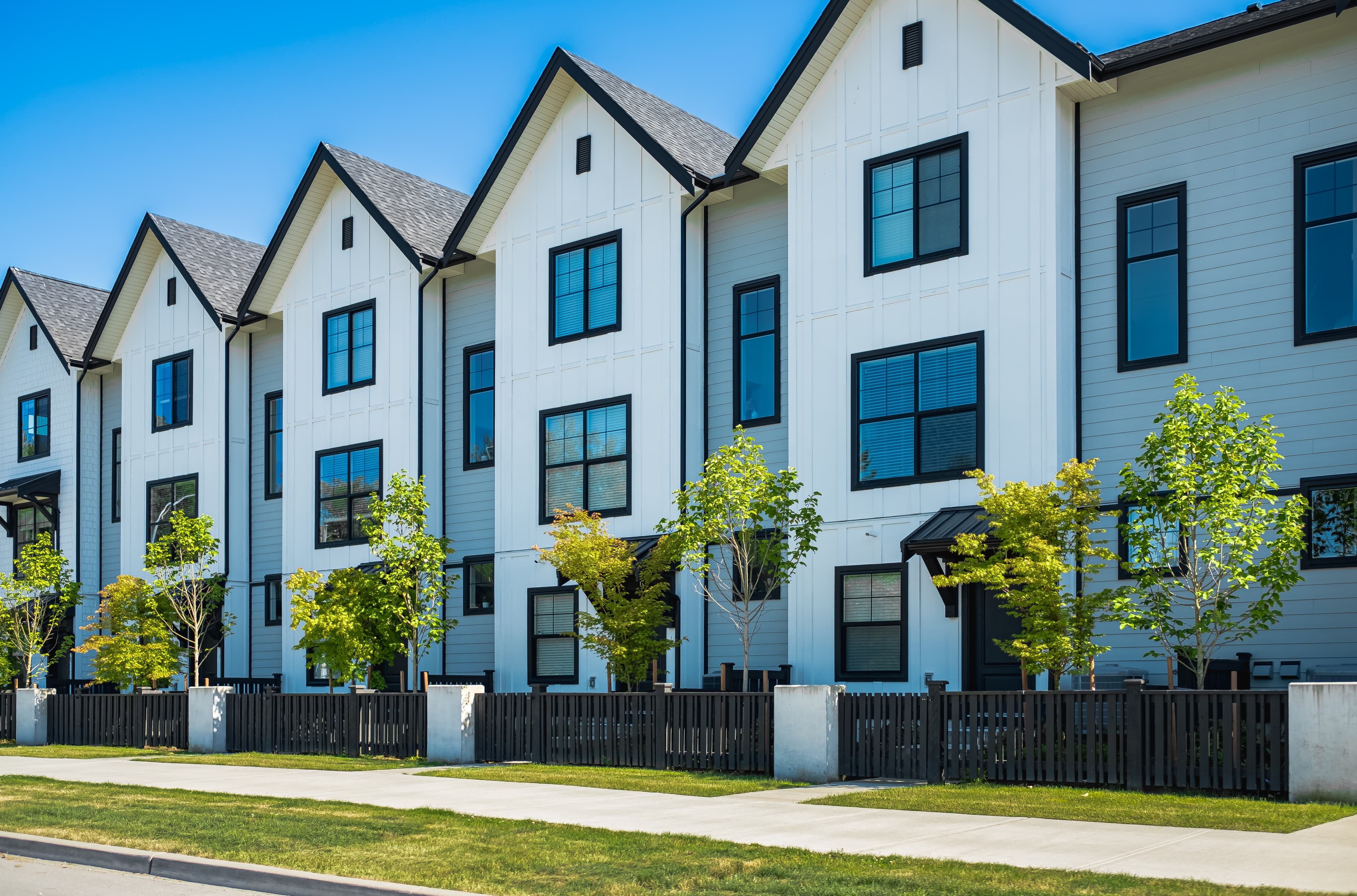
Contemporary townhouses showcase a vibrant residential setting, illustrating trends in national home sales data. (Credit: Shutterstock)
Canada’s newest national housing snapshot is in—and it’s more “quiet market reality check” than “spring market momentum.” In its March 17, 2026 update, CREA’s February 2026 national statistics release reported 30,244 homes sold nationally, with sales down 8.1% year-over-year and down 1.3% month-over-month on a seasonally adjusted basis; the national average sale price was $663,828 (−0.2% year-over-year), while the MLS HPI fell 4.8% year-over-year and 0.6% month-over-month.
For homeowners, the most useful part of that bundle isn’t the sales slump on its own—it’s the HPI move. Sales volumes tell you how busy the market was; the HPI is closer to a “what a typical home is worth” benchmark. When that benchmark is down year-over-year, it can quietly reshape how much equity you appear to have on paper, which can matter during renewals, refinancing discussions, and any borrowing that leans on your home’s value.
This article stays tightly focused on what changed nationally in February 2026, how to read the key indicators (without jargon), and what the HPI decline can mean in practical homeowner terms—without making predictions or telling anyone to buy, sell, or borrow.
A clean way to digest February’s release is to separate activity (how many transactions happened) from market balance (whether supply and demand are pushing negotiations one way or the other). Here’s the national picture in one place:
Two quick definitions help this make sense:
And on “seasonally adjusted”: it’s a statistical method that tries to remove predictable calendar effects (like winter slowdowns and spring surges) so month-to-month comparisons are more meaningful. It doesn’t change the underlying reality that real buyers and sellers still behave seasonally—it just makes the trend easier to see.
So what’s the February pattern?
That “middle-of-the-road” balance is a key context point for homeowners: it suggests the benchmark price decline is happening in a market that’s relatively normal in structure. In other words, this isn’t a single-metric story where inventory is exploding or buyers have completely vanished nationally. It’s more like a market where participants are cautious, and pricing is adjusting accordingly.
National housing numbers are a temperature check, not a thermostat. A balanced national read can still include very different local realities—so it’s best to treat these figures as context for “where Canada is,” not a precise valuation tool for one neighbourhood.
It’s easy to look at February’s near-flat national average price and conclude, “Prices are basically steady.” But the average price can stay calm even while underlying benchmark values soften—because the average is heavily influenced by which homes sold (type, location, and price tier), not just what a typical home might be worth.
That’s the practical value of the MLS HPI in a month like this: it’s designed to track price changes for a benchmark home in a way that reduces “mix” effects. When the HPI is down 4.8% year-over-year, that’s a cleaner signal that the benchmark level of home values is lower than it was a year ago, even if the average sale price doesn’t look dramatic.
Home equity is essentially:
When benchmark values fall, equity can shrink even if your mortgage balance hasn’t changed much—simply because the “value” side of the equation is smaller.
To make the idea concrete, consider the scale of a 4.8% year-over-year benchmark move:
That’s not a prediction for any specific home, and it’s not a statement that every property is down 4.8%. It’s just the arithmetic of what a national benchmark shift can imply when lenders, appraisers, and renewal conversations are anchored to current valuations.
Many lending decisions that involve your home—whether it’s a refinance, adding a secured credit product, or restructuring debt—depend on two practical inputs:
So, even if your day-to-day budget hasn’t changed, a softer benchmark environment can reduce the headroom you expected to have—especially if you were planning around a “my home has probably gone up since I bought” assumption.
This is where February’s HPI story becomes more homeowner-relevant than the sales story. Sales volumes mainly affect participants who are trying to transact right now. Benchmark pricing affects anyone whose future options depend on equity math.
The February release also lands in a rate environment where policy settings have been held steady rather than moving lower aggressively. In its recap of the late-January decision, CREA’s summary of the Bank of Canada holding the policy rate at 2.25% framed the moment clearly: the rate hold was widely expected, and the broader question was whether rate relief to date would be enough to pull buyers back in.
So far, February’s numbers suggest: not meaningfully—not at the national level.
If you only remember one “so what?” for 2026, it’s this: a lot of households are going to be forced to have a mortgage conversation, whether they want one or not. In the Bank of Canada’s staff analytical note on mortgage renewals the Bank estimates roughly 60% of outstanding mortgages renew in 2025 or 2026, and it flags that typical five-year fixed borrowers renewing in those years could see average payment increases of about 15%–20% versus their December 2024 payments.
That renewal pressure is exactly why the HPI decline is not just an abstract market chart:
None of that means homeowners are “stuck” or that outcomes are uniform. It does mean February’s benchmark trend is a relevant piece of context as households head into renewal decisions in a high-sensitivity period.
The MLS HPI is a national benchmark tool, not an appraisal. Lenders typically rely on their own valuation approach for borrowing decisions, and your property’s value can move differently than the national index—sometimes materially—based on location, property type, condition, and recent comparable sales.
February 2026 didn’t deliver a dramatic national pivot in sales activity, and it didn’t show a runaway supply build either. Instead, it delivered a more subtle—but more homeowner-relevant—message: benchmark values, as captured by the national MLS HPI, are meaningfully lower than a year ago even while the national average sale price looks almost unchanged.
In a market that still looks broadly balanced on supply-and-demand indicators, that benchmark decline is best understood as a “what your home may be worth in today’s environment” signal—one that can ripple into equity-dependent options like refinancing flexibility and secured borrowing room. With a large share of Canadian mortgages renewing across 2025–2026, that kind of valuation context is less about timing the market and more about reducing surprises when renewal conversations arrive.
