

How To Read The Latest Starts Data Through A Homeowner Lens
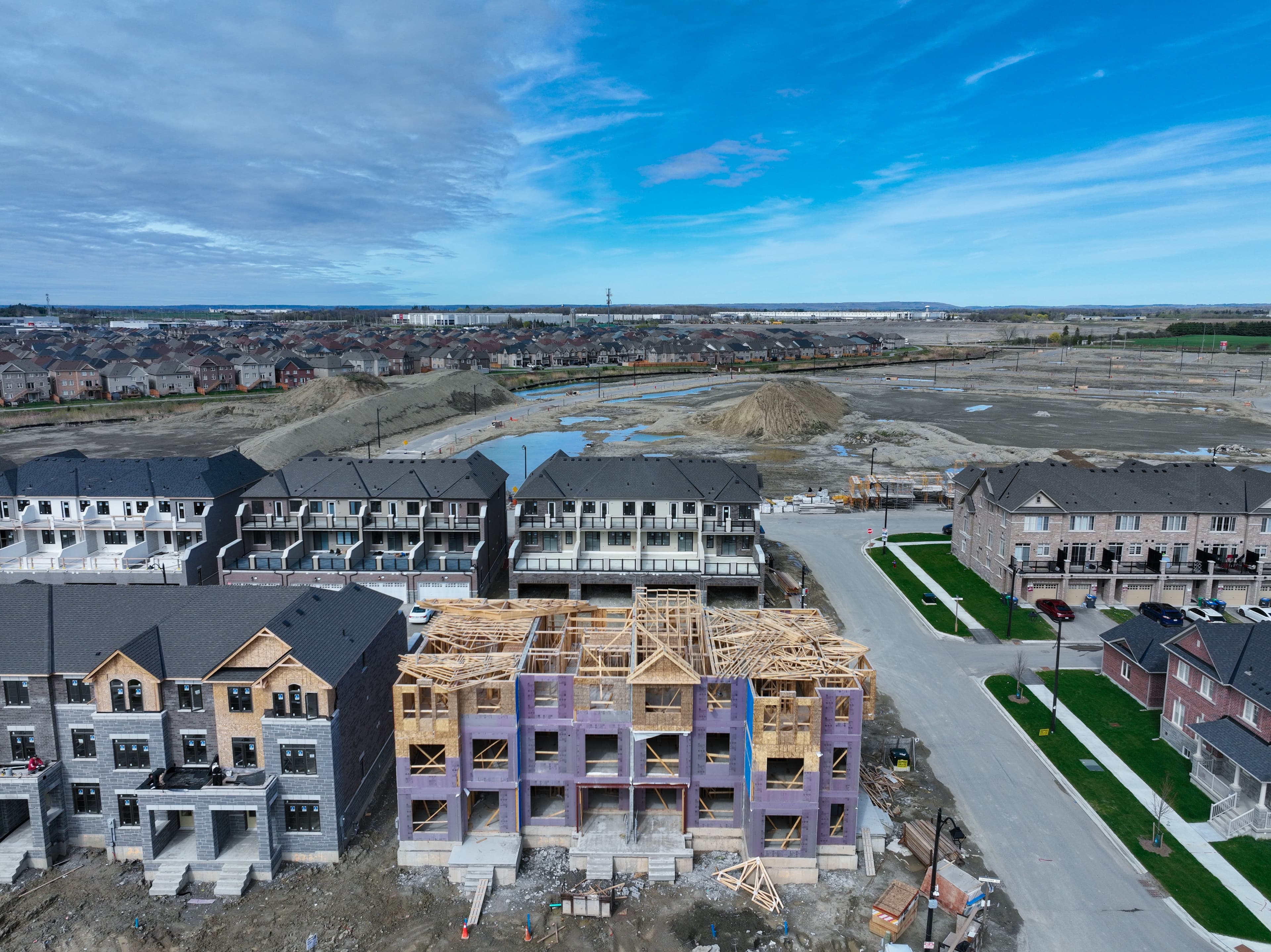
An aerial perspective of a growing residential area, illustrating the progression from construction to completion in urban housing development. (Credit: Shutterstock)
Canada Mortgage and Housing Corporation (CMHC) published its February 2026 housing starts update on March 16, 2026, and the topline message is “steady nationally, split locally.” In the release, CMHC’s February 2026 housing starts bulletin reported the seasonally adjusted annual rate (SAAR) rose to 250,900 units (up 4.5% from January), while the six-month trend measure was virtually flat at about 256,005 units.
Where this gets immediately relevant for homeowners is the divergence across the country’s biggest markets. Toronto saw a sizeable year-over-year decline in starts, while Vancouver posted a large year-over-year jump, and Montreal also rose—moves CMHC linked to changes across both multi-unit and single-detached activity.
Starts data isn’t a price forecast, and it doesn’t tell you what will happen next month. But for homeowners thinking a bit further out—especially those watching their local resale competition—housing starts are one of the clearest early reads on the future new-home pipeline that can reshape inventory levels in the years ahead.
CMHC reports two headline metrics that can look contradictory if you don’t define them upfront:
The practical takeaway is that a rising SAAR can coexist with a flat trend—and that’s not a loophole. It’s a reminder that one month can be “up” because a few big projects moved from planning to shovels in the ground, while the broader underlying pace of new construction remains relatively steady.
From a homeowner perspective, the six-month trend is often the calmer signal. It’s not trying to be exciting; it’s trying to be useful. If the trend is flat, the national construction pipeline is not obviously heating up or cooling down in a way that would quickly change the overall supply backdrop.
Homeowners often hear “starts” and assume “new listings are about to flood the market.” In reality, starts are the beginning of the pipeline—more like the first visible commit of a project moving forward. The market impact typically shows up later, when those homes complete and become available.
If the national picture reads like stability, the big-city picture reads like fragmentation—different markets, different developer decisions, different near-term supply pipelines.
In CMHC’s big-city breakdown, the agency’s February 2026 city-level starts highlights pointed to a year-over-year drop in Toronto (down 28%), a surge in Vancouver (up 60%), and an increase in Montreal (up 18%), with CMHC attributing each move to a mix of multi-unit and single-detached changes.
The key homeowner lens here isn’t just “up” or “down.” It’s what kind of supply is being added (or not added) and what that implies for resale competition later.
When Toronto starts fall across both multi-unit and single-detached categories, it’s not a narrow slowdown; it’s broad-based. For existing owners, this can matter in two non-identical ways:
The homeowner-relevant nuance: a lower future flow of new inventory can be supportive for resale tightness, but it can also reflect a market that’s transitioning—where builders are less willing to take risk.
A large rise in starts is not automatically “bad” for homeowners, but it does change the forward-looking supply map. More homes under construction generally means more options later, and more options tends to increase competition among sellers when those homes complete.
For condo owners in particular, the composition matters because multi-unit delivery can affect resale conditions most directly in the neighbourhoods where new buildings complete around similar times. For detached homeowners, the signal can be different: if a meaningful portion of added supply is attached/multi-unit, the direct substitute effect may be weaker, but the broader “more housing exists” effect still influences the local market’s balance over time.
Montreal’s increase is smaller than Vancouver’s surge, but it still points to additional supply being initiated. For homeowners, that typically translates into a more incremental future change: not necessarily a single “shock,” but a continued flow of new housing that can shape resale competition when projects complete.
CMHC did not frame the February report as a simple green light for construction. The agency’s caution is that business conditions—and the ability to build at workable economics—can still weigh on future starts even if the latest month came in higher.
That matters because the housing supply pipeline isn’t just about demand. It’s also about execution: financing costs, labour availability, material prices, and developers’ confidence that projects will pencil out.
In CMHC’s broader commentary on supply conditions, CMHC’s Spring 2026 Housing Supply Report describes how uncertainty and cost pressures can influence whether projects proceed on schedule, get delayed, or get re-scoped—dynamics that can be especially relevant in high-cost urban markets.
A useful way to interpret starts—without overreacting to one month—is to treat them as a directional commitment:
For homeowners watching resale competition, the “future supply” story doesn’t show up all at once. It tends to arrive in waves—especially in markets where multi-unit completions can cluster. That’s why regional divergence in starts can matter more than the national average.
Put together, the February pattern suggests two different forward-looking local narratives:
Neither story is inherently “good” or “bad.” But they are different—and for homeowners, local differences are often the only differences that matter.
CMHC’s February 2026 starts update is a case study in why homeowners shouldn’t rely on a single national headline. The SAAR rose month-over-month, but the six-month trend held essentially flat, signalling steady national construction momentum rather than a clear acceleration.
At the same time, the country’s biggest markets moved in sharply different directions: Toronto’s decline versus Vancouver’s surge (with Montreal rising) points to future supply pressures that may diverge meaningfully by region. For homeowners, that’s the core insight to carry forward—because starts are one of the earliest, clearest indicators of where new inventory may (or may not) show up to compete with resale homes in the years ahead.