What The February 18, 2026 Announcement Means, How DASH Fits, And What To Watch Next

Miniature home perched on Canada’s flag captures B.C.’s bet on prefab scale and Buy Canadian procurement. (Credit: Shutterstock)
In Housing, Infrastructure and Communities Canada’s February 18, 2026 announcement, the federal government and the Province of British Columbia said they will partner under Build Canada Homes (BCH) to deliver a first-phase portfolio of at least 1,100 homes in the province. The package is split between a minimum of 700 supportive and transitional homes described as shovel-ready (with construction expected to start within the next 12 months) and a second stream that would explore delivering at least 400 affordable rental homes using B.C.’s Digitally Accelerated Standardized Housing (DASH) program and modern methods of construction. The release also spells out a cost-sharing approach: BCH would contribute $170 million toward capital costs, while the province—through BC Housing—would contribute $640 million that includes both capital and operating commitments, including $27 million over 10 years for wrap-around supports tied to housing stability in the supportive/transitional stream.
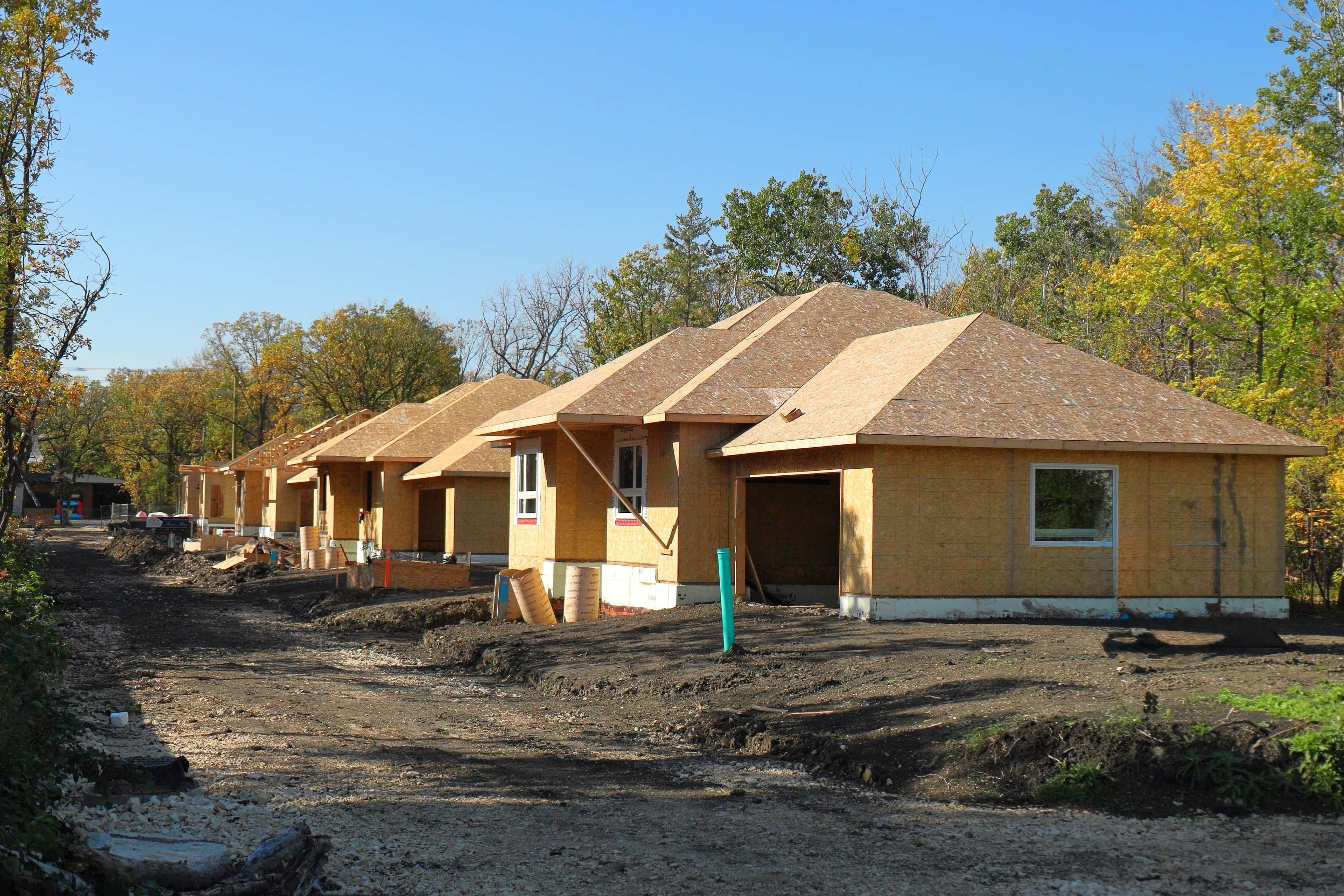
For homeowners trying to make sense of why this matters, the headline isn’t only “more units.” It’s that governments are explicitly treating housing delivery like an industrial workflow: standardized designs, prefabricated Canadian-made components, and a coordinated supply chain are positioned as the mechanism—not an add-on—to shorten timelines and reduce cost pressures. That is a meaningful shift from project-by-project delivery, because it can change how builders source materials, how sites are planned, and how quickly multi-family housing can move from design to construction.
This also lands in a market backdrop where the scale problem remains the dominant constraint. In Canada Mortgage and Housing Corporation reporting summarized by BNN Bloomberg, the agency’s affordability scenario work is described as requiring a near-doubling of annual housing production for an extended period, with British Columbia among the provinces facing the largest gaps. At the same time, near-term construction conditions remain challenging: the outlook covered in Advisor.ca’s summary of a CMHC forecast notes national housing starts expected around 247,000 units for 2026, below 2025, alongside elevated costs and softer demand conditions.
Even outside new-build policy, housing is being discussed as a macroeconomic factor. In a Yahoo Finance report on a CIBC view of Canada’s housing slowdown, the broader narrative is that housing market weakness can spill into the wider economy—one reason governments often emphasize “speed” and “scale” when they talk about supply.
The B.C. package is easiest to understand as two related, but operationally different, build streams.
A simple way to see the mechanics is to separate bricks-and-mortar capital from ongoing operations and supports, because supportive/transitional housing is typically where those two funding types get bundled in public agreements.
The “why B.C., why now?” context is also part of the story. In the early rollout description captured by the Union of BC Municipalities summary of BCH’s launch plan, the first wave of factory-built homes was associated with federal sites in other cities, alongside a separate supportive housing partnership in Nunavut—meaning British Columbia was not positioned as an initial direct-build jurisdiction. The February 18 agreement, by contrast, reads as B.C.’s entry point into an operational portfolio that is both multi-project and explicitly tied to prefab-friendly standardization.
BCH’s side of the arrangement also connects back to its own investment posture. When the federal government released the agency’s guiding approach in Build Canada Homes’ National Housing Day policy framework news release, it positioned BCH as an entity meant to steer financing and development toward repeatable, scalable delivery patterns rather than bespoke one-offs.
Finally, there’s a practical “delivery reality” reason this kind of structure gets attention: the private market has been wrestling with feasibility in higher-cost environments, and housing providers have been grappling with the supply gap. The gap framing highlighted in Mortgage Professional Canada’s overview of CMHC’s 2025 housing market outlook helps explain why agreements that standardize designs and procurement are being pushed as a way to reduce friction in the pipeline.
“Explore delivering” is doing real work in this announcement: it signals a targeted delivery approach and tooling (DASH + modern methods) without presenting the 400-unit affordable rental stream as a fully contracted construction start date in the same way the shovel-ready supportive/transitional stream is framed.
DASH is central here because it describes how B.C. intends to compress timelines—before a shovel hits the ground—by standardizing designs and making approvals simpler to repeat. On the program’s own site, the DASH (Digitally Accelerated Standardized Housing) description explains it as using digital tools and permit-friendly designs to help architects, designers, and housing providers deliver multi-family homes faster and more cost-effectively, supported by standardized designs, prefabricated parts, and a coordinated supply chain.
That matters because a lot of time and cost in multi-family development sits upstream of construction: architectural work, coordination, value engineering, and approvals. The point of standardized “permit-ready” building types is that once a design is accepted and repeatedly used, each additional project can, in theory, be delivered with fewer custom decisions and fewer redesign loops.
B.C. has also attached estimates to why it’s pursuing this. The Canadian Federation of Independent Business Golden Scissors Award backgrounder points to provincial estimates that DASH could save 50–60% of design time and 20–25% on construction costs for eligible projects, which helps translate the program from an abstract concept into something measurable (while still being an estimate, not a guarantee).
BCH’s interest in modern methods is similarly framed around productivity—especially when factories and modular workflows are involved. In the Prime Minister’s September 14, 2025 speech launching Build Canada Homes, factory-built and modular approaches are linked to indicative gains such as faster build times, lower costs, and lower emissions compared with traditional methods. Those figures are presented in broad terms as potential outcomes of industrialized building, not as project-level promises.
The “Buy Canadian” emphasis connects to prefab in a straightforward way: factories and repeatable designs can concentrate purchasing into larger, more predictable orders. In a November 10, 2025 video statement on the federal Buy Canadian policy, the government frames procurement as a deliberate tool to strengthen domestic supply chains and support Canadian jobs—context that helps explain why announcements now often pair housing delivery with material-sourcing language.
This partnership is also a clue about where BCH is heading structurally. In the federal news release introducing the Build Canada Homes Act, the government describes a pipeline of projects and partnerships already advanced across multiple cities and jurisdictions, positioning BCH as something closer to a national delivery platform than a single program fund. The B.C. agreement slots into that “portfolio” concept: multiple projects, more standardized tooling, and a clearer attempt to link industrial capacity (materials, components, factories) to housing outputs.
The governance mechanics matter because they affect how risk, timelines, and multi-year commitments are managed. In the Build Canada Homes Act backgrounder, the federal government explains that BCH is operating as a special operating agency within Housing, Infrastructure and Communities Canada and is intended to transition to a Crown corporation once legislation receives Royal Assent, with an arm’s-length board and greater independence to take on risk. For readers, “Crown corporation” here is less about constitutional theory and more about operating model: a federally owned entity designed to run longer-horizon files with more autonomy than a standard department program.
The statutory tools being proposed are broad, which is relevant to how future phases could be structured. On Parliament’s Bill C-20 page, the summary indicates BCH would be empowered to develop land and construct housing and to use multiple financing instruments—such as loans, grants, guarantees, and equity-type investments—alongside buying, selling, and leasing property and partnering with other orders of government, Indigenous partners, non-profits, and private entities.
The “Buy Canadian” piece is also not just rhetorical; it appears in BCH’s own investment guidance. In Build Canada Homes’ Investment Policy Framework, BCH says it adheres to the Buy Canadian policy by prioritizing projects that use domestically produced materials (including Canadian softwood lumber) as part of strengthening supply chains and supporting jobs, framing it as a prioritization lens rather than an absolute ban on non-Canadian inputs.
Bottom line: the February 18 announcement is best read as a systems test—can governments standardize design, procurement, and construction methods enough to deliver a larger pipeline predictably—rather than as a single-unit-count headline. If future phases arrive, the most meaningful “next” indicators will likely be (1) how quickly the shovel-ready supportive/transitional projects break ground, (2) whether the DASH-linked affordable rental stream turns into specific site commitments, and (3) whether BCH’s Crown corporation transition changes how quickly it can assemble land, financing, and repeatable prefab procurement across provinces.