

What Homeowners In Fire-Adjacent Communities Should Know (And Do) As The 2026 Season Opens
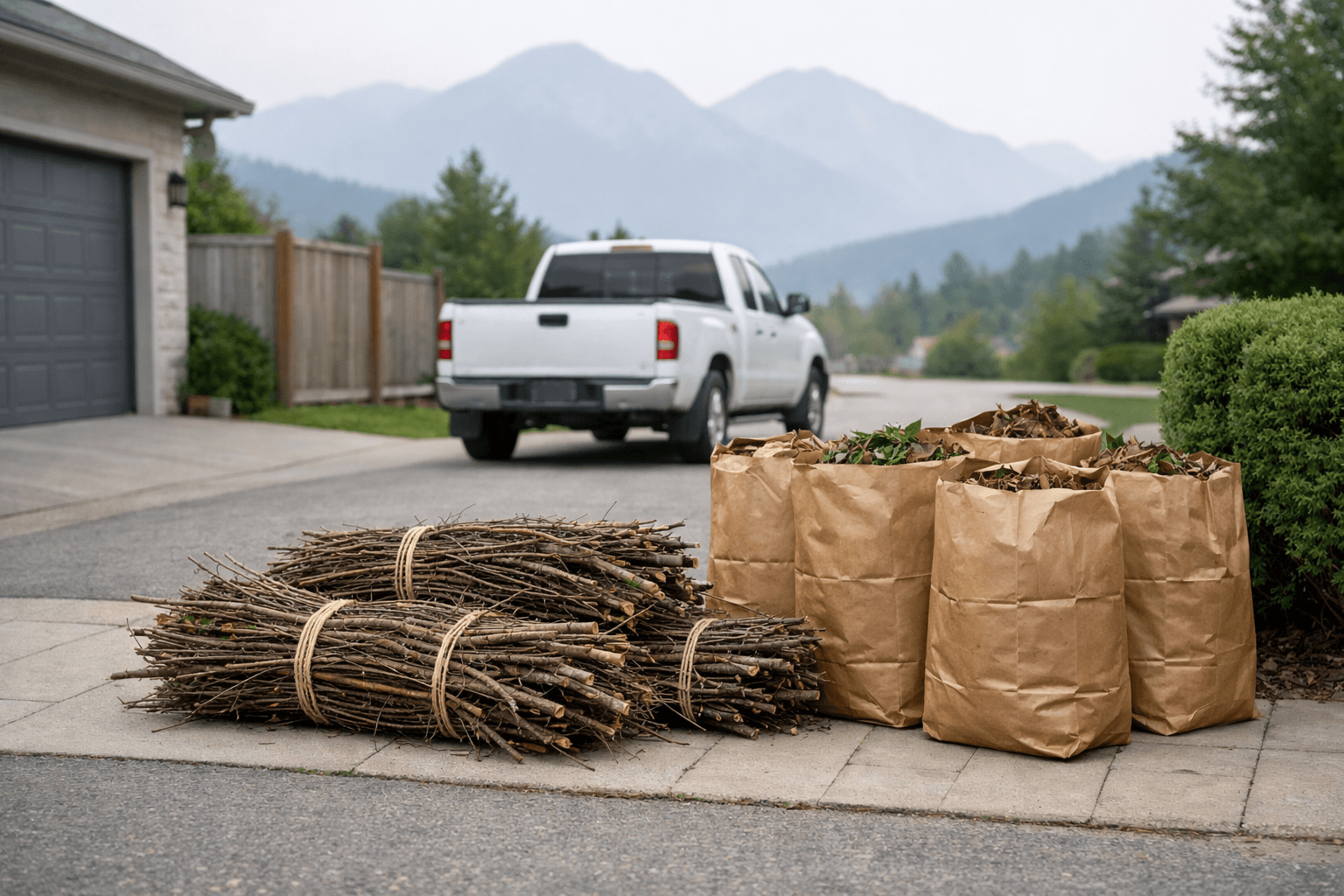
Bundles of yard waste readiness for disposal, set against a backdrop of misty mountains and a parked pickup truck. Reflects community effort during wildfire season cleanup. (Credit: Homeowner.ca)
Alberta’s wildfire season officially began on March 1, 2026, and the date matters for more than symbolism: provincial and municipal messaging treats this period as the formal window when outdoor burning rules tighten and permits are typically required, as described in the Government of Alberta’s wildfire prevention guidance, which frames the March-to-fall season as an active risk period for residents.
In the first week of the season, reporting out of Alberta’s mountain corridor captured a familiar feeling—“low grade anxiety”—and a practical response: communities like Canmore and Hinton are accelerating mitigation work, particularly FireSmart neighbourhood organization and fuel-reduction “fireguard” style projects intended to slow a fast-moving wildfire before it reaches town.
For homeowners, this moment lands in a very specific way. It’s not just “wildfire season again.” It’s the start of a season shaped by the Jasper disaster, and it’s happening at a time when home insurance across Canada is already under strain. The emerging through-line is simple: wildfire mitigation is becoming less of a nice-to-have and more of a baseline expectation—by neighbours, municipalities, and increasingly by insurers—especially in communities that sit close to forest fuels.
The clearest “what’s new” signal this year is tempo. Mountain towns that have always lived with wildfire risk are moving faster and more visibly at the start of the season, with local officials and residents treating FireSmart work the way many communities treat flood berms or snow clearing: not as a special initiative, but as ongoing risk management.
In early March, Global News described Canmore and Hinton ramping up mitigation after Jasper, including FireSmart neighbourhood participation and active fireguard-style fuel removal around communities, in its report on Alberta mountain towns and wildfire “low grade anxiety”, which connected the season’s opening to both preparedness and the emotional reality of living near the wildland–urban interface.
A big part of the urgency is that Jasper changed the mental math for nearby communities: it demonstrated how quickly an event can escalate from “smoky summer inconvenience” to “community-scale destruction,” and it did so in a place that feels familiar to many Albertans—mountain terrain, forest fuels, tourism traffic, and dense neighbourhoods.
The hard numbers are what make Jasper a turning point rather than a cautionary tale in the abstract. In a federal case study, Environment and Climate Change Canada notes that the 2024 Jasper wildfire destroyed 358 of 1,113 buildings and prompted the evacuation of roughly 25,000 people, as documented in its 2024 Jasper wildfires adaptation case study, which is why similar communities are now acting earlier, not later.
What that looks like on the ground in 2026 is a mix of:
Municipal acceleration matters because it changes the baseline. When a town is visibly investing in mitigation, homeowners tend to see two things more clearly: (1) the risk is real enough to budget for, and (2) personal property choices (landscaping, storage, maintenance) are part of a shared community outcome, not just a private preference.
The other reason municipal action matters is quieter but increasingly relevant: it creates the conditions for more standardized conversations with insurers. A community that can demonstrate organized mitigation, assessments, and neighbourhood engagement is in a better position than a community that can only say, “We’re aware of wildfire.”
FireSmart is often described as a program, but for homeowners it’s more useful to think of it as a risk-reduction standard for the area around your home. It focuses on how homes actually burn in wildfires: many structures ignite not from a wall of flame, but from wind-blown embers and heat that find easy fuel right beside (or on) the building.
The core organizing concept is the Home Ignition Zone—the space around a structure where small, practical changes can meaningfully reduce the chance your home ignites. FireSmart Canada defines this as the area within 30 metres of the home, with the “Immediate Zone” closest to the building and an “Intermediate Zone” that extends further into the yard, as outlined in FireSmart Canada’s Home Ignition Zone guidance, which breaks mitigation into zones homeowners can plan and maintain over time.
Here’s the simplest way to apply it without turning wildfire preparedness into a renovation project.
What many homeowners miss is that the first 10 metres is the high-leverage area. It’s also the area most people can control without hiring contractors, which is why it’s often where communities start when they’re trying to raise the overall resilience of a neighbourhood quickly.
That doesn’t mean every home needs to look like gravel and rock. It means the space closest to the house should be managed like the “loading dock” for embers: clean, uncluttered, and less likely to catch and hold fire.
If you’re not sure where to start, start by walking the perimeter of your home with one question: “If an ember landed here, what would it ignite first?” Then remove or relocate that item—do this once now, and once again before peak summer conditions.
With wildfire season opening in March, a homeowner-friendly way to think about timing is: do the simplest, most repeatable tasks early, then maintain them. That’s especially true for items that can change quickly with spring winds and yard clean-up.
A practical early-season checklist (without drifting into a DIY construction guide) usually centres on:
These aren’t glamorous tasks, which is exactly why they work as a community standard: they’re achievable, repeatable, and they lower risk without requiring homeowners to agree on aesthetics or major spending.
It’s important to be careful—and accurate—here: wildfire mitigation does not guarantee a specific insurance outcome. Underwriting varies by insurer, region, and loss experience. But the direction of travel is increasingly clear across Canada: insurers are paying closer attention to climate-related peril exposure, and wildfire-prone locations are one of the most visible pressure points.
One reason homeowners are hearing more about “defensible space” and property condition is that these factors are legible to underwriters: they’re observable, they correlate to loss severity, and they can be documented. In other words, they translate a complex, landscape-level hazard into a set of property-level signals.
Industry research also reflects this shift toward more formalized wildfire scrutiny. A survey summary published by Opta Insurance highlights how insurers and underwriters are assessing wildfire risk and mitigation expectations in Canada in its fire underwriters survey, which helps explain why some homeowners are seeing more questions, inspections, or documentation requests tied to fire exposure.
For a homeowner, the practical implication isn’t to panic-shop a policy. It’s to assume that the “basic condition” of your home and yard—especially in higher-risk zones—may get more attention than it did five or ten years ago. That can show up as:
If you live in or near a forested area, the most realistic mindset is: wildfire mitigation is becoming part of normal homeownership administration, similar to how roof age, plumbing type, or electrical updates have long been part of insurance conversations.
If you make meaningful FireSmart improvements, document them in a simple, non-salesy way: dated photos, a short list of what changed (e.g., “woodpile moved beyond 10 m,” “gutters cleared,” “mulch removed at foundation”), and any municipal assessment notes you receive. This won’t override underwriting rules, but it can reduce friction when questions come up at renewal.
Alberta’s 2026 wildfire season is opening with a familiar mix of readiness and unease—made sharper by Jasper’s recent history and by the visible pace of mitigation work in communities that sit close to forest fuels. The underlying story isn’t that every summer is doomed to be catastrophic. It’s that wildfire planning is becoming more operational: earlier starts, more structured community programs, and clearer expectations for what “prepared” looks like at the property level.
For homeowners, FireSmart is the most useful lens because it converts a big, uncontrollable risk into a set of manageable zones and repeatable tasks—especially in the first 10 metres around the home. And as insurance continues to tighten in high-risk areas, those basics increasingly matter not just for safety, but for how smoothly your home can be insured and renewed.
If you’re in a fire-adjacent community, the most productive next step is simple: treat early-season FireSmart prep like spring maintenance, not emergency response. It’s calmer, cheaper, and—based on how municipalities are acting right now—more aligned with where Canada’s wildfire resilience is heading.