
The risk profile of a well can change without obvious warning because groundwater pathways shift over time. Testing isn’t a judgment on your past—it’s a way to catch changes early before they become a health or treatment problem.


A Practical, Province-Aware Guide for Private Well Owners
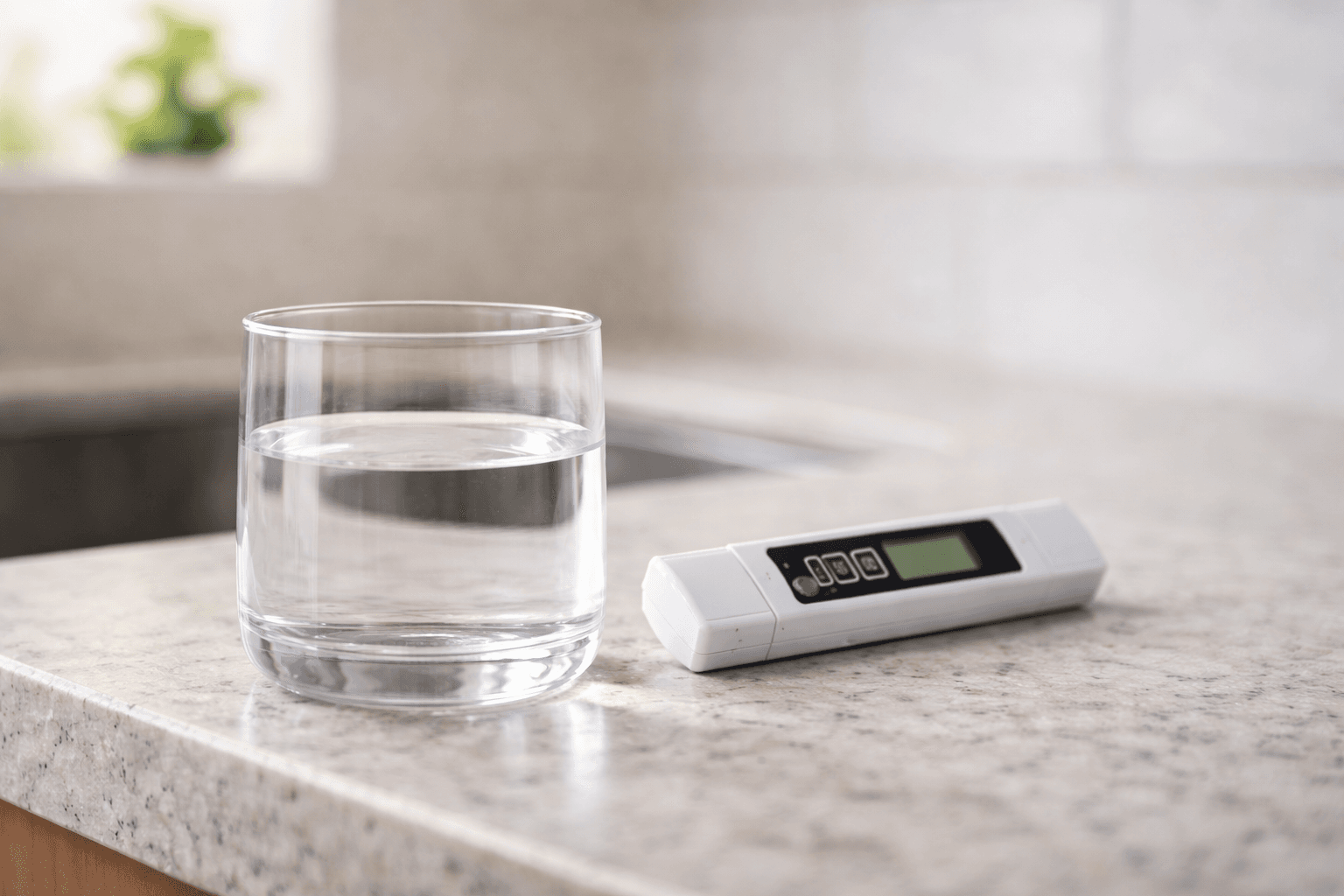
Electronic tester beside a kitchen glass turns everyday water into numbers that guide safe well decisions. (Credit: Homeowner.ca)
Owning a private well is a bit like owning a small, personal utility. You get independence and (often) great-tasting water—but you also inherit the job a municipality normally does behind the scenes: monitoring, testing, and responding when something changes.
The tricky part is that well water problems often don’t announce themselves. In the day-to-day reality of Canadian homeownership, it’s common to rely on taste, smell, or appearance—but in its private well testing guidance Health Canada flags that contaminants can be present even when water looks and tastes normal, which is why a routine schedule matters more than your senses.
This guide is designed to give you a “default operating system” for well water testing anywhere in Canada: what to test for, how often to test, when to test more frequently, and how to collect samples correctly so you can trust the results.
Because Canada is provincial by design, some services and recommendations vary by region. You’ll see examples from different provinces and health units, but the overall goal stays the same: establish a baseline, follow a routine cadence, and treat “unusual events” (like flooding, drought, construction, or a new baby at home) as automatic triggers to retest.
If you want the simplest mental model, it’s this: well water testing is preventive maintenance. It’s closer to cleaning your furnace filter or checking your smoke alarms than it is to “calling someone when something feels off.”
Most homeowners struggle with well water testing because it feels open-ended. What should you test? How often? Where do you even start?
Instead of trying to memorize every possible parameter, use a three-layer framework you can apply in any province:
Here’s the model in one place:
The easiest way to stay consistent is to keep a “well water logbook” (paper or digital) with your test dates, results, weather notes, and any maintenance you did. After a couple of years, patterns become obvious—and so do anomalies.
This framework also solves a common mistake: people over-test randomly, then stop completely. A plan that is too complicated is the same as no plan, so the best schedule is one you’ll actually follow.
Start with a minimum routine that is easy to remember and practical to execute, then adjust upward based on your local health unit, your well type, and your household risk profile.
A widely used baseline is embedded in the routine guidance from Health Canada where private well owners are advised to test for microbial contamination on a regular cadence and to check broader water quality (basic chemistry) periodically rather than only when something seems wrong.
Some regions recommend more frequent bacteriological testing than that minimum. For example, in its regional guidance the Eastern Ontario Health Unit recommends routine testing for coliform bacteria and E. coli on a quarterly schedule for many private wells, especially as an ongoing habit.
A practical schedule that works for many Canadian homeowners looks like this:
If you only remember one thing, remember this: routine testing is the floor, not the ceiling. The real-world risk of contamination isn’t constant—weather and site changes create spikes, and your schedule needs room to respond.
Also consider that a single “clean” result doesn’t always prove stability. Intermittent contamination can be missed if you only sample once in a blue moon, which is why many health units encourage a baseline pattern (multiple samples over time) when you’re trying to understand a new well or a new property.
Think of well water testing as two big buckets:
If you’re choosing what to test for, start with the parameters that directly influence health and treatment decisions. In its guidance on nitrates and nitrites Health Canada emphasizes that both bacterial and chemical aspects of private well water should be considered, and that understanding nitrates/nitrites and general water chemistry is important before selecting residential treatment equipment.
A “baseline panel” that is practical for many Canadian wells looks like this:
Some provinces publish detailed chemical panels that help you understand what a “real” lab test can include. In Nova Scotia’s well water testing guidance the Government of Nova Scotia outlines a broad chemical panel that spans hardness-related minerals, general chemistry indicators, and a range of metals—while also noting that some groundwater sources can contain naturally occurring chemicals such as arsenic and uranium, making periodic chemistry testing worth doing even when there’s no obvious human pollution source.
That same Nova Scotia guidance also provides a useful reality check on budgeting, noting that routine bacteria testing is often relatively affordable compared with full chemistry panels and giving homeowners a concrete sense of what “normal” costs can look like for basic bacteriological screening.
Your “baseline panel” should match your reality. If you have a shallow dug well, nearby agriculture, or flooding history, you’ll usually lean heavier on routine bacteria testing and nitrates. If you’re in an area known for naturally occurring metals, you’ll prioritize periodic chemistry and metals.
A lot of homeowners do this backwards: they buy a treatment device first and test later. The better sequence is:
If you’re looking at treatment equipment, your lab results should answer questions like:
Treatment without testing is guesswork. Testing without follow-up is wasted information. The value is in the loop: test → act → retest.
Routine schedules are designed for stable conditions. The real world isn’t stable—especially in Canada, where spring thaw, intense rainfall, wildfires, and long dry spells can change groundwater behaviour.
In its private well guidance Health Canada highlights that microbial testing is especially important during higher-risk periods and after specific events, and it also points out that certain groups—like infants, pregnant people, seniors, and immunocompromised individuals—can be more vulnerable to contaminants, which is a practical reason to be more conservative with testing triggers.
Here are common triggers that justify retesting even if your routine schedule is “on track”:
After flooding, assume the risk profile changed until testing proves otherwise. If you have any reason to suspect contamination, use an alternative safe water source for drinking and food prep until your results confirm safety.
“Trigger testing” works best when it’s automatic. If your basement flooded, your yard was submerged, or you had a major storm event, put “well water test” on your next-day checklist the same way you would photograph damage for insurance.
Most homeowners only discover the testing ecosystem when they urgently need it. It’s better to map your options while things are calm.
In Ontario, a clear example of the public/private split is described by Public Health Ontario which explains that private well owners can access bacteriological testing for E. coli and total coliforms through local public health units, while chemical testing typically requires an accredited laboratory rather than the public program.
Across Canada, the pattern is often similar even if the exact program names differ:
For homeowners looking for an industry “starting point,” the resource hub from the Ontario Ground Water Association can be a useful orientation tool for understanding private well testing concepts and where to begin when you’re unsure what’s normal.
Here’s how to compare your options:
“Accredited” matters most for chemical testing. If you’re basing treatment decisions on the results, you want a lab that follows recognized methods and reporting standards.
A lab can only test what you deliver. If your sample is contaminated by poor technique—or compromised by heat, delay, or the wrong container—your results can be misleading.
For detailed, region-specific sampling instructions, the Eastern Ontario Health Unit provides practical guidance on collecting and submitting well water samples correctly, including the idea of building confidence in a new baseline by submitting multiple samples spaced over time.
Below is a robust “best practice” sampling workflow that aligns with the kind of instructions most public health units and labs provide. The key is to follow the exact directions that come with your bottle, then use this as a quality-control checklist.
If you’re establishing a baseline for a new home or a new well, consider a short “baseline burst” of testing—multiple samples over a few weeks—so you’re not relying on a single data point that might miss intermittent contamination.
If you can’t meet the required drop-off timing, don’t “make it work.” Resample. A late sample can produce results that are technically “real” for that bottle, but not representative of your well.
If you just moved into a well property—or you’ve done a major well repair—use a simple baseline plan:
That approach helps you avoid the false confidence that can come from a single “good” result.
Results are only useful if you can translate them into decisions. A helpful way to think about “next actions” is to separate immediate safety decisions from longer-term system decisions.
Total coliforms and E. coli are not interchangeable, and interpretation matters. In its technical document on this topic Health Canada discusses why private supplies should be tested during periods of higher risk and why new or rehabilitated wells should be tested before use, reinforcing that bacteria results should trigger follow-up rather than being ignored.
Use this decision table as a practical starting point, then follow your local public health guidance for your region:
If results are inconsistent, your job is to determine whether the well is inconsistent or the sampling is inconsistent. Often it’s both—until you standardize your process.
Nitrates/nitrites can be especially important for households with infants or pregnant people, and provincial health resources often explain why. In its health information on this issue the Government of Québec describes health effects associated with nitrates and nitrites, which is why testing and proper treatment selection matter rather than guessing.
When nitrates/nitrites are elevated, don’t assume a generic filter will solve it. Your next step is typically to:
If you have infants in the home, treat “unknown nitrate status” as a reason to test sooner rather than later. “We’ll test eventually” is not a strong plan when a household is more vulnerable.
Chemical results often drive long-term decisions:
The practical move is to interpret trends, not single points. A stable, repeatable chemistry profile can often be managed with targeted treatment and periodic retesting. A chemistry profile that is drifting—especially alongside new staining, odour, or scaling—justifies both retesting and a physical well inspection.
Pair your lab results with a quick “well condition scan”: check the well cap, the grading around the wellhead, and any obvious pathways where water could pool and infiltrate.
A frustrating reality of well ownership in Canada is that you can get different advice depending on where you live. That’s normal—and manageable—as long as you understand what’s “structural” versus what’s “local.”
What usually doesn’t change:
What can change:
For example, Nova Scotia’s environmental guidance Nova Scotia Environment notes that private water supply owners are generally not legally required by provincial legislation to test, while still recommending routine testing intervals that many homeowners adopt as a practical standard.
Ontario’s provincial guidance takes a strong homeowner-responsibility framing. In its resource on private wells the Government of Ontario emphasizes that well owners must do what they can to ensure water is suitable for drinking and that frequent testing, combined with inspection and maintenance, is a proactive step rather than an optional extra.
Here’s a simple way to think about these differences without getting lost in bureaucracy:
If you’re unsure what’s normal for your area, use a layered approach: start with bacteria + basic chemistry, then expand based on local guidance, geology, and your household’s vulnerability profile.
If you’re feeling behind, aim for progress, not perfection. The goal is to get a reliable baseline and a workable routine in place.
Here’s the same plan in a quick operational table:
The “best” routine is the one you’ll follow for five years. Start with a simple cadence and add sophistication only after you’ve proven you’ll stick with it.
The risk profile of a well can change without obvious warning because groundwater pathways shift over time. Testing isn’t a judgment on your past—it’s a way to catch changes early before they become a health or treatment problem.
Many homeowners choose a quarterly bacteria routine, especially if they want higher confidence or have a shallow well. In regional guidance the Eastern Ontario Health Unit describes routine bacteriological testing on a regular schedule as a practical habit for private well safety.
In many areas, yes, and you access it through your local public health unit rather than a chemistry lab. The process and scope are described by Public Health Ontario which explains that the public program focuses on bacteriological testing, while chemical testing typically goes through accredited labs.
Not usually. For monitoring well safety, you typically sample a representative cold-water tap using the method your lab specifies, and you may also test “raw” water before treatment if you have equipment installed.
Hot water is not ideal for bacteriological sampling and can be influenced by the water heater. If your concern is the drinking supply, focus on cold water and follow your lab’s instructions.
Taste can be a comfort signal, but it’s not a safety test. Many higher-concern contaminants are not reliably detected by taste or smell, which is why routine lab testing exists.
Treat it like a baseline project: bacteria testing plus a broader chemistry panel, then confirm with follow-up sampling so you’re not relying on a single data point. A baseline approach is described in the Eastern Ontario Health Unit’s sampling instructions where multiple samples spaced over time are used to establish initial quality with more confidence.
They can be useful for quick screening of some chemistry indicators, but they don’t replace accredited testing for bacteria and many health-significant contaminants. Use strips as a supplement, not as your main safety decision tool.
It can mean there’s a vulnerability even if fecal contamination isn’t indicated in that sample. Treat it as a prompt to retest, review your sampling technique, and consider an inspection if it repeats.
Assume instability until you prove otherwise. Increase sampling frequency temporarily, standardize your method, and look for contextual triggers like weather swings or seasonal shifts.
Yes—retesting is how you confirm performance. Any time you change treatment equipment, you want proof that the output water matches the result you were trying to achieve.
Not necessarily. Staining and scale often relate to chemistry (hardness, iron, manganese, pH) rather than bacteria, but they’re still worth testing because they influence treatment selection and plumbing longevity.
Chemical risks and bacterial risks don’t always move together. A stable bacterial profile can coexist with chemistry issues (including naturally occurring metals), so periodic chemistry testing remains a smart baseline move.
Yes. Treatment can improve water quality at the tap while the well itself remains vulnerable, which is why many homeowners test both raw and treated water at least occasionally depending on their goals.
Rushing the process—using the wrong tap, contaminating the bottle, or missing timing requirements for drop-off. A careful sample is the difference between a useful result and a confusing one.
Treat it as a trigger and prioritize bacteriological retesting before returning to normal assumptions. After you have clean results, you can decide whether additional chemistry testing is justified based on what happened and where water flowed.
Start with your province or local health authority guidance, then expand based on local geology, nearby land use, and your prior lab history. Well associations and professionals can also help you interpret risks and choose the right panels.