


In most homeowner situations, no. Focus on moisture control and safe cleanup, because the wall conditions that allow mould to grow are the real driver.


A Canadian Homeowner’s Practical Playbook for Fast Decisions and Safer Cleanup
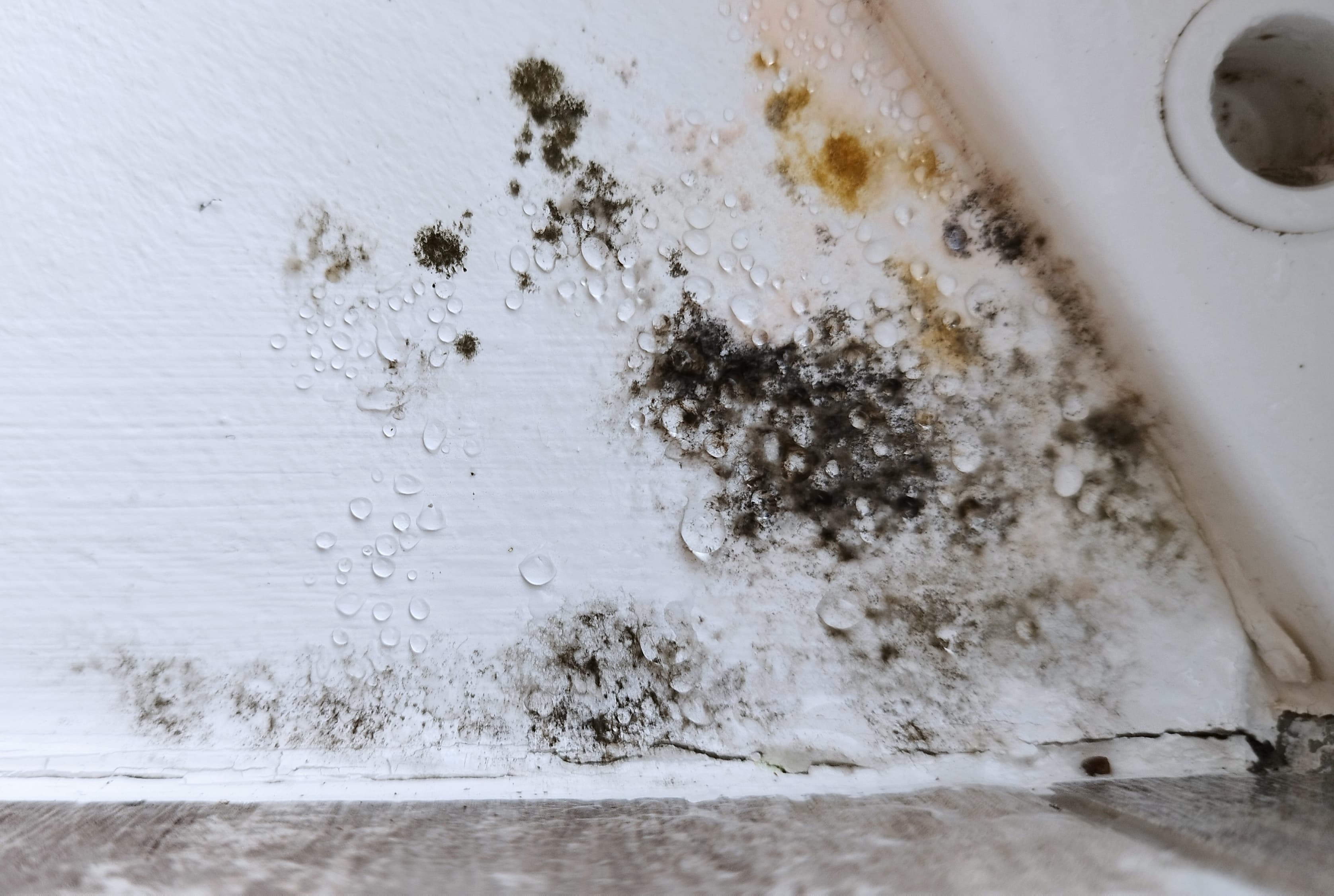
Mould blooms beside clinging droplets, where hidden moisture decides between scrubbing the surface and cutting drywall. (Credit: Shutterstock.com)
Wall mould is rarely “just a cleaning problem.” It’s a moisture problem that shows up on a wall because that surface (or what’s behind it) has been damp long enough for fungi to grow.
What makes wall mould tricky is that it can be both obvious and hidden at the same time. A small patch on paint might be the only visible sign, while the bigger issue sits behind drywall, above a ceiling, or inside an exterior wall cavity where damp materials don’t dry quickly. In Health Canada’s guidance on reducing humidity, moisture, and mould mould is described as fungi that grow on damp building materials and often show up as discoloured staining and musty odours, even when growth is concealed.
For homeowners, the goal isn’t to become a mould “identifier.” The goal is to make three decisions quickly and confidently:
This guide walks through what to inspect, what to clean, what to remove, and the prevention habits and ventilation fundamentals that matter most in Canadian homes—especially through winter condensation season and damp basement months.
Colour gets all the attention, but moisture signals are what drive smart decisions.
A wall mould problem often announces itself through subtle “building symptoms,” and Health Canada’s homeowner guide to addressing moisture and mould lists common indicators like staining or discolouration, peeling paint, wrinkled wallpaper, cracks in plaster, warped wood, and white powdery deposits on masonry (efflorescence), along with musty odours.
Use a fast scan that prioritizes where moisture tends to linger:
If you can smell a musty, earthy odour but can’t see anything, treat that as a clue to look for hidden dampness—not as proof you need an expensive “mould test.”
Before you pick up a sponge, make a quick call on whether this is a DIY clean or a professional remediation job.
A practical sizing framework appears in Health Canada’s mould guidance where mould problems are described as small (1–3 patches each under 1 m²), medium (total affected area between 1 and 3 m²), or extensive (any single patch larger than 3 m²), with extensive areas generally needing professional assessment and cleanup.
Here’s the homeowner-friendly translation:
Also factor in who’s in the home. If you have infants, older adults, or people with asthma/allergies, your threshold for “call a pro” should be lower because damp and mouldy environments are linked with respiratory symptoms and asthma impacts in Canadian public health messaging such as the Canadian Lung Association’s information on dampness and mould which emphasizes health effects and prevention.
Cleaning without moisture control is like mopping while the tap is still running.
Canadian guidance is consistent on what drives indoor mould growth: condensation from high humidity or cold surfaces, plumbing/roof leaks, water infiltration, and flooding events. In Health Canada’s residential indoor air quality guideline on moulds the core message is to address moisture and dampness as the primary control strategy rather than focusing on mould species.
Two practical implications for homeowners:
Time matters, too. If a leak or spill soaked a wall assembly, you’re racing a clock because mould can start quickly. The Gouvernement du Québec’s homeowner guidance on finding and eliminating mould notes that cleaning and drying water damage within roughly 24–48 hours is a key step to prevent mould growth from taking hold.
If you can’t confidently say “the moisture source is fixed,” treat any cleaning as temporary and prioritize diagnosis: where is the water coming from, and why isn’t it drying?
When the area is small-to-medium and the wall materials are still intact, the safest approach is usually the simplest: detergent + controlled moisture + thorough drying.
Start with basic personal protection and “don’t spread it around” habits. In Health Canada’s mould guidance recommended minimum protection for small and medium cleanups includes safety glasses or goggles, a well-fitting disposable N95 respirator, and disposable gloves, and it also highlights using a HEPA-filter vacuum before and after cleaning to help remove spores.
A homeowner-focused step-by-step:
If you’re tempted to reach for bleach, pause. In Health Canada’s chemical safety guidance for DIY projects routine household mould cleanup is described in terms of soap and water or mild cleaners, and bleach is not positioned as a default requirement for typical residential situations.
Drywall is the “gotcha” surface because it’s typically gypsum wrapped in paper. That paper facing is a food source for mould, and it’s easy to damage if you over-wet it.
For surface mould on drywall that’s still firm, use a damp (not dripping) approach. The Baseline Inspections homeowner’s guide to mould describes wall-safe cleaning options for drywall such as using mild detergent or a baking soda solution while avoiding heavy saturation.
Use these decision cues while you clean:
For practical “do and don’t” reminders, the CAA‑Québec guide on getting rid of mould warns against dry brushing (which can spread particles) and emphasizes using approaches that limit dispersal.
A wall that can’t dry is a wall that can’t stay mould-free. If you clean but the wall remains cool and damp to the touch, treat that as a ventilation/insulation/condensation problem to solve—not as a cleaning problem to repeat.
Some wall assemblies simply aren’t salvageable once they’ve been wet long enough.
Porous materials can hold mould deep inside where scrubbing can’t reach. The U.S. Environmental Protection Agency’s guidance on mould cleanup explains that absorbent or porous items like ceiling tiles, wallboard, and carpet may need to be discarded when mouldy because they can be difficult to clean completely.
That’s consistent with healthy-housing guidance such as the National Center for Healthy Housing’s mould prevention and solutions resource which describes porous building materials as particularly challenging to remediate when contaminated.
A practical “cut-out” checklist for walls:
When you cut out, plan the repair properly:
The “hidden cost” of demolition is cross-contamination. Cutting drywall can release dust and spores into adjacent rooms if you don’t control airflow and debris.
Containment and safe handling methods are described in remediation training resources like the U.S. Environmental Protection Agency’s mould course chapter on remediation which outlines work-zone control concepts such as limiting spread during removal and cleanup.
For a homeowner-scale approach, focus on three controls:
Control the boundary
Control the debris
Control the exit
For more specific disposal handling, the North Carolina State University mould remediation guidelines describe sealing and bagging mould-contaminated debris to prevent dispersal, including the use of heavy plastic bags for non-salvageable materials.
Most “recurring wall mould” is predictable: moisture builds up faster than the home can remove it.
A concrete prevention target is indoor relative humidity. In the Health Canada Healthy Home guide indoor humidity is commonly framed in a practical comfort and mould-prevention range around 30% to 50% relative humidity in many home conditions.
Seasonal nuance matters in Canada, and the CAA‑Québec guidance on temperature and humidity variations discusses keeping humidity above roughly 30% in winter (to avoid overly dry air) while still limiting excess humidity that drives condensation and mould, and it also addresses keeping humidity from running too high during warmer months.
If you want an additional “sanity check” reference for humidity as an indoor air quality variable, the Health Canada guide for improving indoor air quality in office buildings describes relative humidity as a comfort and environmental parameter often managed in a similar 30%–50% band, reinforcing that this isn’t a niche number—it’s a widely used moisture-control target.
Ventilation habits matter more in airtight, energy-efficient homes where moisture can build up indoors. The Natural Resources Canada guidance on humidity levels and ventilation describes how moisture can accumulate in tight homes and show up as window condensation and wall dampness, and it points to source ventilation (bathroom/kitchen exhaust and proper venting) as a key control.
Make these habits non-negotiable:
Daily operation guidance that connects comfort, moisture, and mechanical systems is also covered in homeowner resources like Natural Resources Canada’s “Operating Your House” section which emphasizes managing how home systems run as part of maintaining a stable indoor environment.
Basements are mould-friendly because they’re cool, often humid, and sometimes have chronic seepage or condensation.
Practical basement controls that work:
Many homeowners miss that storage choices matter. Cardboard boxes against cool foundation walls can trap moisture and create perfect mould habitat, which is why the Gouvernement du Québec’s mould guidance calls out common household locations like closets, windows, and behind furniture where airflow is poor and condensation forms.
Homeowners often treat exhaust fans as optional “comfort upgrades,” but ventilation is also a baseline expectation in Canadian building practice.
In British Columbia, Part 9 ventilation requirements appear in BC Publications’ online version of the BC Building Code ventilation provisions which describes mechanical ventilation requirements and includes expectations for local exhaust serving kitchens and bathrooms with discharge to the outdoors.
If you want a plain-language example of how ventilation clauses get applied in real situations, the BC Building Code Appeal Board decision BCAB 1920 discusses ventilation-related code interpretation in the context of dwelling requirements.
Ontario uses similar Part 9 ventilation structures, and reference tables for required ventilation capacities are shown in resources like BuildingCode.Online’s Ontario Building Code ventilation table page which outlines minimum exhaust rates by room type.
What this means for mould prevention is simple: if your bathroom fan vents into an attic, is undersized, or isn’t used consistently, you’re fighting a problem the building code is already designed to reduce.
DIY cleanup has limits, and “extensive” mould isn’t just unpleasant—it’s higher risk because disturbance can spread contamination and increase exposure.
If anyone in the home is high-risk, take that seriously. The Centers for Disease Control and Prevention guidance on mould cleanup advises that people with allergies, asthma, immune suppression, or chronic lung disease should not take part in mould cleanup, which is a good baseline rule even for smaller projects.
Also consider professional help if:
For families, the “why” is important: public health resources emphasize that dampness and mould exposure can affect respiratory health, especially in kids. The Canadian Partnership for Children’s Health and Environment’s resource on mould and dampness highlights children’s vulnerability and reinforces prevention through moisture control and timely cleanup.
If you’re trying to understand symptom patterns and why mould is treated as a serious indoor contaminant, the Gouvernement du Québec overview of health problems caused by mould summarizes common irritation and respiratory impacts and underscores the value of removing dampness and contamination.
In most homeowner situations, no. Focus on moisture control and safe cleanup, because the wall conditions that allow mould to grow are the real driver.
If you can see mould or dampness, testing usually doesn’t change the first steps: fix moisture, clean small areas safely, and remove damaged porous materials when needed.
It can start quickly—think in days, not weeks—so drying and dehumidifying early is one of the best ways to avoid cutting out drywall later.
Bleach is often overused in homes. For many small wall cleanups, mild detergent and controlled moisture with thorough drying is the safer, more practical baseline.
At minimum, eye protection, a well-fitting N95 respirator, and disposable gloves are a sensible baseline for small-to-medium surface cleanup.
You can sometimes clean it if it’s truly on the surface and the drywall stays firm and dries fully. If the drywall is soft, swollen, or keeps smelling musty, replacement is usually the better move.
Cut-out is usually the right call when porous materials stayed wet, when mould is on the back side of drywall or in insulation, or when growth keeps returning even after you’ve addressed moisture.
Repeat growth almost always points to repeat moisture—often condensation on a cold exterior surface, poor airflow behind furniture, or an underperforming exhaust fan.
A practical target range is usually in the 30%–50% relative humidity band, adjusted seasonally so you’re not driving condensation in winter or high humidity in summer.
Yes. These rooms generate large moisture loads quickly, and consistent exhaust to the outdoors is one of the most reliable ways to prevent wall and ceiling mould.
Treat the smell like a moisture clue: reduce humidity with dehumidification, improve airflow, and inspect common hiding spots like behind storage and along exterior foundation walls.
The wall should be clean, dry, and odour-free. If odour persists or staining returns, assume moisture is still present or contamination is deeper than the paint layer.