For many homes, a practical winter target is around 30–35% RH, with some homes comfortably holding 35–45% when windows stay clear and there’s no condensation. The “ideal” number is the highest RH you can maintain without persistent condensation.


A Climate-Aware Target Range You Can Actually Maintain Without Condensation Headaches
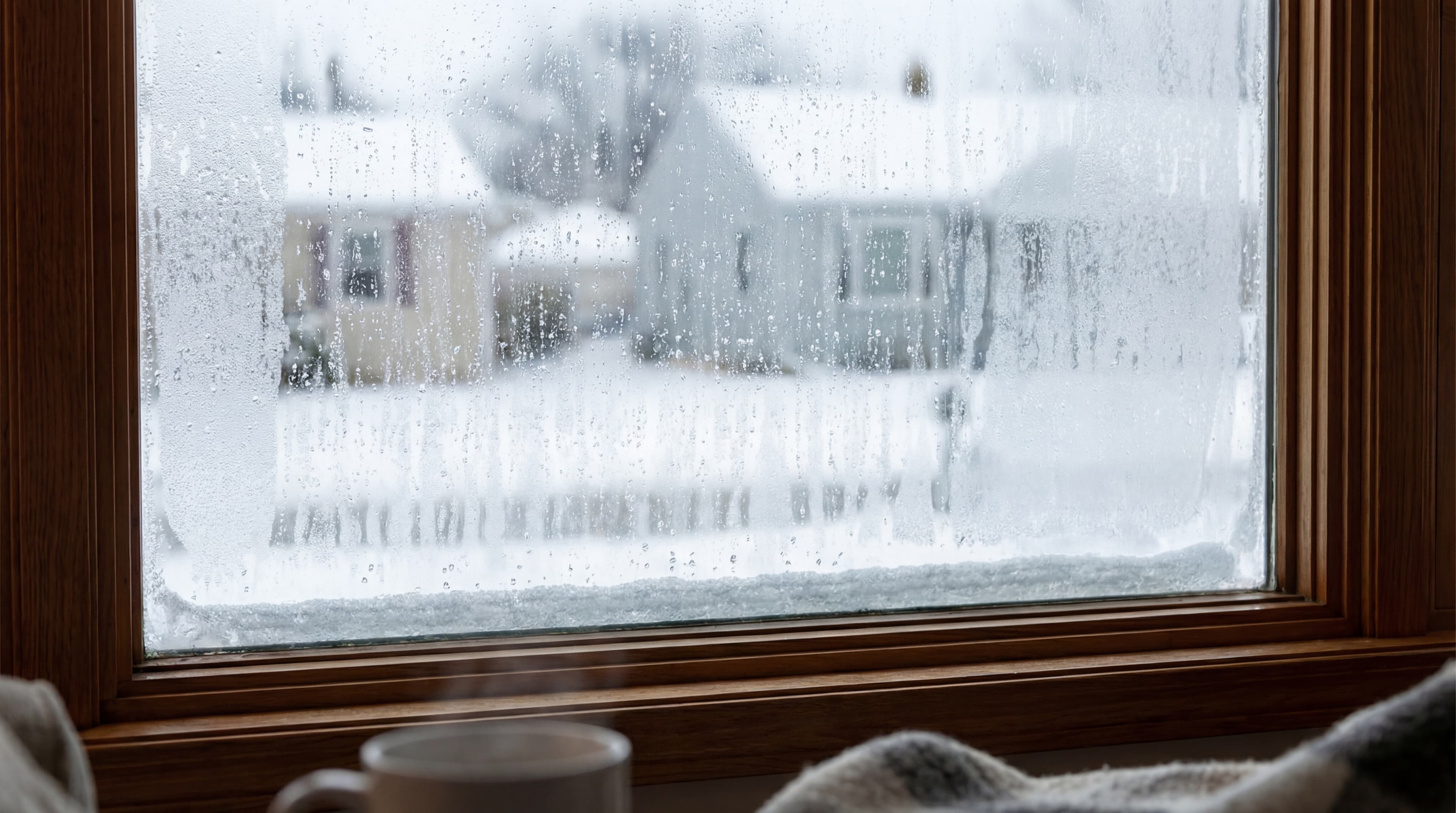
Condensation beads on cold glass while snow falls outside, showing humidity’s tightrope between comfort and mould. (Credit: Homeowner.ca)
Winter is when humidity becomes a real Canadian homeowner problem—because winter is when the house is closed up, the heat is running, and outdoor air swings from “bone-dry Prairie cold” to “damp coastal chill” depending on where you live.
If you’ve ever noticed static shocks, cracked lips, dry eyes, or a sore throat that mysteriously improves when you leave the house, your indoor air may be too dry. If you’ve ever wiped water off windows, seen frost build along the glass edges, or smelled that “damp basement” odour, your indoor air may be too humid for the outdoor temperature and your home’s building envelope.
The tricky part is that both can be true in the same winter—sometimes in different rooms. A bedroom can be dry enough to irritate sinuses while a poorly ventilated basement is humid enough to grow mould. That’s why the most useful approach isn’t a single “perfect” humidity number. It’s a practical target range you can tune based on your region, your home, and what your windows are telling you.
This guide gives you a system: the baseline winter target most Canadian homes can start with, the signals that tell you to go up or down, and the tools that make it easy to maintain the range without creating condensation or indoor air quality issues.
Relative humidity (RH) is a percentage that tells you how close the air is to “full” at its current temperature. Warm air can hold more moisture than cold air, so when you heat winter air indoors, the relative humidity often drops—even if you didn’t remove moisture.
That’s why you can take outdoor air that doesn’t feel especially dry, heat it, and suddenly your indoor RH looks low. It’s also why raising the thermostat without adding moisture can make the house feel drier (and increase static).
A simple mental model that works well in Canadian winters:
Here’s how that shows up in real homes.
If you only measure one spot, you’ll miss the real story. Winter humidity is often a room-by-room issue—start with a main-floor living area, a bedroom, and the basement.
For most households, you’re aiming for a winter RH range that supports comfort while avoiding condensation on cold surfaces. In Health Canada’s indoor air quality guidance for office buildings the recommended indoor relative humidity range is 30% to 50%, with the practical benefit of reducing condensation risk when the building is operating in typical heating season conditions.
In real Canadian homes, winter targets usually live toward the lower half of that range because windows, exterior walls, and rim joists can get cold enough to condense moisture when indoor RH is pushed too high.
A homeowner-friendly way to think about it:
“Ideal” humidity is the highest RH you can maintain without persistent window condensation or damp spots. If your windows are showing you moisture, believe them—and lower the target.
Canada’s winter humidity challenge isn’t uniform. Where you live changes how quickly your indoor RH drops (or climbs), and how aggressively you need to manage it.
One reason many homeowners in colder inland climates feel the dryness so strongly is described in FurnacePrices.ca’s guide to ideal winter humidity which explains how cold winter air—particularly common in Prairie provinces—carries very little moisture, and heating it indoors often results in very low indoor RH unless moisture is added.
Use this table as a starting framework, not a rulebook.
Your home’s “humidity personality” is usually more important than your postal code. A leaky 1970s home in Ontario behaves very differently than a tight 2020s home in the same neighbourhood.
Below a certain point, dryness stops being a minor annoyance and becomes a quality-of-life issue—especially for kids, seniors, and anyone with respiratory sensitivity.
In CAA‑Quebec’s guidance on temperature and humidity variations indoor relative humidity falling below about 30% in winter is associated with irritation of nasal and throat mucous membranes and can worsen certain skin and eye conditions, which is why a “don’t go below this” lower limit is often recommended for comfort.
Practical signs your winter RH may be too low:
What helps first (before you buy anything):
Don’t chase humidity with the thermostat. If you raise temperature without adding moisture, RH often drops—and you can end up feeling drier at a higher setpoint.
High indoor RH in winter is less about “feeling humid” and more about moisture showing up where it doesn’t belong. The earliest, most visible symptom is usually window condensation.
That matters because condensation isn’t just cosmetic—it’s a sign that indoor moisture is meeting a cold surface, which can create the conditions for hidden mould and material damage over time.
A common Canadian winter pattern—especially in tighter homes that stay closed up—is described in Air Quality Canada’s article on winter moisture and hidden mould which explains how winter conditions can trap indoor moisture, increasing condensation risk and creating mould-friendly conditions in poorly ventilated areas.
Use this table to translate symptoms into action.
If you’re seeing recurring condensation and you “solve it” by running a humidifier harder, you’re pushing moisture into the exact places where mould and rot start. Condensation is a stop sign, not a suggestion.
Even with a sensible baseline, there are days when you need to go lower—because outdoor temperature drops and cold surfaces get colder.
A useful rule is: the colder it gets outside, the lower your safe indoor RH ceiling becomes (especially with older double-pane windows or any noticeable drafts).
In Alberta Mountain Air’s guidance on winter indoor humidity a winter target around 30–35% is recommended for cold conditions, with the warning that higher levels can increase window condensation and mould risk while lower levels can aggravate dryness symptoms.
Here’s a simple “adjustment ladder” that works in many Canadian homes:
Make adjustments slowly (think 2–3% RH at a time). Big swings can create the feeling that “nothing works” because comfort lags behind the number.
If your home has mechanical ventilation, it can quietly become the main driver of winter humidity—sometimes more than the humidifier.
This difference is explained in Health Canada’s guidance on ventilation and the indoor environment which notes that heat recovery ventilators can significantly dry indoor air in winter, while energy recovery ventilators transfer some moisture and therefore typically don’t dry homes as much.
A practical way to use this information:
Ventilation is a humidity tool and an air quality tool. If you change settings, watch both humidity and how the home feels (stale air, lingering odours, etc.), and consider professional guidance if you’re unsure.
Humidifiers can absolutely improve comfort in a dry winter home—but they’re not “set and forget.”
In Mayo Clinic’s humidifier guidance humidifiers are described as helpful for easing issues caused by dry indoor air (like dry sinuses and cracked lips), while also warning that dirty humidifiers or overly high indoor humidity can contribute to illness by promoting mould and bacteria.
If you use a humidifier, treat these as non-negotiables:
If the humidifier is producing odour, visible residue, or you’re unsure when it was last cleaned, stop using it until it’s properly cleaned. A poorly maintained unit can turn a comfort tool into an air-quality issue.
You don’t need a complicated setup, but the right tools reduce trial-and-error.
A practical toolbox—common in Canadian home comfort guidance—is outlined in Appleby Systems’ guide to controlling indoor humidity which discusses options like portable humidifiers, whole-home humidifiers, and humidity-sensing controls or smart devices to help monitor and maintain an appropriate range.
Use this comparison to match tools to the problem you’re solving.
Place one sensor where you sleep and one where moisture builds (often the basement). Those two points reveal most winter humidity problems quickly.
Some homes can hold 40% RH comfortably all winter. Others can’t—especially during cold snaps or with older windows. For those homes, tying indoor RH targets to outdoor temperature is a practical strategy.
This approach is commonly presented as a temperature-based humidistat setting method in Canadian HVAC guidance like Shiptons Heating & Cooling’s advice on setting indoor humidity where indoor humidity is treated as something you adjust in response to outdoor conditions to reduce condensation risk.
You don’t need a perfect chart to make this work. You just need a consistent rule:
If you’re adjusting based on outdoor conditions, make one change per day and watch the windows the next morning—that’s when condensation signals are clearest.
This is the repeatable routine that works across most Canadian homes.
Step 1: Measure in three zones
Step 2: Choose a starting target
Step 3: Run a one-week observation Track these daily:
Step 4: Adjust with a single rule
Step 5: Lock in habits that reduce moisture spikes
If you can’t get stable results after two weeks of careful measurement and small adjustments, the issue is often ventilation balance, window performance, or a hidden moisture source—not “the wrong humidifier.”
For many homes, a practical winter target is around 30–35% RH, with some homes comfortably holding 35–45% when windows stay clear and there’s no condensation. The “ideal” number is the highest RH you can maintain without persistent condensation.
It depends on your windows, insulation, and outdoor temperature. In a newer home with good windows, 40% may be fine. If you see window fogging or frost, 40% is too high for today’s conditions and you should reduce your target.
Overnight, indoor temperatures near windows often drop and bedrooms can accumulate moisture from breathing. If indoor RH is high for your window performance and outdoor temperature, condensation shows up first thing in the morning.
If you’re regularly below about 30% RH and you’re noticing dry throat, dry eyes, cracked skin, or frequent static, many homeowners find that’s too low for comfort and should consider cautious humidification.
Yes. “Feeling dry” can come from warm air and drafts, while localized areas (basements, closets, window frames) can still be damp enough for condensation or mould risk.
Only if you’re measuring RH and staying within a safe range. Many homeowners do better using humidifiers strategically (especially at night in bedrooms) and backing off during cold snaps.
Keep one in a main living area away from vents and direct sunlight, one in a bedroom at about head height, and one in the basement where humidity issues tend to show up first.
Basements are cooler and often have less airflow. Cool air reaches saturation faster, so RH readings can be higher even with the same moisture content.
It can, especially in very cold, dry weather or if it’s set to high airflow continuously. If you suspect over-drying, check your indoor RH trend and consider whether ventilation rates can be adjusted safely.
In many homes, an ERV tends to preserve more indoor moisture in winter, which can help comfort. Whether it’s “better” depends on your home’s humidity patterns and air quality needs.
If there’s a musty smell, visible residue, or you haven’t cleaned it regularly, stop using it and clean it thoroughly. Also check that indoor humidity isn’t being pushed too high, which can encourage microbial growth.
There isn’t a single “mould-proof” number, but keeping winter humidity conservative—especially when you’re seeing condensation—and addressing damp areas quickly reduces risk significantly.
Brief ventilation can help reduce humidity, but it can also over-dry the home in very cold, dry weather. In winter, targeted ventilation during moisture events is usually more effective than leaving windows open.
Comfort depends on more than RH—drafts, cold surfaces, and high indoor temperatures can all change how humidity feels. Check bedroom RH overnight and watch whether you’re overheating the home.
Bedrooms are often the best first target because overnight comfort is where dryness is most noticeable. Whole-home humidification can work well but needs careful monitoring to avoid condensation.
Lower the humidity target a few points, run bathroom and kitchen exhaust during moisture events, and improve airflow around windows (open blinds slightly, avoid blocking vents near exterior walls).