The base and drainage plan. A well-built surface over a weak, wet, poorly compacted base is still a weak driveway.


A Freeze–Thaw-Ready Guide to Comparing Materials, Planning the Build, and Avoiding Regret Purchases
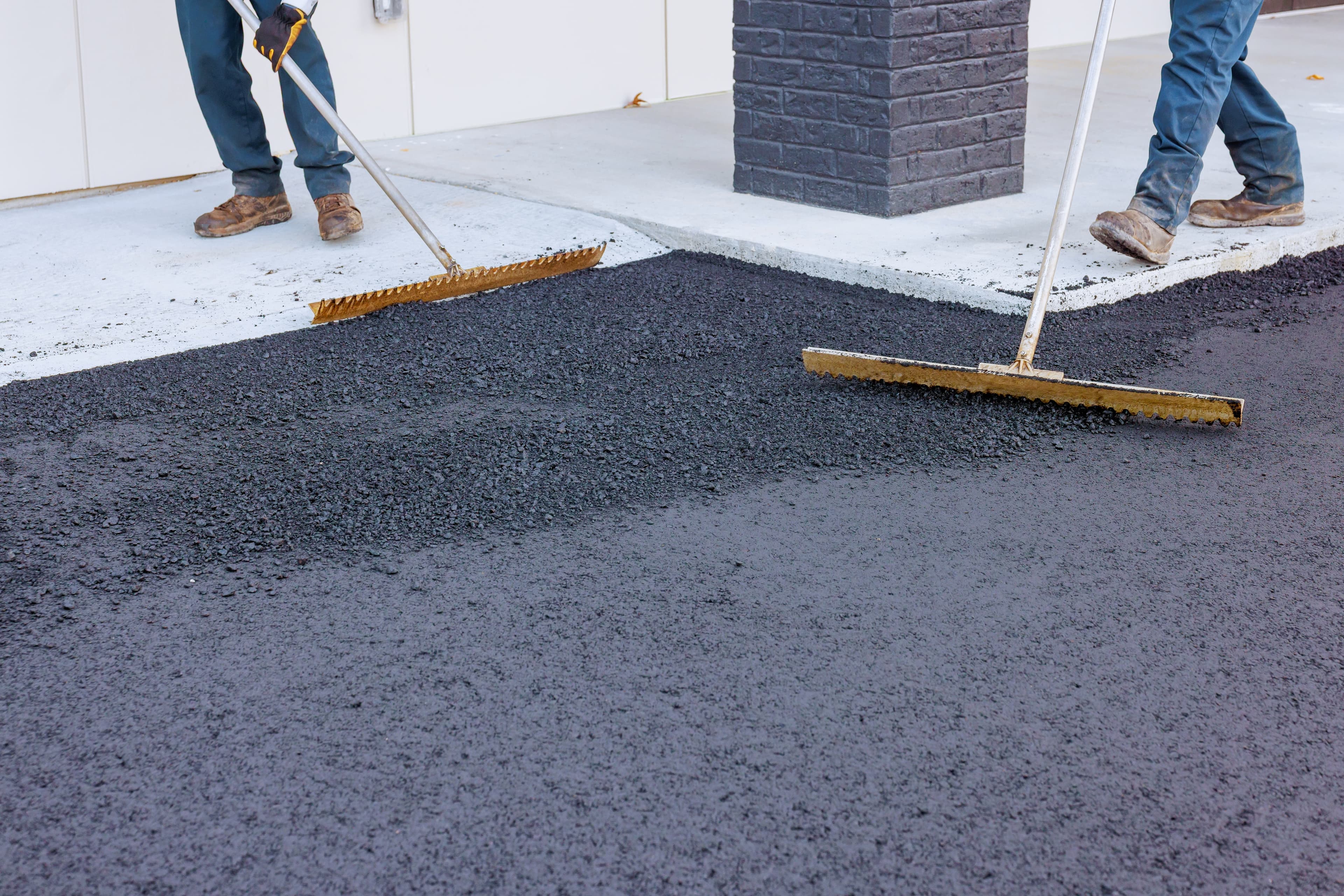
Skilled hands level fresh asphalt, where base depth and drainage decide survival through Canadian freeze–thaw cycles. (Credit: Shutterstock)
Replacing or repaving a driveway sounds straightforward until you remember what a Canadian driveway lives through: months of freezing temperatures, fast thaws, snow piles that turn into rivers, and de-icing products that don’t always play nicely with pavement. The result is that many “driveway problems” are really water problems, base problems, or winter-use problems that only show up once the first full season has passed.
This matters because driveway projects are easy to misprice. Two bids can look similar on the surface—same square footage, same material, same start date—but produce very different outcomes if one contractor is planning a deeper, well-compacted base with clean drainage lines and the other is counting on your driveway “settling out” after the cheque clears.
The good news is that you don’t need to become an engineer to make a smart choice. You do need a consistent way to compare options (concrete vs asphalt vs paving stones), a homeowner-level understanding of how each is typically installed, and a short list of questions that force clarity in quotes. When you have those, you can decide based on long-term fit instead of marketing, neighbour recommendations, or the lowest number on the page.
This guide is built for Canadian realities: freeze–thaw cycles, snow removal, spring melt, and the practical question every homeowner eventually asks—“What will I be living with for the next 10–30 years?”
If you only compare driveway surfaces, you’ll miss the real drivers of performance. In Canada, a driveway is a system: surface + base + subgrade + drainage. The surface is what you see; the system is what survives.
A reliable way to shortlist materials is to begin with three property truths:
Water truth: Where does rain and meltwater go today—toward the street, toward the garage, or into low spots that become ice?
Winter truth: Do you clear snow promptly, or do you let it pack and melt-refreeze repeatedly? Do you use de-icers?
Ground truth: Does your area have heavy clay, poor drainage, or a history of seasonal movement?
From there, compare materials using consistent decision factors. The table below is designed to keep you honest about trade-offs without overloading you with technical jargon.
A fast, practical way to decide: pick your two non-negotiables (for example, “lowest ice risk near the garage” and “easy future repairs”) and eliminate any option that can’t plausibly meet both on your site.
Concrete appeal is easy to understand: it’s solid underfoot, visually consistent, and doesn’t come with the same “seal it every so often” expectations many homeowners associate with asphalt. Concrete can also handle heavy vehicles well when the slab, base, and joints are designed properly.
In Canadian winters, concrete’s biggest risk isn’t strength—it’s surface durability under repeated freeze–thaw exposure when salts and de-icing chemicals are present. Concrete industry guidance in Alberta warns that de-icing products such as calcium chloride and commercial road de-icers can contribute to surface scaling and deterioration, especially when concrete is less than a year old, as outlined in Concrete Alberta’s de-icing guidance which is why many homeowners shift toward mechanical snow removal and traction strategies early in the slab’s life.
That same winter chemistry problem shows up even if you never spread salt yourself. Vehicles can track road salts onto the driveway, then meltwater dripping near the garage concentrates chlorides in the most-used areas. If you’ve seen a concrete driveway that looks worst right where cars park, that’s often the mechanism.
Concrete is usually a good fit when you can manage two things: keep water from sitting on the surface (good slope and drainage) and be intentional about winter products and habits.
What installation looks like (homeowner-level): Concrete work is front-loaded. The critical decisions happen before the truck arrives: excavation depth, base material, compaction quality, and the slope plan that prevents ponding. After the pour, the focus shifts to finishing (including traction-friendly textures), proper jointing so cracks are controlled rather than random, and curing rules that protect strength and surface integrity.
If you expect to use aggressive de-icers every winter, concrete can still work—but only if you treat winter care as part of ownership, not an afterthought. Otherwise, the surface can age faster than you planned.
Asphalt is often chosen because it’s typically faster to install and commonly feels cost-effective up front. It also has a “forgiving” reputation because the surface flexes slightly. In Canadian conditions, that flexibility can help, but it does not compensate for a weak base.
The most important asphalt insight for homeowners is simple: if the base is too thin or poorly compacted, asphalt will telegraph that failure as ruts, depressions, and cracks—often within a few seasons. In a Canadian “top to bottom” walkthrough, Ital Paving’s asphalt driveway overview describes frost-prone residential practice as commonly using around 12 inches of granular base placed in 4–6 inch lifts with compaction between layers so voids don’t become movement in freeze–thaw cycles.
Once you understand that, you can spot risky quotes quickly. If one contractor is budgeting for deep excavation and careful base work while another is planning a thinner build, the prices won’t be comparable—and neither will the outcomes.
What installation looks like (homeowner-level): Asphalt projects move quickly because the surface course is installed in a short window, but prep takes time. Expect removal of old materials, excavation to create room for base layers, subgrade preparation, then base placement and compaction in lifts. Asphalt placement itself is time-sensitive because compaction quality depends on temperature and timing.
What ownership looks like: Asphalt tends to reward small, early maintenance. Keeping cracks sealed and edges supported helps prevent water intrusion that weakens the system from below.
If an asphalt quote is missing base depth, base material spec, and compaction approach, treat it as incomplete rather than “competitive.”
Paving stones (often called interlocking pavers or “interlock”) change the driveway problem from “How do I prevent a slab from cracking?” to “How do I build a stable platform that stays level and drains well?” Instead of one monolithic surface, you get a system of units restrained at the edges and locked together through jointing and compaction.
That system approach can be an advantage in Canadian regions with soil movement, especially where clay expands when frozen and contracts when thawed. Manitoba landscape professionals describe interlocking as a flexible pavement that can shift slightly and be re-leveled, reducing the long-term trip hazards and random cracking you might see in rigid slabs, as explained in Bulger Brothers’ interlock discussion which highlights why modular surfaces are often easier to correct over time.
Interlocking also tends to win on repairability. If a utility cut happens, a section settles, or you need to adjust grading, individual units can be lifted and re-laid rather than replaced wholesale. Some Canadian installers also emphasize the potential for reuse and recycled content in paver systems, with Precision Pavers’ overview of eco-friendly interlocking noting that pavers can be disassembled at end of life and that durability and reuse can reduce waste compared with demolishing monolithic slabs.
What installation looks like (homeowner-level): The work is in the base and edges. A driveway-rated paver build typically involves deeper excavation than most homeowners expect, a carefully compacted base, a bedding layer, edge restraints that prevent lateral movement, then laying, cutting, jointing, and final compaction.
Interlock can be an excellent driveway surface, but only when it’s designed like a driveway. Patio-grade prep on a driveway is a slow-motion failure.
Permeable interlocking pavers are still “pavers,” but the system is designed so water moves through the surface instead of across it. That changes how the driveway behaves in spring melt, in heavy rain, and in the freeze–thaw cycle that punishes trapped water.
In a Toronto-area landscape guide, LandCon’s permeable pavers explanation describes a typical design with wider joints filled with clean aggregate over a deep open-graded stone base—often on the order of 10–18 inches—that acts as a reservoir, a structure meant to handle frequent freeze–thaw swings such as temperatures moving from about −10°C to above freezing in short periods.
If that sounds abstract, a simpler mental model is: permeable pavers are built to “store and seep” water rather than “shed and rush” it. A plain-language overview from Toemar’s permeable pavers page describes water moving through joint spaces into crushed stone layers and then into underlying soil so the driveway behaves more like a controlled infiltration zone than an impervious sheet.
Permeable systems are also often positioned as winter-friendly because managing water reduces the conditions that create glare ice. Canadian industry sources argue that allowing water to drain through the pavement rather than pooling can reduce surface ice risk and better accommodate freeze–thaw movement, as described by Interlocking Contractor’s overview of permeable interlocking benefits which emphasizes drainage and winter performance.
Permeable pavers are not a universal default. They require thoughtful design for your soil, clean aggregate layers that don’t clog, and an ownership mindset that includes keeping joints and surface void spaces functional. When those conditions are met, they can be a strong option for homeowners who are tired of ponding, ice sheets, or runoff that damages landscaping.
Permeable pavers shift maintenance from “fix cracks” to “protect drainage performance.” If you want the benefits, plan for periodic cleaning and joint care so the system keeps infiltrating instead of sealing over.
Once you’ve shortlisted a material, the next step is planning the build so winter doesn’t immediately expose weaknesses. Good contractors handle the technical work, but homeowners still control key inputs: scheduling windows, access constraints, and water decisions that influence design.
Start by planning around three project realities.
Weather windows: Concrete curing, asphalt compaction, and base preparation all depend on conditions. A late-season rush can force compromises, especially if temperatures drop quickly or you’re trying to “squeeze it in” before winter.
Access and staging: Driveway projects need equipment access, stockpiles, and hauling routes. If access is tight, contractors may propose smaller machines or altered workflows; those choices can affect compaction quality.
Water routing: Downspouts, garage thresholds, and side-yard grading are part of driveway performance. If water is directed onto the driveway today, it will likely remain your biggest failure driver after repaving unless you change the routing.
The homeowner’s role is to make those constraints explicit before you accept a quote, because “we didn’t know that was there” often becomes an expensive mid-project change order.
Ask for a simple, plain-language “water story” before you sign: where water arrives, where it flows, where it leaves, and what happens when it refreezes.
Most driveway regret comes from scope ambiguity. Homeowners think they’re buying a surface; contractors are pricing a system with variable depth, variable base quality, and variable drainage work. Your job is to turn the quote into a clear statement of what will be built and how it will be verified.
A strong quote usually does three things well.
First, it defines removal and excavation in measurable terms: what comes out, how deep you’re going, and what happens to unsuitable soil. Second, it specifies the base build: material type, depth, and compaction method. Third, it states edge and drainage details: slopes, restraints, transitions, and any related grading work.
When those pieces are missing, you can’t fairly compare bids. More importantly, you can’t predict performance.
Be cautious with “we can just pave over it” proposals. Overlays can work in limited cases, but they can also hide drainage and base failures that reappear faster—often right when winter arrives.
New homes often start with gravel driveways for a reason: construction traffic is hard on finished surfaces, and the lot may continue to settle after heavy equipment work and the first full winter. If you pave too early, you can lock in grading problems and settlement patterns that would have been easier to correct in gravel.
Gravel can be a perfectly functional driveway, but only if you treat it as a system with shape and drainage. The most common gravel failures—ruts, potholes, washouts—almost always trace back to water concentrating in wheel paths or flowing along the driveway rather than off it.
If you’re in a new build, a practical approach is to plan one “gravel tune-up season.” Use it to confirm where water truly flows during storms and spring melt, then refine grading before you invest in a permanent surface. When the driveway holds shape through heavy rain and thaw cycles without frequent regrading, that’s a stronger signal that you’re ready to pave.
Gravel isn’t automatically “temporary.” Many homeowners keep gravel longer than expected once it’s properly shaped and maintained, especially in rural areas or long driveways where hard surfacing would be a major cost.
Driveway longevity is rarely about doing everything; it’s about doing the few high-impact things consistently—especially in winter.
Across materials, the biggest performance boost usually comes from reducing standing water and limiting freeze–thaw exposure at the surface. In practical terms, that means clearing snow before it becomes ice, keeping drainage paths open, and avoiding habits that concentrate meltwater in the same places over and over (often near the garage).
Material-specific care is still important, but it works best when it’s tied to your winter routine rather than treated as a one-time “spring maintenance day.”
Some homeowners also look for winter products that reduce reliance on chloride salts, particularly in households with pets. For example, products marketed as salt-free and pet- and concrete-safe appear in Safe Paw’s Canadian product information which is why they sometimes show up in a winter-care plan alongside shovelling and traction sand.
If your driveway ices over in the same spots every year, treat it as a drainage and grading issue first. Changing the surface without changing the water behaviour often recreates the same problem in a new material.
Driveway choices affect more than curb appeal. They influence runoff volume, localized flooding risk, and how much water is managed on your property versus sent to municipal storm systems. That’s why permeable approaches are getting attention in many Canadian communities where intense rainfall and spring melt can strain infrastructure.
Permeable paver resources commonly emphasize on-site stormwater management and groundwater recharge, with Simcoe Solutions’ discussion of permeable paver benefits describing how infiltration reduces runoff volume and helps manage rain and snowmelt on site in a way that can ease pressure on stormwater systems.
Water quality is part of the picture as well. Permeable pavement designs are often described as filtering stormwater as it moves through aggregate layers, with Hardscaping Is’ sustainability overview explaining that these layers can capture suspended solids and reduce pollutants such as hydrocarbons and metals before water infiltrates.
It’s also worth recognizing how the industry frames the trend. Some contractors and manufacturers argue that permeable pavers are becoming a default “green infrastructure” feature for residential hardscapes, as suggested in ProFlow Pavers’ article on permeable pavers as an eco-friendly future which reflects how the market is positioning these systems even when site conditions still need to be evaluated carefully.
A balanced environmental view considers lifecycle as much as permeability. A driveway that lasts longer, is repairable in small sections, and can be reused or reconfigured can reduce demolition waste over decades. In that sense, modular paver systems often have an advantage over monolithic slabs when major repairs are needed, even before you factor in infiltration.
Environmental performance is site-specific. The most sustainable driveway is often the one that works with your property’s drainage realities without requiring repeated rebuilds.
If you’re still torn, it often helps to match materials to situations rather than to general pros and cons.
In a flat suburban lot where water already drains well and winter maintenance is consistent, asphalt can be a pragmatic choice if the base is built properly, while concrete can work well if you’re careful with winter chemicals and prioritize traction sand and smart snow clearing. In that scenario, the decision often comes down to your tolerance for periodic asphalt maintenance versus concrete’s higher consequence if winter care goes off track.
In an older neighbourhood where ponding and ice sheets happen near the garage or at a low corner, drainage performance should drive the decision. Permeable pavers can be compelling where runoff management is the real problem, but only when the system is designed and maintained to keep infiltration working. If permeable isn’t suitable for your lot, the alternative is to treat grading and drainage as the main scope item regardless of surface.
In regions with clay-heavy soils and noticeable seasonal movement, interlocking pavers often fit the reality that “some movement will happen.” A system that can be re-leveled and repaired in small areas can feel less stressful than chasing slab cracks year after year, especially if you value long-term adjustability.
The base and drainage plan. A well-built surface over a weak, wet, poorly compacted base is still a weak driveway.
Not automatically. Asphalt’s flexibility can help, but it still fails if the base settles or stays wet. Concrete can perform well too, but winter chemistry and ponding need attention.
Depressions often indicate base compression, voids from weak compaction, or water-driven subgrade softening beneath repeated wheel loads.
Driveway-rated pavers can handle vehicles when the base, bedding, and restraints are designed for load. Patio-grade prep on a driveway is a common failure mode.
They don’t “prevent” movement, but they handle it differently. Pavers can shift slightly and be re-leveled, while slabs often crack when movement exceeds what the slab can tolerate.
Repairability. You can lift and re-lay sections, replace damaged units, and correct settlement without rebuilding the entire driveway.
They can. The design intent is to manage water so it doesn’t pool and refreeze, and to accommodate freeze–thaw movement through a layered system.
No driveway eliminates ice. Permeable systems can reduce ponding that becomes ice, but you still need snow clearing and safe winter habits.
Expect periodic cleaning so joints and surface void spaces don’t clog, plus the usual interlock tasks such as joint material upkeep and occasional re-leveling.
Certain salts and de-icing chemicals can contribute to scaling and surface deterioration, especially early in the slab’s life and under frequent freeze–thaw exposure.
Road salts can be tracked in on vehicles and concentrated where meltwater drips and refreezes repeatedly.
Sealing can help, but it’s not a substitute for good base and drainage. Think of sealing as a protective layer, not a structural fix.
Excavation depth, base material and depth, compaction method, drainage/slope plan, edge details, surface thickness, and clear warranty terms.
Sometimes, but it depends on whether the underlying structure is sound and whether drainage issues are resolved. Overlays can hide problems that return quickly.
When the lot and driveway shape have stabilized through rain and thaw cycles and you’ve confirmed drainage behaviour. Paving too early can lock in settlement.
“Least hassle” depends on your habits. Concrete asks for careful winter chemical choices, asphalt asks for periodic maintenance, and pavers ask for joint care and occasional re-leveling but offer excellent repair flexibility.
Start by fixing grading and drainage in the scope. Permeable pavers can be a strong solution where infiltration is appropriate, but the design must match your site.
Compare scope, not just price. Insist on written details for excavation, base depth, compaction approach, and drainage—those are the usual shortcuts in low bids.